THE GENERATIONAL RESET
Both sides lied. Here is what trade actually is, what the UK actually sells, and what leaving the single market actually cost.
Executive Summary
The Brexit trade debate was conducted almost entirely in bad faith, on both sides. The misrepresentation ran in opposite directions, and both need naming precisely. No serious figure on the Remain side claimed Britain would be unable to trade with China, the United States, or the rest of the world outright — that claim does not survive contact with what was actually said, and the UK traded with every major economy on earth while inside the EU and continues to do so under WTO rules. Rolls-Royce sold engines in Beijing before the referendum. Scotch whisky reached Tokyo. Range Rovers filled American driveways. EU membership was not the mechanism for any of this, and none of it was threatened by leaving.
Where Remain's case did overstate things was in the short-term shock it forecast. HM Treasury's May 2016 pre-referendum analysis predicted the economy would fall into a year-long recession within two years of a Leave vote, with GDP 3.6–6% smaller, unemployment up by roughly 500,000, and house prices down by as much as 18% — forecasts that earned the label "Project Fear," not entirely unfairly.1 None of that materialised at anything like the speed or scale predicted; the UK did not enter the forecast recession, and the gap between prediction and outcome became one of Leave's most durable rhetorical weapons. Separately, Barack Obama's warning that Britain would go "to the back of the queue" for a US trade deal outside the EU2 was a claim about negotiating priority, not a claim that trade would stop — but campaigners on both sides frequently blurred it into the stronger, false version. The overstatement was in timing and severity, not in underlying direction: the Treasury's short-term shock predictions proved too fast and too severe, but its core logic — that leaving the single market would make trade with Britain's largest and nearest partner harder, with a real GDP cost over the long run — has held up closer to the OBR's own 4% long-run estimate — comparable estimates from NIESR and the LSE, covered in Section 7.1, run somewhat higher still — than either campaign's soundbites credited it as being.
Leave's version was the equal and opposite misrepresentation. The campaign conceded we could trade with the world; its claim was narrower and still wrong — that the EU was preventing Britain from trading with those countries on its own terms, and that independent deals would be materially better than what the EU had negotiated on Britain's behalf. This too was false, or at best a systematic overstatement. The EU was not blocking Britain from bilateral deals in any meaningful commercial sense. British goods reached global markets under WTO rules that apply universally. What the EU did was give Britain negotiating weight — as part of a 450-million-person bloc — that Britain does not possess alone. Leaving didn't unlock better deals — it transferred negotiations to a smaller, less leveraged party, and the results since 2021 confirm it.
The honest account is this: a trade deal is not a declaration of commercial friendship. It is an exchange of concessions: lower tariffs in return for lower tariffs, regulatory alignment in exchange for market access, dispute resolution mechanisms that constrain sovereignty in the very act of protecting trade. The freedom to negotiate your own deals is real. The claim that those deals would be better, or would compensate for leaving your largest and nearest trading partner, was not.
This pillar makes five arguments. First, that the public deserves an honest account of how trade actually works — what it is, what negotiations involve, and what countries give up to get access. Second, that the UK is not, and has not been for decades, a goods trade powerhouse — it runs a persistent goods trade deficit, and its genuine export strengths lie in services, where WTO rules provide almost no protection. Third, that the single market was categorically different from a trade deal, and that no external arrangement can replicate what it provided. Fourth, that the measurable costs of leaving — the OBR's 4% long-run GDP reduction estimate, the documented friction in sectors of genuine UK strength — are real and should be named honestly. Fifth, that the forward policy question is not about relitigating the referendum but about what a realistic trade strategy looks like for a services-dominated, mid-sized economy with specific high-value export strengths and a complex relationship with its nearest neighbours.
The Generational Reset does not campaign to rejoin the EU. It insists on honesty about what membership provided, what leaving cost, and what the realistic options are. That honesty is the precondition for any credible trade policy.
Key Proposals
Require an annual OBR Trade Impact Assessment. Quantifying the measured effects of post-Brexit trade arrangements on UK GDP, sectoral output, FDI, and business investment, replacing political assertion with independent measurement.
Enshrine food safety standards in primary legislation. Removed permanently from any trade negotiating mandate without explicit parliamentary approval, rather than left to executive discretion.
Publish negotiating mandates touching NHS pricing before deals conclude. Where NHS pharmaceutical pricing, procurement access, or NICE methodology are relevant to a counterpart's objectives, the public has a right to know what is being offered in their name before negotiations close.
Pursue a UK-EU Services and Investment Framework as the primary trade objective. Stable financial services equivalence, mutual recognition of professional qualifications, and a creative industries protocol.
Establish a Services Export Strategy with binding sectoral targets. Financial services, professional services, creative industries, and higher education — the UK's genuine competitive strengths — rather than a goods-tariff-led trade policy.
Commission an independent assessment of the realistic scope of a UK-US deal before conceding. What the US would actually offer against what the UK would need to concede on agriculture, food standards, and NICE pricing, pursued primarily through the defence and security relationship that gives the UK its real leverage.
1. How Trade Actually Works — What Both Campaigns Got Wrong
The most important corrective this pillar can offer is foundational: most people in Britain do not have an accurate mental model of what international trade is, how it is governed, or what trade agreements actually do. The Brexit campaign exploited that gap — on both sides.
1.1 The WTO Baseline — The Floor Both Sides Ignored
The World Trade Organisation governs trade between its 164 member countries through a set of agreed rules, the most important of which is Most Favoured Nation (MFN). Under MFN, if a country offers a tariff rate on a product to one WTO member, it must offer the same rate to all WTO members. This creates a global floor of market access that operates regardless of whether two countries have a bilateral trade agreement.
The UK traded with China, the United States, Japan, and every other major economy while inside the EU — not because the EU gave it permission, but because WTO rules guaranteed baseline access. Rolls-Royce does not need an EU-China trade deal to sell cars in Beijing. BMW does not need one either. Scotch whisky reaches Japan under MFN tariff schedules that apply universally. This baseline was never seriously the subject of dispute — as the Executive Summary sets out, no serious figure on the Remain side claimed leaving the EU would sever it. Where Remain's case overstated things was elsewhere: in the severity and speed of the short-term shock it forecast for the economy as a whole, not in a claim about losing access to the rest of the world.
1.2 What a Trade Deal Actually Is
A trade deal is an exchange of concessions. Both sides give something up to get something in return. This is the foundational reality of trade negotiations that almost no Brexit commentary acknowledged.
The concessions fall into three categories. First, tariff reductions: you lower your import tariffs on their goods in exchange for them lowering theirs on yours. The gain for your exporters comes at a cost to domestic producers competing with cheaper imports — there is no arrangement in which tariff reductions are costless. Second, regulatory alignment or mutual recognition: you accept their standards, or agree yours are equivalent. This is the element that constrains sovereignty. You cannot simultaneously maintain full regulatory autonomy and frictionless market access — those two things are in direct and irresolvable tension. Third, dispute resolution: you accept some mechanism for adjudicating disputes. This is what critics called surrendering control of British law. Every trade deal requires it. Without it, agreements are unenforceable. The Leave campaign promised trade deals without these costs. No such deals exist.
1.3 The Leverage Problem — Size Determines Terms
Trade negotiating leverage is a function of market size. The EU negotiates as a bloc of 450 million consumers — the largest market access prize on earth. The United Kingdom alone represents 67 million consumers and approximately 2.5% of global GDP. In a bilateral negotiation with the United States — 340 million consumers and 26% of global GDP — the leverage asymmetry is severe. The US can simply wait. It has other priorities. The UK needs the deal more visibly and more urgently, and professional negotiators on the American side know it.
This asymmetry is structural, not diplomatic. No amount of negotiating skill changes the underlying arithmetic. A country with a large domestic market and diverse trading relationships can afford to walk away from a deal that does not serve it. A country that has recently left its primary trading bloc and needs to demonstrate the trade dividend of doing so cannot. That is the UK's position, and it has shaped every significant trade negotiation since 2016.
2. What the UK Actually Trades — The Honest Picture
The second foundational corrective concerns the UK's actual economic structure. The image of Britain as a trading nation — merchant fleets, imperial commerce, the workshop of the world — is historically real and currently misleading. The UK of 2025 is not the UK of 1885. Its competitive strengths are concentrated in services, and its goods trade tells a story of persistent structural deficit.
2.1 The Goods Trade Reality
The UK has run a goods trade deficit in every year since 1983. In 2024, the deficit was approximately £235 billion — the UK imported significantly more goods than it exported. This is not a temporary imbalance. It is the structural consequence of the UK's economic evolution away from manufacturing and toward services over four decades.
The goods the UK does export successfully are concentrated in a small number of high-value categories: aerospace (Rolls-Royce engines, Airbus wing components), pharmaceuticals, Scotch whisky, luxury automotive (Range Rover, Bentley, Jaguar), and specialist chemicals. These are genuinely world-class products that compete globally on quality and brand. But they were already succeeding under EU membership. They are also too concentrated and too small in aggregate to anchor a broad-based export growth strategy of the kind the Leave campaign implied was available.
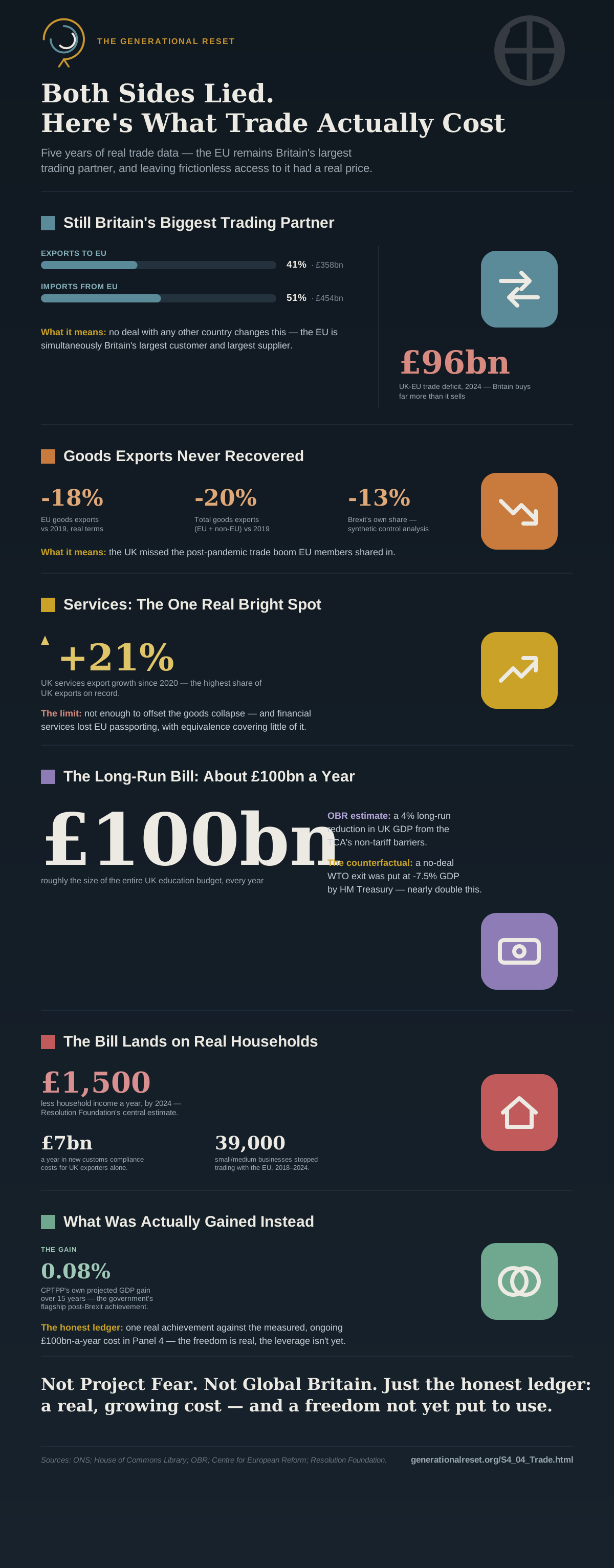
The UK has run a goods trade deficit every year since 1983 — approximately £235bn in 2024 — while financial services alone generate £209bn in GVA and creative industries £124bn, sectors where Britain genuinely competes at world level. Services trade is governed almost entirely outside the WTO framework; GATS provides only a thin baseline far short of the market access goods enjoy. Services exports grew 21% since 2020 — the one clear bright spot — but not enough to offset the goods export collapse.3
Global and bilateral trade architecture is built overwhelmingly to reduce goods barriers, not services ones — this is this project's own connecting argument, not a finding any single source states on its own. Because the UK's genuine comparative advantage sits in services while the available toolkit of trade deals addresses goods, any trade strategy built primarily around signing new agreements will systematically underserve the sectors that actually anchor the UK economy. Financial services makes this concrete: passporting is gone, equivalence is unilateral and revocable at 30 days' notice, and jobs, regulatory capital, and decision-making have measurably followed to Dublin, Luxembourg, Amsterdam, and Frankfurt.
The causation above is compatible with responses other than EU-focused deepening: pursue new goods-oriented trade deals — the CPTPP model — on the theory that even a mismatched toolkit is better than none, accepting that such deals mostly help a UK export base that is small and already competing successfully; focus domestic industrial strategy on diversifying and strengthening goods exports instead of chasing services-market access no partner is currently offering; or, as this pillar proposes, prioritise a negotiated deepening of the UK-EU services relationship specifically, on the reform-commitment basis that no other partner can substitute for the UK's largest and nearest market.
Choosing to prioritise EU services-market deepening over pursuing new global trade deals reflects a value judgement this pillar makes explicitly: that realistic gains in the sector the UK actually depends on matter more than the broader political narrative of new "Global Britain" agreements, even though re-engaging with the EU is politically harder than signing deals with more distant partners. A reader who weighs the diversification value of new goods-oriented deals, or who judges renewed EU services negotiation as politically unrealistic regardless of its economic logic, is not wrong on the evidence — they are weighing the same trade data against a different read of what's actually achievable.
Pursue a negotiated deepening of the UK-EU financial and professional services relationship as a strategic trade priority, per the Reform Commitment above, rather than treating new goods-oriented deals with distant partners as the primary response to Brexit's trade costs. The falsification test below is what would show this specific prioritisation is actually closing the services-access gap, not just redirecting political attention.
2.2 Where the UK Is Actually Strong — Services
The UK's genuine competitive advantages are in financial services, professional services, creative industries, higher education, and specialist consulting. Financial services alone generate £209 billion in GVA and make London the world's second-largest financial centre. The creative industries contribute £124 billion annually. These are the sectors where Britain genuinely competes at world level.
The structural problem is that services trade is governed almost entirely outside the WTO framework. The General Agreement on Trade in Services (GATS) provides a thin baseline that falls far short of the comprehensive market access goods enjoy under WTO rules. Services access is negotiated bilaterally, sector by sector, and what it delivers is typically far less than the political language around trade agreements suggests. This is the fundamental mismatch at the heart of UK trade policy: the country's strengths are in the domain where global trade architecture is weakest.
2.3 Financial Services — Passporting Is Gone and Equivalence Is Not a Substitute
EU passporting allowed UK-based financial firms to sell products and services across all 27 member states under a single regulatory authorisation. The Trade and Cooperation Agreement contains almost nothing on financial services. The UK sought equivalence — a determination by the EU that UK regulations are sufficiently similar to EU regulations to allow market access. The EU has granted equivalence in a small number of narrow areas. Equivalence is unilateral, revocable at 30 days notice, and covers a fraction of what passporting covered. It is not a substitute.
The consequence is that UK financial firms requiring EU market access have established subsidiaries in Dublin, Luxembourg, Amsterdam, and Frankfurt. The jobs, the regulatory capital, and increasingly the decision-making have followed. London remains formidable. But the direction of travel — at the margin, EU financial centres gaining from what UK-based operations lose — is visible in the data and structurally unlikely to reverse under current arrangements.
3. The Single Market — What It Actually Was
The most important conceptual error in the Brexit trade debate was the persistent conflation of the single market with a trade agreement. They are categorically different, and understanding the difference is essential to understanding what the UK gave up.
A trade agreement reduces barriers between two parties — primarily tariffs — while leaving each party's domestic regulatory regime intact. A customs union goes further, adding a common external tariff so goods can move without rules of origin checks. The single market goes further still: it harmonises the underlying regulations, so a product approved in one member state is automatically approved in all, a service provider licensed in one country can operate in all, and capital and people move without restriction.
The TCA restored zero tariffs on goods traded between the UK and EU — a genuine achievement. But it did not and could not restore the regulatory union that made the single market what it was. The customs declarations are now required. Rules of origin certificates must be produced. Separate regulatory approvals must be obtained. Professional qualifications must be revalidated. Work permits must be applied for. These frictions are not the result of EU vindictiveness. They are the mathematical consequence of having different regulatory regimes — which is what leaving the single market means.
3.1 The Standards Nobody Named — What the Single Market Was Actually Doing for British Consumers
The EU single market did not merely provide market access. It provided a regulatory floor — product safety standards, food standards, environmental standards, chemical standards — that applied to everything sold within it, regardless of where it was produced. British consumers benefited from these standards for decades without knowing it, because the standards were working. Regulation that works is invisible. The food scandal that did not happen generates no headlines.
EU food and agricultural standards are among the highest in the world, grounded in the precautionary principle: where there is scientific uncertainty about a risk, the burden of proof falls on demonstrating safety, not on proving harm. This is why chlorine-washed chicken is not sold in British supermarkets. Not because of any specifically British law, but because EU standards applied to the single market prohibit it — and the UK, as a member, benefited from that prohibition automatically. The same principle governs hormone-treated beef, certain pesticide residue limits, genetically modified food labelling, and a range of food additives permitted in the United States that were not permitted in the EU single market.
Beyond food, EU product safety standards — the CE marking system — governed toys, electrical equipment, medical devices, cosmetics, and thousands of other product categories. A toy sold in any EU member state had to meet standards that applied across the entire market. A British parent buying a toy from a European manufacturer was protected by a regulatory system they had likely never heard of. Post-Brexit, the UK has established its own UKCA marking system broadly equivalent to CE, but UK manufacturers exporting to the EU must still obtain CE certification — they have not gained regulatory sovereignty, they have gained a domestic marking system and lost the seamless equivalence that membership provided.
3.2 The Rule-Taker Problem — Sovereignty in Practice
The Leave campaign's central promise was the restoration of British sovereignty — the ability to make British rules for British people. This is a legitimate value. The question is what it means in practice for a country that exports substantially to the EU single market.
Inside the EU, the UK had a vote on the rules of the single market. British ministers sat in the Council. British MEPs sat in the Parliament. British officials participated in the regulatory committees that drafted the technical standards. The UK was, in the language of trade policy, a rule-maker. The rules were not always the rules the UK would have chosen unilaterally — that is the nature of collective decision-making. But British influence was real, documented, and consequential. British positions on financial services regulation, on data protection, on competition policy shaped the rules that governed the world's largest single market.
Outside the EU, any UK business that exports to the EU must still meet EU standards. The EU has not lowered its requirements because Britain left. A British pharmaceutical company selling into the EU must meet European Medicines Agency standards. A British food exporter must meet EU food safety requirements. A British car manufacturer must meet EU vehicle type approval. The rules are identical to those that applied under membership. The difference is that Britain no longer helps write them. Regulatory sovereignty in practice has meant the freedom to set domestic standards for the domestic market, combined with the obligation to meet EU standards for exports — with no seat at the table that determines what those standards will be next year, or the year after.
4. The Deal Britain Actually Had — What the Campaigns Never Told You
There is a test for how much sovereignty EU membership actually removed from everyday British life. It is sitting in every room of every house in the country.
The British plug socket — BS 1363, the three rectangular pins in a triangular arrangement, with its individual fuse, its shuttered live and neutral slots — is unique in the world. No other country uses it. It was designed in 1946 and has remained the British standard ever since. Britain was a member of the EU for 47 years. In those 47 years, not once was the British plug socket changed, threatened, or harmonised away. It remains today exactly as it was before the UK joined the European Economic Community in 1973.
This is not a trivial observation. It is the most concrete possible demonstration of how the single market actually worked. It harmonised where harmonisation served the economic purpose of the single market — product safety standards for goods traded across borders, financial services regulation for capital moving between member states, food standards for agricultural products sold throughout the union. It left entirely intact the things that were distinctively national and did not affect cross-border trade. The British plug is in every British home because no European lorry driver ever needed to use one.
The same principle is demonstrated even more vividly by the car. Britain drives on the left — opposite to every continental EU member state. British number plates follow a British format. British speedometers read in miles per hour. British MOT standards are set by the DVSA. British road tax is administered by the DVLA. British insurance is regulated by the FCA under British law. None of this was touched by EU membership. None of it was under any threat. The Leave campaign's imagery of faceless Brussels bureaucrats dictating to Britain did not extend to asking those bureaucrats to explain why, after 47 years, British people were still driving on the left.
Freedom of movement worked the same way — in both directions. The campaign presented it as Europeans coming to Britain. The honest picture is bilateral. At the time of the referendum, approximately 1.3 million British citizens were living and working in EU member states — in Spain, France, Germany, Italy, Portugal, and across the continent. Over 200,000 young British people had studied in European universities through the Erasmus programme, with their fees subsidised and their credits recognised. The right to work in Paris, to retire to Tuscany, to study in Amsterdam — these were British rights that British people exercised. They were surrendered in the same vote that was presented as taking back control.
4.1 The Exceptional Position Britain Had — And Will Never Have Again
Britain's position inside the EU was not the position of an average member state. It was the product of decades of negotiation that had secured an arrangement no other country had, and that no country leaving and seeking to rejoin would ever be offered again.
The United Kingdom retained the pound. Every other major EU economy either uses the euro or is committed to adopting it. Britain's monetary policy was set by the Bank of England, not the European Central Bank. British interest rates, British quantitative easing, British currency management — all entirely sovereign throughout EU membership.
Britain was not part of Schengen. The passport-free travel zone that covers most of continental Europe did not include the UK. British border controls remained British border controls. Passport checks at Dover, at Heathrow, at St Pancras — these were British decisions throughout membership, and the UK could and did enforce them.
Britain had the Thatcher rebate — a structural reduction in its budget contribution negotiated in 1984 that reduced the UK's net payment to approximately £9 billion per year. This was not a temporary concession. It was a permanent feature of Britain's membership terms, resented by other member states and unavailable to any new or rejoining member.
Britain had an opt-out from the Charter of Fundamental Rights in its domestic application. Britain had opt-ins rather than automatic participation in justice and home affairs measures. Britain had, in aggregate, more formal opt-outs and special arrangements than any other member state.
The net budget contribution of £9 billion — the figure the Leave campaign cited most frequently — should be understood in context. It was approximately 0.4% of GDP. It purchased membership of a market that the OBR estimates was worth 4% of GDP in trade and investment flows. The return on that investment was not complicated arithmetic. And the deal that delivered it — the rebate, the opt-outs, the retained pound — was a deal that took decades to negotiate and will never be on the table again for Britain in any configuration.
5. The World's Trading Blocs — Gains, Losses, and Where the UK Actually Sits
To understand what leaving the EU single market meant in strategic terms, it is necessary to understand the architecture of global trade honestly. The world's economic weight is concentrated in a small number of major trading blocs. The Brexit debate presented this architecture as an opportunity — Britain free to deal with all of them on its own terms. The honest picture is more complicated: the UK already traded with most of these blocs before Brexit, the EU negotiated most of those relationships on Britain's behalf, and Britain's departure from the EU changed its leverage with every one of them.
5.1 The EU Single Market — What Was Lost
The EU single market is not merely a trading bloc. It is a regulatory union covering 27 member states, 446 million consumers, and approximately 18% of global GDP. As a member, the UK had zero-tariff, zero-friction access to this entire space — for goods, services, capital, and people. It contributed to setting the rules. It benefited from the EU's negotiating weight in every other relationship on earth.
What the UK gained from the EU: frictionless access for goods and services to a £14 trillion market next door; passporting for financial services across all 27 states; freedom of movement for 1.3 million British citizens living and working in Europe; the Erasmus programme for 200,000 British students; EU food and product safety standards that protected British consumers; EU negotiating power with the US, China, and every other major economy; and a seat at the table that wrote the rules governing the world's largest trading space. What the UK gave up: a net budget contribution of £9bn per year, some regulatory autonomy in areas harmonised for the single market, and the constraints of collective decision-making. The return on that investment was not a close call.
Post-Brexit, the TCA restored zero tariffs on goods but erected a full regulatory border, eliminated passporting, ended freedom of movement, and removed the UK from the EU's negotiating bloc. UK goods exports to the EU are 18% below their 2019 level in real terms. Financial services operations have migrated to Dublin, Amsterdam, and Frankfurt. Small and medium exporters have stopped trading with Europe rather than absorb compliance costs.
5.1a Defence — The Dimension the Brexit Debate Ignored
One aspect of the UK-EU relationship that the Brexit trade debate almost entirely ignored is defence. EU membership was not primarily a defence arrangement — that was NATO's role — and Leave campaigners correctly pointed out that defence cooperation would continue outside the EU. This was true. What it obscured was the degree to which the EU relationship underpins the practical architecture of European defence industrial cooperation, joint procurement, and the political conditions under which security partnerships operate.
The Defence pillar of the Generational Reset documents this in detail. UK defence procurement depends on European industrial partners — MBDA for missiles, Airbus for transport aircraft, the GCAP programme with Italy and Japan, the submarine industrial base that depends on specialist European components. These are not EU programmes in the formal sense, but they operate within a political and regulatory environment shaped by the UK-EU relationship. Post-Brexit friction in defence industrial cooperation — customs classification of dual-use components, professional mobility of defence engineers, data sharing arrangements — adds cost and delay to programmes that are already chronically over budget.
More significantly, the Macron dissuasion avancee initiative of March 2026 and the July 2025 UK-France nuclear coordination agreement — the most significant development in European nuclear posture since de Gaulle — were made possible partly by the broader UK-EU rapprochement that followed the Labour government's reset in 2024-25. The political conditions for deeper defence cooperation and the political conditions for deeper trade cooperation are the same conditions: a UK-EU relationship that functions as a partnership rather than an adversarial negotiation. The Trade and Defence pillars of this project are not separate arguments. They are the same argument about the consequences of Britain's strategic positioning, approached from different angles.
5.2 USMCA — The Bloc We Are Not In
The US-Mexico-Canada Agreement covers approximately 510 million people and roughly 28% of global GDP — the largest trade zone by nominal GDP. Trilateral trade in goods and services within USMCA reached $1.9 trillion in 2024. The US is the UK's single largest country trading partner, with total bilateral trade of £329bn in 2024.5 But the UK is not in USMCA and has no bilateral deal with the United States.
What the UK could gain from a US deal: the US is already the largest buyer of UK services exports — £140bn in 2024, led by business services (£61bn), financial services (£28bn), and insurance (£12bn). A deal with meaningful services coverage could protect and expand these flows, provide data adequacy certainty, and offer digital trade provisions suited to UK strengths. What the UK would have to give: access for American agricultural exports at standards below what EU membership enforced — chlorine-washed chicken, hormone-treated beef — and potentially changes to NHS pharmaceutical pricing that NICE's cost-effectiveness threshold currently prevents. The leverage asymmetry is severe: the US represents 26% of global GDP; the UK 2.5%.
The honest verdict: a UK-US deal is theoretically achievable but practically stalled because the US wants agricultural and NHS concessions the UK is unwilling to make, and the UK wants services access the US is unwilling to give at the required depth. The UK's departure from the EU did not bring it closer to a US deal — it removed the EU's scale from the negotiating table, making the leverage gap worse. The 69% services share of UK exports to the US means any deal must be services-first. No government has negotiated on that basis with sufficient seriousness.
5.3 RCEP — The Bloc the UK Cannot Access
The Regional Comprehensive Economic Partnership is the world's largest free trade agreement by GDP coverage — 15 Asia-Pacific nations including China, Japan, South Korea, Indonesia, and the ASEAN bloc, together representing approximately 30% of global GDP and 2.2 billion people. Intra-RCEP trade has been growing rapidly since the agreement came into force in January 2022: China's trade with RCEP partners exceeded $5.4 trillion in the three years to 2024. RCEP aims to eliminate tariffs on over 90% of goods traded between members within 20 years and establishes harmonised rules of origin across the entire bloc.
The UK is not a member of RCEP and has no meaningful prospect of joining. RCEP was conceived as an Asia-Pacific regional agreement; the UK has no geographic basis for membership. The UK trades with China, Japan, South Korea, and the ASEAN economies on WTO MFN terms — the same terms available to any WTO member, with no preferential access. UK exports to China fell 27% in 2024 alone, partly reflecting geopolitical distance and partly the absence of the preferential access that RCEP members enjoy with each other.
What the Leave campaign promised was that outside the EU, Britain could forge its own relationships with these fast-growing Asian economies. The honest arithmetic: UK bilateral trade with Southeast Asia and China would need to grow at 15-20% per quarter for 18 months simply to match UK-EU area trade. That is not a realistic near-term trajectory. What RCEP is doing — trade diversion from non-members to members — will increasingly disadvantage UK exporters competing in Asian markets against suppliers from within the bloc who face zero tariffs while UK exporters pay MFN rates.
5.4 CPTPP — What Was Actually Gained
CPTPP is the UK's most significant post-Brexit trade achievement. It covers 12 nations including Japan, Canada, Australia, Mexico, Vietnam, and Singapore — approximately 15% of global GDP. The UK joined in 2024, becoming the first non-founding member to accede. The agreement provides comprehensive tariff elimination on goods, digital trade provisions, services commitments, and modern rules on intellectual property and investment.
What the UK actually gained: genuinely new preferential access to Brunei, Malaysia, Vietnam, and Chile — countries with which the UK had no prior bilateral deal. Improved access to Canada (going beyond the inherited EU-Canada deal in some areas). A stronger institutional relationship with Japan, Singapore, and Australia beyond existing bilateral agreements. Digital trade provisions and services commitments more modern than those in the inherited EU deals.
What the UK did not gain: meaningfully better access to Japan, Singapore, Australia, New Zealand, or Canada, where inherited EU-era deals already provided the substance of preferential access. The government's own modelling projected a GDP uplift of 0.08% over 15 years — not because CPTPP is without value but because most of the work was already done by the agreements it replaced. CPTPP's deeper value is institutional: membership of a growing Asia-Pacific framework that could expand to include South Korea, India, and potentially China provides a platform for future relationships rather than an immediate trade dividend.
5.5 The UK Alone — The Honest Position
View underlying data as a table
| Trading Bloc | Global GDP share | UK status | Net gain or loss vs pre-Brexit position |
|---|---|---|---|
| EU Single Market | ~18% | TCA — outside single market | NET LOSS. Zero tariffs on goods preserved; passporting gone; regulatory border erected; goods exports -18% real vs 20193; SME exporters stopped trading. OBR: -4% GDP long run6 |
| USMCA / US | ~28% | No bilateral deal; trading on MFN terms | NEUTRAL to SLIGHT LOSS. UK already traded freely with the US under WTO rules. No new deal materialised. Lost EU negotiating scale. UK exports to US remain strong (£203bn) but no preferential terms gained |
| RCEP (China/Japan/ASEAN) | ~30% | Outside RCEP; WTO MFN terms only | LOSS vs RCEP members. UK exports to China -27% in 2024. RCEP trade diversion increasingly disadvantages UK suppliers vs competitors who access ASEAN at zero tariff. Brexit did not create this problem but removed the EU's weight that might have addressed it |
| CPTPP (Pacific 11 + UK) | ~15% | Full member since 2024 | MARGINAL GAIN. Genuinely new access in Brunei, Malaysia, Vietnam, Chile. Improved terms with Canada. GDP impact: +0.08% over 15 years in government's own assessment. Platform value for future Asia-Pacific relationships is the real long-term argument |
| UK standalone | ~2.5% | Negotiating alone | Net position vs pre-Brexit: negotiating with blocs 7-12x its economic size, having lost EU scale as the backstop. The freedom is real. The leverage is reduced. The results so far reflect the leverage, not the freedom |
The table above is the honest ledger. The UK traded with most of these blocs before Brexit — EU membership was not preventing it. What Brexit changed was the terms of engagement: the UK lost the EU's negotiating scale, lost the single market's depth of access, and gained the freedom to negotiate independently. That freedom has produced one significant new achievement (CPTPP) and, so far, no others. The arithmetic of that change is visible in the data.
6. The Trade Data Before and After — What Actually Changed by Sector
The aggregate picture is important. The sectoral picture is more revealing, because it shows precisely where Brexit friction has landed hardest, where other forces — the pandemic, global supply chain disruption, commodity price shifts — are the primary explanation, and where the Leave campaign's promise of new export opportunity has and has not materialised.
6.1 Goods Trade — The Headline Picture
UK goods exports to the EU were above £215 billion in each of 2017, 2018, and 2019. In 2024 they were £177 billion — 18% below the 2019 level in real terms. This is not entirely attributable to Brexit: the pandemic disrupted global trade significantly, and goods exports to non-EU countries also fell, to 14% below their 2019 real-terms level. But the EU decline is larger, more persistent, and concentrated in the sectors most exposed to new non-tariff barriers — which is what the data should look like if Brexit friction is a material cause alongside the global disruption.
The most striking single statistic is the SME collapse. Between 2018 and 2020 — before the TCA came into force, purely on the basis of referendum uncertainty — 23,000 small and medium-sized businesses stopped trading solely with the EU. A further 16,000 stopped between 2021 and 2024 after the TCA's customs requirements came into effect. These are not large multinationals with dedicated compliance teams. They are precisely the businesses for which the friction of customs declarations, rules of origin certificates, and sanitary checks is prohibitive relative to the revenue from European sales.
View underlying data as a table
| Sector | 2019 (pre-Brexit) | 2024 (post-Brexit) | Primary driver of change |
|---|---|---|---|
| UK goods exports to EU (total) | £215bn+ | £177bn (−18% real) | Brexit friction + pandemic. Both causes material; EU decline larger and more persistent than non-EU |
| UK services exports to EU | ~£155bn | £186bn (+19% real) | Services trade more resilient. Growth driven by financial services and professional services; but below what it would have been with passporting intact |
| Food & drink exports to EU | Pre-TCA peak | Sharply lower | Primarily Brexit — sanitary & phytosanitary checks at the border hit fresh produce hardest. 64% of UK food exports still go to EU, but volumes down significantly |
| Automotive (car exports to EU) | ~£10bn+ | Only 30% of car exports now EU-bound (was 55%+) | Mixed — EV battery rules of origin (40% local content required under TCA) threaten tariffs from 2026. Major structural risk for UK manufacturing |
| Aerospace (Rolls-Royce, Airbus) | ~10% of goods exports | Recovering but below 2019 | Primarily pandemic — global aircraft deliveries halved 2018-2020. Brexit-specific friction smaller but real in certification and parts supply chains |
| Pharmaceuticals to EU | £12bn+ (2024) | Broadly maintained | Long supply contracts insulate from short-term friction. But UK firms must now seek separate EMA and MHRA approvals — duplicating regulatory cost |
| Financial services surplus (EU) | ~£26bn surplus | £34bn exports, surplus maintained | Headline resilient but structural shift underway — EU subsidiary assets now €1 trillion+. London losing market share in euro clearing, equities listing, derivatives |
7. The Hard Brexit Counterfactual — What Was Actually Avoided
One argument that recurs in post-Brexit discourse — particularly among those who supported Leave — is that the problems with trade since 2021 are the result of a Brexit that was 'not done properly.' The argument has two variants. First, that a harder, cleaner WTO Brexit would have been better than the half-in, half-out TCA. Second, that remaining as a full member state, had Remain won, would have been a continuation of an unsatisfactory status quo. Both deserve honest engagement.
7.1 The WTO No-Deal Scenario — What the Numbers Actually Show
The OBR modelled the no-deal WTO scenario explicitly in its November 2020 forecast, alongside its assessment of the TCA. Its central estimate was that trading on WTO terms without the TCA would reduce UK GDP by approximately 6% in the long run — compared to 4% for the TCA as implemented. The National Institute of Economic and Social Research estimated WTO terms would produce a 5-6% GDP reduction versus 3-4% for a standard FTA. The LSE's Centre for Economic Performance estimated 5.5-7% for WTO terms.
The TCA was therefore worth approximately 2 percentage points of long-run GDP compared to no deal — roughly £50 billion of annual economic output at 2024 prices. This is not a trivial gain. The negotiation of the TCA, completed on Christmas Eve 2020 after years of political chaos, delivered something genuinely better than the alternative. That should be acknowledged honestly. The relevant comparison for assessing the TCA is not EU membership — it is the no-deal cliff edge that was the realistic alternative in late 2020.
The OBR's long-run estimate is that the TCA's non-tariff barriers reduce UK GDP by approximately 4% — around £100bn a year at 2024 levels, roughly the entire education budget.6 UK goods exports to the EU are 18% below their 2019 level in real terms.3 The EU remains the UK's largest single trading relationship — 41% of exports, 51% of imports.4 The same OBR modelling found the no-deal WTO alternative would have cost approximately 6% of GDP, with NIESR estimating 5-6% and the LSE 5.5-7% for the same scenario.
The TCA eliminated tariffs but could not replicate the single market's regulatory union — this project's own connecting argument, not a finding any single source states on its own: it is the loss of frictionless regulatory alignment, not tariffs, that produces both the 18% goods export decline and the 4% GDP estimate. The customs declarations, rules of origin certificates, and separate regulatory approvals are the mechanism connecting a zero-tariff deal to a measurable GDP cost — friction from a regulatory border, not from the price of goods at that border.
The causation above is compatible with responses other than deepening the current TCA: pursue a harder, cleaner WTO Brexit, on the theory that regulatory clarity would unlock faster divergence and bigger gains — an option this pillar's own §7.2 directly rejects as empirically unsupported, and one the same OBR/NIESR/LSE modelling above shows would have cost 5.5-7% of GDP, materially worse than the TCA's 4%; campaign to rejoin the single market outright, restoring the regulatory union entirely — a position this project explicitly does not take; or, as this pillar proposes, deepen the existing TCA through a negotiated UK-EU Services and Investment Framework, narrowing the regulatory gap in the sectors (financial services, professional services) where the cost is concentrated, without reopening single market membership.
Choosing to deepen the TCA rather than campaign to rejoin or pursue harder divergence reflects a value judgement this pillar makes explicitly: that practical, negotiable improvement within the current framework is worth more than re-litigating a settled referendum, even though full single market membership would recover more of the estimated 4% GDP gap than a Services and Investment Framework alone plausibly could. A reader who weighs recovering the full economic cost more heavily than political feasibility — and judges rejoining worth reopening that fight — is not wrong on the evidence; they are weighing the same OBR figures against a different tolerance for political cost.
Pursue a UK-EU Services and Investment Framework as the primary trade objective — financial services equivalence, mutual recognition of professional qualifications, a creative industries protocol — and require an annual OBR Trade Impact Assessment to measure whether it is actually narrowing the 4% GDP gap. The falsification test below is what would show deepening the TCA this way isn't closing that gap.
7.2 The 'Clean Brexit' Argument — Why It Doesn't Hold
The harder version of the argument — that a clean WTO Brexit would have been better — rests on the proposition that the clarity of a full regulatory break would have unlocked faster divergence and bigger regulatory gains than the TCA's hybrid arrangement. This is theoretically coherent but empirically unsupported. The sectors most exposed to WTO tariffs are precisely those where UK export strength is greatest: aerospace faces tariffs of up to 7.5% under WTO schedules, automotive up to 6.5%, pharmaceuticals up to 6.5%. These are not trivial numbers for industries operating on narrow margins in globally competitive markets.
The 'not done properly' argument also struggles with the question of what 'properly' means in practice. The TCA is a shallow agreement — it covers goods comprehensively but services barely at all — because the UK government chose regulatory divergence over market access depth. A deeper TCA, with more services coverage and less regulatory distance from the EU, would have required accepting more EU rules. The choice of how deep to go was made. The consequence of the choice made is what we observe. Arguing that a different choice — in the direction of less integration, not more — would have produced better outcomes requires specifying which additional regulatory freedoms would have generated sufficient economic gain to offset the additional trade barriers. That case has not been made with any rigour.
8. The Rest-of-World Deals — What They Delivered
The Leave campaign's central trade promise was that Brexit would enable the UK to negotiate better trade deals with the rest of the world than the EU could achieve on Britain's behalf. Eight years on, the honest assessment is available.
8.1 The Inherited Deals
When the UK left the EU, it also left the trade agreements the EU had negotiated on its behalf with over 70 countries. The first priority of post-Brexit trade policy was rolling these over — negotiating bilateral equivalents on broadly the same terms. This was largely achieved, but it was not a triumph of British negotiating power. Most countries agreed to replicate existing terms because doing so cost them nothing. The rolled-over deals did not deliver better access than the EU agreements had. They delivered continuity — a floor, not an improvement.
8.2 CPTPP — The Government's Flagship
UK accession to the Comprehensive and Progressive Agreement for Trans-Pacific Partnership was presented as a landmark achievement. The government's own modelling projected a GDP uplift of 0.08% over 15 years. This is not a rounding error. It is a genuine estimate of near-zero economic significance. The reason is that the UK already had bilateral deals with most CPTPP members — Japan, Canada, Australia, New Zealand, Singapore — inherited from EU membership. The genuinely new access was limited. CPTPP is a real achievement in institutional terms. It is not the compensating prize for single market exit it was presented as.
8.3 The US Deal — The NHS Question That Was Never Answered
The UK-US trade deal was the most symbolically important promise of the Leave trade agenda. It has not happened, and the structural reasons why illuminate the leverage problem precisely. The US wants expanded access for American agricultural exports — chlorine-washed chicken, hormone-treated beef, American dairy — that UK food standards currently prohibit. Granting that access would require changing those standards or accepting a two-tier system. Neither option has been politically acceptable to any government. This is not an accident. It is the direct consequence of the standards argument in section 3: the EU food safety floor is now a British domestic standard, and abandoning it is the price of the US deal.
The agricultural question is the one that received most public attention. The question that received almost none is NHS access. US pharmaceutical companies and healthcare companies have a documented, long-standing interest in two specific aspects of any UK-US trade deal. First, pharmaceutical pricing: the National Institute for Health and Care Excellence operates an explicit cost-effectiveness threshold — currently approximately £20,000-30,000 per quality-adjusted life year — that determines which drugs the NHS will fund at what price. US pharmaceutical companies regard this as a form of price control that suppresses the returns on drugs for which American patients pay full commercial rates. A trade deal that required the UK to change NICE's methodology, or that committed the UK to reference pricing arrangements more favourable to US manufacturers, would directly increase the cost of medicines to the NHS.
Second, NHS procurement: US healthcare companies have sought access to NHS service delivery contracts — the provision of diagnostic services, elective procedures, and back-office functions. This was raised during the 2019 election and dismissed as scaremongering. The honest account is that it appeared in formally published US trade negotiating objectives. The US Trade Representative's 2019 report on trade barriers explicitly referenced NHS pricing as a market access concern. Any government negotiating a US trade deal needs to state explicitly what is and is not on the table. No government has done so with sufficient clarity.
9. What a Good Brexit Looks Like Now — Taking the Pain and Moving Forward
The pain has been taken. The costs are real and largely irreversible in the short term. The question that matters now is not whether Brexit was the right decision — that debate is settled democratically, if not intellectually — but what the best available version of Britain's trading future looks like from where the country actually stands in 2025.
A good Brexit, from this position, is not a return to the single market. It is not the pretence that CPTPP compensates for what was lost. It is not the insistence that the WTO no-deal path would have been cleaner. It is an honest, clear-eyed strategy built around four realities: what the UK actually exports and where its genuine strengths lie; what the EU relationship can realistically provide under the TCA framework; what the US relationship is actually capable of delivering given the structural leverage asymmetry; and what regulatory freedoms, used ambitiously, might eventually generate returns to offset the costs.
9.1 Acknowledge the Cost Honestly — Then Build From It
A good Brexit begins with honesty. Four percent of GDP is approximately £100 billion of annual output that the UK economy is not generating relative to the counterfactual of remaining in the single market. That is not a number that can be wished away, reframed as Project Fear vindicated, or offset by pointing at CPTPP. It is the baseline from which the strategy must be built, and acknowledging it is the prerequisite for building credibly.
Acknowledgement also means naming the distribution of the cost. The 4% aggregate figure falls differently across different parts of the economy. SME exporters who stopped trading with Europe absorbed it directly. Financial services firms that relocated capital and compliance to Dublin, Amsterdam, and Frankfurt absorbed it structurally. Agricultural producers who lost EU market access absorbed it commercially. Workers in industries where EU supply chain integration was deep absorbed it through job losses and wage pressure. A good Brexit strategy addresses these communities specifically, not through the generalised language of Global Britain, but through specific measures targeted at the sectors and geographies most exposed.
9.2 Maximise the TCA — It Is a Floor, Not a Ceiling
The TCA is the most significant underutilised asset in UK trade policy. It provides the legal architecture for a much deeper relationship than currently exists — the text explicitly provides for review and deepening across multiple areas. The priorities for deepening are clear from the data: financial services equivalence on a stable, comprehensive, and durable basis; mutual recognition of professional qualifications in architecture, law, accounting, and engineering; a creative industries and touring protocol; and sanitary and phytosanitary arrangements that reduce the border friction on food and agricultural exports without requiring regulatory capitulation.
None of these require treaty renegotiation. None require a referendum. All require sustained diplomatic effort, a willingness to offer the EU something in return, and a political culture that treats trade diplomacy as a multi-parliament strategic commitment rather than a communication exercise for the next news cycle. The UK-EU summit of May 2025 moved in this direction. The trajectory needs to be sustained and deepened, not treated as a one-off reset.
9.3 Use the Regulatory Freedom That Brexit Actually Provides
The genuine benefit of Brexit — the one that the Leave campaign pointed at but has not yet been realised at scale — is regulatory autonomy. The UK can now design its financial regulatory framework for its own market without consensus with 26 other member states. It can approve clinical trials at MHRA speed without alignment with the EMA timetable. It can design AI governance frameworks that reflect UK priorities rather than EU caution. It can provide state aid in forms the EU's competition rules would have constrained.
A good Brexit uses these freedoms deliberately and ambitiously, not as abstract assertions of sovereignty but as specific, named policy choices with identified beneficiaries. Which industries benefit from which regulatory changes? What is the timeline for those benefits to materialise? How do they compare in scale to the costs being borne? These questions have not been answered with the rigour that would justify the cost already paid. A good Brexit commits to answering them.
9.4 Build a Services Trade Strategy Around Actual Strengths
Britain's export strengths are in financial services, professional services, creative industries, and higher education. A good Brexit builds its trade strategy around these sectors explicitly, not around the goods trade deals that are better suited to economies with strong manufacturing export bases. That means financial services equivalence as the non-negotiable first priority in every significant negotiation. It means digital trade provisions in every bilateral agreement. It means professional mobility frameworks that reduce the friction of temporary cross-border service delivery. It means protecting the university sector's international student revenue — which is directly linked to immigration policy — rather than treating student visas as a migration control tool.
10. The Honest Forward Picture — What a Realistic Trade Policy Looks Like
The Generational Reset does not argue for rejoining the EU. The referendum result was a democratic decision, and the question of future UK-EU relations must be approached from where the UK now is, not where it was before 2016. But honest policy requires distinguishing between options that are realistic and options that are politically comforting but substantively empty.
10.1 The TCA Is a Floor, Not a Ceiling
The Trade and Cooperation Agreement is the legal floor of the UK-EU relationship, not its settled destination. Multiple areas are explicitly designated for review, and the relationship in practice continues to be negotiated — on financial services equivalence, data adequacy, the Windsor Framework's implementation, and defence cooperation. The UK has more room to deepen the trading relationship with the EU within the existing TCA framework than political debate acknowledges, without requiring treaty renegotiation or referendum. Sustained diplomatic effort and a willingness to offer the EU something in return are the requirements. That is the logic of every negotiation the UK now claims to want to lead.
10.2 A Services-First Trade Strategy
The UK needs a trade strategy built around its actual economic strengths. That means services-first: financial services market access as the primary objective in every significant bilateral negotiation; digital trade provisions that protect UK technology and creative exports; professional services mobility frameworks that reduce friction for consultants, lawyers, architects, and other professional exporters; and higher education partnerships that sustain the UK's position as a destination of choice for international students.
It also means being honest about what goods trade deals can realistically deliver for an economy with a persistent goods trade deficit. The beneficiaries of tariff reductions on goods are exporters — and the UK exports relatively few goods at scale. A realistic assessment of the UK-US deal would acknowledge that it would benefit American agricultural exporters more than UK goods exporters, while potentially delivering real gains in services that the negotiating process has so far been unable to unlock.
10.3 The Geopolitical Dimension
The UK's position — outside the EU but aligned with it on security and values, closely tied to the US but without a formal trade deal — is genuinely complex. The opportunity is to be a credible bridge: a country that can facilitate US-EU commercial relationships, that hosts financial infrastructure for both, and that uses its position in NATO and Five Eyes to anchor a relationship with Washington that is more than a standard commercial negotiation. The risk is attempting to be all things to all parties and ending with insufficient leverage with any of them.
The UK should pursue a formal UK-EU Services and Investment Framework — not a return to the single market, but a structured deepening of the TCA's services provisions, anchored by stable financial equivalence, mutual recognition of professional qualifications in key sectors, and a digital trade chapter. This is achievable within the existing legal architecture, requires no referendum, and directly addresses the area of greatest economic cost from the current arrangement.
11. The Steel Man
The imbalance is real, and worth naming plainly rather than explaining away. But it reflects an asymmetry in the evidence available, not a thumb on the scale. The OBR's cost estimate is a measured, methodologically published outcome with years of post-2021 trade data behind it. What regulatory freedom could deliver is inherently more speculative, for a specific reason this pillar itself documents: most of that freedom remains unused, by the government's own choice — a finding about what has and hasn't been done, not a rhetorical hedge. An honest account of an asymmetric situation looks asymmetric. Forcing artificial balance between a measured cost and an undelivered, hypothetical benefit would be the actual distortion.
The clearest evidence against a hidden Remain lean is what this pillar actually proposes. It does not argue for rejoining the single market or the customs union. Its central forward recommendation — a UK-EU Services and Investment Framework — is explicitly a framework short of membership, built around the sectors where the UK has genuine, documented strength. A pillar quietly making the case to rejoin would centre that argument on regaining what was lost. This one centres its argument on what a mid-sized, services-dominated economy does next, on its own terms, given where it actually stands.
12. Counter-Arguments
'The 4% GDP cost estimate is speculative — nobody can know what would have happened if we had stayed'
The counterfactual problem is real. No economist can produce a controlled experiment. But the OBR's synthetic control methodology — comparing UK performance against a weighted basket of comparable economies that did not experience the same shock — is the most rigorous available approach. The consistency of findings across the OBR, the Centre for European Reform7, and academic institutions using different methodologies provides reasonable confidence in the direction and approximate magnitude, even if the precise figure is uncertain. 'Uncertain' does not mean 'zero.' The government's own fiscal watchdog stands behind this estimate.
'The UK always traded with the world — the EU was holding us back from better deals'
The first half is true. The second requires specifying what the EU was holding the UK back from achieving, and demonstrating that those achievements have materialised since leaving. The UK has had full control of its trade policy since 2021. The US deal is stalled. CPTPP delivers 0.08% GDP. The India deal took years longer than projected. The claim that EU membership was the binding constraint on UK trade ambition has not been validated by post-Brexit experience.
'Regulatory autonomy will deliver long-run gains that the short-run costs obscure'
This is the strongest honest argument for the Leave trade agenda, and the Generational Reset takes it seriously. Regulatory freedom is real. The UK has moved faster than the EU on financial technology regulation, clinical trials reform, and some areas of AI governance. If those advantages compound over decades, they could generate genuine returns. The honest verdict is that it is too early to know, and that realising the dividend requires sustained, coherent regulatory strategy — which has not consistently been in evidence.
'Geography doesn't matter — we can trade with growing economies further afield'
This is perhaps the most empirically contested claim in the entire Brexit trade debate. The gravity model of trade — one of the most robust findings in international economics — demonstrates that trade volumes fall with distance, consistently and significantly, even after controlling for every other variable. The EU is 22 miles away across the Channel. The UK can load a lorry in Birmingham on Monday morning and have it in Warsaw by Tuesday. No trade deal with New Zealand, however well designed, changes the physics of geography. The proximity of a £14 trillion market on Britain's doorstep was not a political convenience. It was an economic structural advantage that no diplomatic creativity can replicate with markets that are ten times further away.
Negotiating leverage is not a function of determination. It is a function of what you have to offer and how much the other party needs it. The UK cannot negotiate its way to US financial services access if the American negotiating mandate does not include it. Better ministers would not change the US agricultural lobby's influence on Congress. The answer to the leverage problem is to build the underlying economic strengths that create genuine leverage — not to suggest that different personalities would have produced different outcomes from the same structural position.
Cross-Pillar Dependencies
| Pillar | Connection |
|---|---|
| Economy | The UK's goods trade deficit and services export strength are direct reflections of the structural economic failures the Economy pillar diagnoses: underinvestment in productive capacity, manufacturing decline, regional concentration of high-value activity. Trade policy cannot compensate for structural economic weakness — it can only work with the strengths that exist. |
| Immigration | Freedom of movement was the single market's most politically contested provision and its most economically significant for services trade. The loss of the right of UK professionals to work freely across the EU is a services trade friction. The loss of EU workers in agriculture and food processing is a goods supply chain friction. The immigration debate and the trade debate are the same debate about the single market, separated for political convenience. |
| Energy | UK-EU energy market integration — shared interconnectors, carbon market alignment — was inadequately addressed in the TCA. The UK's departure from the EU Emissions Trading Scheme and replacement with a domestic scheme creates carbon border adjustment complications of increasing economic significance as EU CBAM implementation proceeds. |
| AI | Digital trade provisions — data flows, intellectual property, cross-border AI services — are the frontier of the trade agenda for a services-dominant economy. The UK's departure from the EU's digital single market created data adequacy requirements resolved in the TCA but subject to review. UK AI services exports to the EU face a patchwork of national regulatory requirements rather than the unified framework single market membership would have provided. |
| Political Renewal | The trade policy failures documented here — the stalled US deal, the thin CPTPP gains, the unaddressed services gap with the EU — are partly consequences of a political system that incentivises announcement over delivery, cannot sustain a multi-parliament negotiating strategy, and has treated trade policy as a communication exercise rather than a strategic one. |
| Economic Renewal | A UK with a more productive, less financialised economy and a robust domestic tax base is a UK with more genuine leverage in trade negotiations. The sovereign wealth fund proposed in the Economic Renewal pillar could anchor long-term investment in export capabilities — particularly in services, technology, and high-value manufacturing — that trade strategy requires. |
| Defence | The UK's most significant unrealised trade asset is its defence and security relationship with the US and Europe. A deepened UK-US defence industrial partnership creates the governmental and commercial relationships within which trade negotiating progress is most likely. Defence cooperation is simultaneously security and trade policy. |
14. Proposals for Change
The following represent the evidence-based proposals of this pillar, put forward for public discussion and challenge.
Honest Accounting — The Prerequisite
-
P1 Require the OBR to publish an annual Trade Impact Assessment quantifying the measured effects of post-Brexit trade arrangements on UK GDP, sectoral output, FDI, and business investment — replacing political assertion with independent, verifiable measurement.
-
P1 Publish a full public account of the economic gains and costs of every significant trade agreement concluded or being negotiated, using consistent methodology and including distributional analysis of who bears the costs and who receives the benefits.
-
End the practice of presenting trade deal GDP estimates over 15 years without also presenting what they represent relative to the costs already incurred from single market exit. The public deserves the complete ledger, not selected lines from it.
Standards — Protect What the Single Market Provided
-
P2 Enshrine in primary legislation the commitment that UK food safety standards will not be reduced as part of any trade agreement — making the food standards question a matter of domestic law rather than executive discretion, and removing it permanently from any trade negotiating mandate without explicit parliamentary approval.
-
P3 Publish the full UK negotiating mandate for any trade deal in which NHS pharmaceutical pricing, NHS procurement access, or NICE methodology are relevant to the other party's stated negotiating objectives — before negotiations conclude, not after. The public has a right to know what is being offered in their name.
-
Commission an independent assessment of the consumer protection consequences of regulatory divergence from EU standards — identifying where UK standards have diverged post-Brexit, whether that divergence benefits or harms UK consumers, and what the implications are for exporters who must still meet EU standards regardless.
The EU Relationship — Deepen What Exists
-
Pursue a UK-EU Services and Investment Framework as the primary diplomatic trade objective — covering financial services equivalence on a stable and durable basis, mutual recognition of professional qualifications in architecture, law, accounting, and engineering, and a creative industries protocol removing carnet and work permit requirements currently impeding the sector.
-
Negotiate UK association with the EU Emissions Trading Scheme or full bilateral carbon market alignment, eliminating the carbon border adjustment friction increasing in significance as EU CBAM implementation proceeds.
-
Extend the principle of UK participation in EU research programmes beyond Horizon to other areas where UK scientific and industrial capability is a net contribution to both parties.
Services Trade — Build Around Actual Strengths
-
P5 Establish a Services Export Strategy with binding targets for financial services, professional services, creative industries, and higher education — sectors of genuine competitive advantage — rather than a trade policy focused primarily on goods tariffs where the UK's structural position is weaker.
-
Negotiate digital trade chapters in all future bilateral agreements including stable data flow provisions, AI services export protections, and intellectual property frameworks suited to a creative and technology-exporting economy.
-
Create a Professional Mobility Framework with key partner countries providing simplified routes for temporary cross-border professional services delivery, removing immigration friction for short-term professional engagements.
The US Relationship — Realism Over Rhetoric
-
P6 Commission and publish an independent assessment of the realistic scope of a UK-US trade deal — what the US is actually willing to offer in financial services and digital trade, what the UK would need to concede in agriculture and food standards to unlock it, and whether the achievable deal is net positive for the UK economy given its actual export structure.
-
P6 Pursue the US relationship primarily through defence industrial cooperation and intelligence partnership — creating the governmental and commercial relationships within which trade progress is most likely, rather than treating trade negotiation as a standalone process disconnected from the security relationship that gives the UK its primary leverage.
15. A Note on Tariff Exposure — What Happens When a Large Economy Acts Unilaterally
This pillar has argued throughout that trade leverage is a function of market size, and that the UK's position as a 2.5% economy negotiating alone is structurally weaker than its position as part of an 18% trading bloc. The Trump tariff programme of 2025-26 provides a live, real-time demonstration of exactly this argument — and of what trade powerlessness actually looks like in practice.
In April 2025, the United States imposed a baseline 10% tariff on all UK goods exports, with sector-specific tariffs of 25% on steel and aluminium already in place. The UK's response illustrated the leverage problem with uncomfortable precision. The UK government negotiated a partial exemption — specifically a quota-based arrangement for steel and aluminium — but accepted the 10% baseline tariff on all other goods. The UK could not credibly threaten reciprocal action: its goods imports from the US are smaller than its exports, and a tariff war with the US would damage UK businesses more than American ones. The deal struck, announced in May 2025, reduced some sectoral tariffs in exchange for preferential access for American beef — the very agricultural concession that has stalled the broader US trade deal for five years, extracted under duress.
The EU's response to the same tariffs was categorically different. The EU threatened immediate, calibrated retaliation across $95 billion of American goods — targeting sectors with political sensitivity in swing states, drawn up by a team of trade lawyers with decades of WTO litigation experience. The US negotiated with the EU as an equal. It negotiated with the UK from a position of overwhelming leverage. The difference is not diplomatic skill or political will. It is market size. The EU represents 450 million consumers and 18% of global GDP. When it retaliates, American exporters feel it. When the UK retaliates, American exporters barely notice.
This is not a hypothetical scenario about future trade relationships. It is the documented, current experience of what it means for the UK to negotiate trade terms without the EU's scale behind it. The Leave campaign promised that independence would mean Britain could set its own terms with the world. The Trump tariff episode shows what 'our own terms' actually means for a mid-sized economy without a bloc: it means accepting terms set by larger parties, with limited recourse, and offering concessions under pressure that a stronger negotiating position would not have required.
There is a further dimension to the tariff episode that has received almost no public attention but deserves to be named directly. The beef concession extracted in May 2025 matters in itself — agricultural access refused in five years of formal negotiation, obtained through tariff coercion in weeks. But it matters equally as a signal. The UK demonstrated under tariff pressure that it will make concessions rather than absorb the cost of holding firm. That signal is now visible to every future negotiating counterpart — including the US pharmaceutical industry.
This pillar has already documented that US pharmaceutical companies have a long-standing and formally stated objective in any UK-US trade deal: changes to the NICE cost-effectiveness threshold that governs which drugs the NHS will fund and at what price. NICE currently applies a threshold of approximately £20,000-30,000 per quality-adjusted life year. US manufacturers, whose drugs American patients pay full commercial rates for, regard this as price suppression. The US Trade Representative's 2019 National Trade Estimate Report named NHS pricing explicitly as a market access barrier. The concession was not obtained in the formal trade negotiation. Under the Trump tariff episode, the UK showed that it can be moved when pressure is sufficient.
The question that will be asked in Washington — privately if not publicly — is whether the same leverage dynamic that extracted beef access can extract movement on NICE. This is not a conspiracy. It is the straightforward logic of sequential negotiation with an asymmetrically powerful counterpart. A country that concedes under pressure on one issue signals that pressure works. The beef concession was the demonstration. The NICE threshold is the next target. The UK's ability to resist depends on the same thing its ability to resist the tariffs depended on: leverage it currently does not have.
Sources: OBR Economic and Fiscal Outlook March 2025; OBR Brexit Analysis 2023; Centre for European Reform, Brexit Cost Tracker 2024 and Perfect Storm 2025; Resolution Foundation, Living Standards Outlook 2024; ONS Trade in Goods and Services 2024; HMRC Trade Statistics 2024; HM Government, CPTPP Impact Assessment 2023; UK in a Changing Europe, The Economic Impact of Brexit 2024; TheCityUK, Key Facts about UK Financial and Related Professional Services 2024; House of Commons Library, Statistics on UK Trade with the EU 2025; DBTIS, US Trade and Investment Factsheet 2026; US Trade Representative, 2019 National Trade Estimate Report.
The Generational Reset is a non-partisan, public-interest project. Not affiliated with any political party. | generationalreset.org
The Generational Reset | S4_04: Trade & Global Britain | For public discussion. Not affiliated with any political party. | generationalreset.org