This document sits in Section Three — The Wider Conversation. Energy policy involves genuinely contested questions about economics, timescales, and trade-offs where reasonable people disagree. The Generational Reset presents the strongest arguments on all sides — including steel man cases for positions it ultimately challenges — and grounds every conclusion in evidence rather than ideology.
Executive Summary
The United Kingdom's energy system has a fundamental structural failure: consumers pay for electricity as if it all runs on gas, even when 70% of the grid is powered by near-zero-cost renewables.1 The marginal pricing system — in which the most expensive generator needed at any moment sets the price for every generator — converts a gas supply crisis into a comprehensive electricity pricing crisis, and converts a clean energy transition into a windfall for fossil fuel generators.
This pillar makes four arguments. First, that the wholesale electricity market requires structural reform — not as an ideological choice but because the current market design systematically overcharges consumers for renewable power they are already paying to build. Second, that the North Sea debate — framed as a binary between immediate closure and unlimited expansion — misrepresents what the evidence actually supports: strict fiscal discipline on existing assets, no new exploration requiring public co-investment, and a funded just transition for workers. Third, that the delay in the clean energy transition is not primarily a technical or economic failure — the technology is available and increasingly cheap — but a political one, engineered by lobbying interests whose financial stakes in delay are documented. Fourth, that the structural conflicts of interest in energy policy — the same mechanism the Public Office Covenant addresses — are the primary explanation for why policy has consistently served incumbents rather than citizens.
The barriers to a better energy system are not technical. The technology exists. The economics increasingly favour the transition. The barriers are political: market structures built for the old world, planning systems that cannot move at the required speed, and a lobbying infrastructure that has successfully delayed action for three decades.
Key Proposals
Reform the wholesale electricity market to decouple consumer prices from gas. A transition timetable protecting existing investment contracts, extending Contracts for Difference to legacy generation.
Mandate Vehicle-to-Grid ready standards for all new EVs from 2027. Standardised communication protocols and smart tariff infrastructure.
Maximise North Sea revenue under strict fiscal discipline. No additional public co-investment or tax relief, full financial security bonds in escrow, and no new exploration licences requiring subsidy to be viable.
Fund a fully costed Just Transition plan. Financed from a ring-fenced levy on current production revenues, with specific retraining pathways into offshore wind, CCS, and hydrogen.
Fix the grid connection queue. Binding connection timelines backed by regulatory consequences for Ofgem.
Invest in long-duration storage and reform the capacity market. Enough storage to cover multi-day low-wind, low-solar periods without gas backup, with firm backup power priced at its genuine long-run cost.
1. How Electricity Is Priced — And Why It Fails Consumers
1.1 The Marginal Pricing Problem
The UK uses a marginal pricing system — also called the merit order. Every generator bids into the market, and all generators are paid the price set by the most expensive one needed to meet demand at any given moment. That most expensive generator is almost always a gas plant. This means that when 70% of the grid is running on near-zero-cost wind power, every generator is still paid the gas price. Wind operators receive a windfall. Consumers pay as if the entire grid ran on gas.
The 2022 energy crisis demonstrated this mechanism with devastating clarity. Wholesale gas prices spiked — but the marginal pricing system amplified that spike across every unit of electricity on the grid, including the majority coming from renewables with zero fuel cost. Average UK household bills exceeded £3,000 per year.2 British consumers subsidised extraordinary oil and gas company profits at their most vulnerable. The system converted a gas supply crisis into a comprehensive electricity pricing crisis, and it did so by design.
1.2 The Real Cost of Generation
The table below shows the levelised cost of electricity by generation type — what it genuinely costs to build and run each technology per unit of output. Source: DESNZ, Arup research3, and CfD auction results (2025)4. LCOE does not include grid connection, transmission, balancing, or the system cost of intermittency.
View underlying data as a table
| Source | Low p/kWh | High p/kWh | Key note |
|---|---|---|---|
| Onshore Wind | 4.0p | 5.5p | Cheapest source. Recent auction contracts at ~7p due to real-world build costs. |
| Solar PV (utility) | 4.0p | 5.5p | Very cheap globally. UK sunshine limits output versus southern Europe. |
| Offshore Wind (fixed) | 5.5p | 9.5p | Real-world ~8.9p/kWh. Grid connection adds ~2p. Core of UK clean strategy. |
| Offshore Wind (float) | 12p | 18p | Early-stage for deep waters. Costs expected to fall through the 2030s. |
| Gas CCGT (unabated) | 9p | 14p | Sets the marginal price for the entire grid — the core of the bill problem. |
| Nuclear (large, new) | 9.3p | 16p+ | Hinkley C strike price now worth ~13-15p with inflation. Firm, always-on. |
| Nuclear (SMR) | 10p | 20p | First units contracted at Wylfa (2026). Costs remain uncertain pre-series production — could fall sharply if standardised factory-build model delivers as projected. |
| Battery storage (4hr) | 8p | 12p | Storage add-on cost, not generation. Falling rapidly. V2G transforms this. |
1.3 The Case for Market Reform
The main options for reform are: a split market where renewables and nuclear trade at their actual cost, with gas only topping up what is genuinely needed and priced accordingly; zonal pricing with regional prices reflecting local supply and demand; or extended Contracts for Difference that isolate more generation from gas pricing. The obstacle is commercial and political, not technical. Existing generators built business models around the current system. Any reform creates transition costs. But the long-run arithmetic is clear: a grid priced at the genuine cost of near-zero-fuel renewables is structurally and permanently cheaper for consumers than one perpetually anchored to gas.
Reform the wholesale electricity market to decouple consumer prices from marginal gas pricing, with a clear transition timetable that protects existing investment contracts while ending the windfall for generators producing at zero fuel cost.
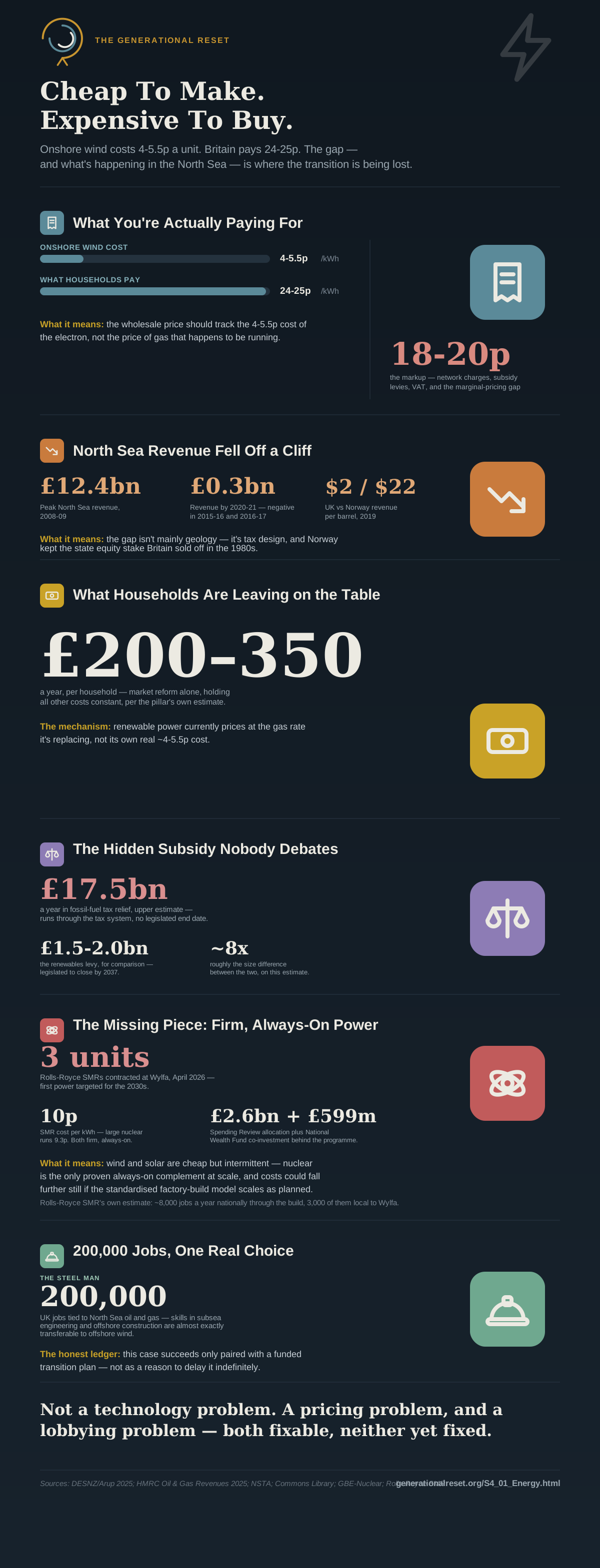
Marginal pricing means every generator is paid the price set by the most expensive one needed at any moment — almost always gas — even in hours when 70% of the grid runs on near-zero-cost renewables.1 Onshore wind generates at 4-5.5p/kWh; households pay 24-25p/kWh. Market reform alone is estimated to cut the wholesale component of bills by £200-350 per household per year. Set against that: GB balancing costs were £2.7bn in 2024/25, forecast to reach £6.4-8.3bn by 2030 without accelerated transmission investment, with transmission constraints already 71% of that total.5
The marginal pricing mechanism structurally transfers value from consumers to gas generators regardless of the true cost of generation — this is the project's own connecting argument built on the documented mechanism and cost data above, not a finding any single source states on its own. But removing that distortion and consumers actually seeing lower bills are not automatically the same event: if the grid-investment gap behind rising balancing costs isn't closed at the same pace as market reform proceeds, the saving reform is meant to deliver could simply be absorbed by a different line on the same bill.
Above, this section already names three genuinely different reform paths, not a strawman beaten by the preferred one: a split market where renewables and nuclear trade at actual cost with gas only topping up what's needed; zonal pricing, with regional prices reflecting local supply and demand; or extending Contracts for Difference to legacy generation, isolating more of the grid from gas pricing incrementally. This pillar proposes the third.
Choosing extended CfD over a full split market or zonal pricing reflects a value judgement, not something the evidence alone settles: protecting existing investment contracts and delivering a faster, administratively simpler transition matters more here than the potentially larger but riskier and slower restructuring the other two options would require. Zonal pricing in particular would create explicit regional winners and losers — a redistributive question this pillar doesn't resolve — which extended CfD avoids by design. A reader who weighs a cleaner, faster full restructuring more heavily than transition stability and investor confidence is not wrong on the evidence; they are weighing the same facts against a different value.
Reform the wholesale electricity market to decouple consumer prices from marginal gas pricing, extending Contracts for Difference to legacy generation on a transition timetable that protects existing investment contracts. The falsification test below is what would show this specific path — not market reform in general — isn't delivering the saving it promises.
1.4 The Subsidy Picture — Both Sides of the Ledger
Public debate about energy subsidy is usually fought as a binary — "renewables are propped up by subsidy" versus "fossil fuels get the real subsidy" — and both claims are used selectively because government support for energy actually flows through at least three distinct mechanisms that are rarely laid out side by side.
Direct government spending — roughly £35bn a year, per the Public Spending Overview's "Energy & net zero" line — covers energy price support schemes (including the 2022–23 crisis-era support), grid investment, and nuclear co-investment such as the Wylfa SMR programme. This is money the government actually spends, appearing in departmental budgets.
Consumer-levy-funded subsidy for renewables — Contracts for Difference, legacy Renewables Obligation Certificates, Feed-in Tariffs, and the capacity market — is a different mechanism entirely. It is not paid from general taxation. It is funded through a supplier obligation added to household electricity bills, currently estimated at £1.5–2.0bn a year (see the honest-context note below on sourcing). This is the subsidy renewable critics usually mean, and it is real — but it is smaller than the contested fossil fuel figure below, not larger, and it is legislated to wind down (the Renewables Obligation closes to new capacity by 2037).
Tax-side support for fossil fuels — decommissioning tax relief, investment allowances, and similar reliefs — is not direct spending at all. It is revenue the Exchequer chooses not to collect. Because it never appears as a spending line, it is easy to miss entirely, which is itself part of why the public debate is so lopsided. Estimates range from £3.5bn to £17.5bn a year depending on methodology — the low end counts only the narrowest direct reliefs, the high end follows the OECD/IMF convention of also counting wider implicit support. Unlike the Renewables Obligation, it has no sunset date.
The width of that range is itself worth explaining rather than just stating. North Sea oil and gas extraction is taxed at a combined marginal rate around 78% — ring-fenced corporation tax, the supplementary charge, and the Energy Profits Levy together — and the investment allowances that reduce this effective rate exist because a 78% marginal rate would otherwise choke off virtually all new investment, not because producers are under-taxed in absolute terms. That's the low end of the range. The high end is driven substantially by a different mechanism entirely: the IMF/OECD convention of counting the UK's reduced 5% VAT rate on domestic gas and electricity bills — support that flows to households, not producers — as an implicit fossil fuel subsidy. The two ends of the £3.5–17.5bn range are largely measuring different things, not disagreeing about the same thing. The full reasoning and sourcing is in the Net Zero working paper.
2. The North Sea — What the Evidence Actually Supports
The North Sea debate is typically framed as a binary: immediate closure or unlimited expansion. Neither position is supported by the evidence. The honest policy position is more specific — and more uncomfortable for both sides.
2.1 The Steel Man for Continued Production
Seven arguments are made for continued North Sea production. The jobs and skills argument is the most compelling: approximately 200,000 UK jobs are directly or indirectly tied to North Sea oil and gas6, concentrated in Aberdeen and the northeast of Scotland, with skills — subsea engineering, offshore construction, pipeline installation — almost exactly transferable to offshore wind, carbon capture, and hydrogen infrastructure. This is a genuine case for managed decline with an explicit funded transition plan, not for open-ended expansion.
The fiscal revenue argument matters but requires honest examination. Net North Sea tax revenues fell from £12.4 billion in 2008-09 to just £0.3 billion in 2020-21, with the net position going negative in 2015-16 and 2016-17. In 2019, the UK received less than $2 per barrel in revenue versus Norway's $22 per barrel from the same waters. In the years before the 2022 crisis, roughly half of all North Sea tax revenues went straight back out as relief payments. The NSTA estimates a combined Exchequer decommissioning liability of £11.7 billion in present value terms.7
2.2 Geology or Policy? What the UK–Norway Gap Actually Shows
A common explanation for why Norway captures so much more value from North Sea oil than the UK does is that Norway's geology is simply easier — bigger fields, cheaper to reach. There is a real geological story here, but on the evidence it explains a smaller part of the gap than it is usually given credit for.
The genuine part: the UK sector of the North Sea is an older, more depleted basin than it was at its 1980s–90s peak, and the fields still being worked today are, on average, smaller and more technically complex than the giant fields that drove peak production. The North Sea Transition Authority's own benchmarking data shows the average cost of producing a barrel of oil equivalent on the UK Continental Shelf rose from £13.82 in 2020 to £19.49 in 20248 — a genuine, worsening cost problem, and the reason the government itself gives for one of the most generous investment allowances of any oil and gas fiscal regime in the world, with reliefs reported as high as 91p for every £1 a company invests.9
What that does not explain is the scale of the gap with Norway. Since 1970, the UK government has captured on the order of $11 in revenue per barrel of oil produced; the Norwegian government has captured close to $30 — a gap of roughly $19 a barrel, compounding across five decades of production from the same basin.10 Analysis of that gap attributes it mostly to two things, and neither is geology: a genuinely higher tax take, and Norway's state holding a direct equity stake in its own oil and gas fields — through its State's Direct Financial Interest mechanism and majority-owned Equinor — and collecting dividends on top of tax, which the UK government has no real equivalent of.10 Norway is extracting from the same basin, with plenty of its own small, mature, and technically difficult fields, and still captures roughly three times the UK's revenue per barrel.
The state-ownership piece is not a case of Norway thinking of something Britain never had access to. Britain had the same tool and gave it up. In 1975–76 the government created the British National Oil Corporation specifically to secure the state a direct ownership stake in North Sea proceeds — the same role Norway's Statoil, founded a few years earlier, was built to play. Through the same period the state also held a majority stake in BP itself: 51% in 1977. Both were sold off through the 1980s — BNOC's upstream assets floated on the stock exchange as Britoil in 1982 and 1985, BP fully privatised by 1987 — and Britoil was then absorbed into the now fully private BP in 1988.11 Norway kept its equivalent and built on it. Britain sold its equivalent to the company that would go on to become the dominant private operator of the same fields.
That history changes what "the industry needs subsidy to operate" actually means in practice. When BP and Shell — BP once itself majority state-owned, now the two largest private operators in the basin — responded to the 2022 windfall tax, neither argued the fields had become geologically unworkable. BP said it would have to review its planned £18 billion of UK investment in light of the levy; Shell was explicit that its own £20–25 billion decade-long UK investment plan depended on the investment allowance relief built into the same measure.12 Both companies have extracted profitably from this basin for decades under a lighter tax regime than Norway's. What they were actually signalling is that they will not accept Norway-level taxation without Norway-level relief attached to soften it — a negotiating position from companies operating a resource the state once had a direct stake in and chose to sell, not a geological constraint. That is the honest basis for the policy position below: continued extraction on ordinary commercial terms is welcome. Extraction conditioned on public subsidy to remain profitable is not something the evidence supports funding further.
None of this means the fix is to rebuild a UK version of Statoil now. That option was genuinely available in the 1970s, when BNOC was created alongside a state stake in BP and the basin was heading toward peak production. It is a materially different proposition today, against a basin already worked down to smaller, costlier, more marginal fields — a new state operator entering now would be buying into the tail of the resource, not its peak, at exactly the moment the country needs to be redeploying North Sea capital and skills into the clean energy transition rather than committing fresh public capital to extending fossil fuel extraction. The BNOC history matters for understanding how the UK ended up with a weaker hand than Norway's, and for being honest that "we could never have done this" is not true. It does not change what the right move is from here, which is the position this pillar already sets out below: manage what remains under strict fiscal discipline, fund the transition, and stop treating further public subsidy to industry as the only way to keep extraction going.
2.3 What the Evidence Supports
Taking all arguments together, the evidence-based policy position is not 'stop everything immediately.' It is: maximise revenue extraction from existing fields under strict and enforced fiscal discipline, without additional public co-investment or relief; require full financial security bonds held in escrow as a condition of all production licences; do not approve new exploration licences requiring public co-investment or additional tax relief to be commercially viable; and fund a fully costed Just Transition programme financed from a ring-fenced levy on current production revenues.
3. Lobbying, Vested Interests, and Democratic Accountability
The technology for a substantially cleaner UK electricity grid has been available for decades. The delay in deploying it at scale is primarily political, not technical or economic, and the mechanism is documented. ExxonMobil's own scientists understood the mechanics of climate change from the 1970s.13 The corporate response was to fund manufactured doubt — the same playbook the tobacco industry used. You do not need to win the scientific argument; you only need to keep it appearing unsettled long enough to delay regulation.
In the UK, the oil and gas industry has spent millions annually on direct lobbying, with ministerial access that environmental groups cannot match. The revolving door between government energy departments and industry is documented. The 2022 test was instructive: the case for accelerating the clean transition had never been stronger — it was live, on every household's energy bill. The policy response included approving new North Sea licences. The lobbying infrastructure was powerful enough to convert a crisis caused by fossil fuel dependency into a public argument for more fossil fuels.
The deeper problem runs past individual corruption. Most politicians aren't corrupt in a simple transactional sense; the system creates structural conflicts of interest that produce bad outcomes without requiring any explicit exchange. A minister who holds shares in an oil company, whose party received donations from one, or who is planning to join an industry board after leaving office, does not need to be bribed to make decisions that happen to align with fossil fuel interests. The bias is baked into their position before they walk into the room.
4. The Go-Forward Framework
4.1 Immediate Priorities (2025-2030)
-
Reform the wholesale electricity market to decouple consumer prices from marginal gas pricing, protecting existing investment contracts while ending the windfall for generators producing at zero fuel cost.
-
P5 Accelerate renewable planning approvals — address the grid connection queue delaying projects by years and establish binding connection timelines backed by regulatory consequences.
-
P2 Introduce mandatory Vehicle-to-Grid ready standards for all new EVs sold in the UK from 2027, with standardised protocols, smart tariff infrastructure, and minimum state-of-charge protections for drivers.
-
Require full financial security bonds as a condition of all North Sea production licences — decommissioning funding held in escrow, not reliant on future company solvency.
-
P4 Publish and fund a fully costed Just Transition plan for North Sea workers, financed from a ring-fenced levy on current production revenues, with specific retraining pathways into offshore wind, CCS, and hydrogen industries.
-
Require full lobbying transparency for energy policy — all ministerial meetings, submissions, and material financial interests publicly disclosed within 30 days.
4.2 Medium-Term (2030-2040)
-
Achieve a grid where gas is a minor, infrequently used backup — not a price-setter — through continued renewable buildout, storage deployment, and completed market reform.
-
Deliver the Wylfa SMR programme — three Rolls-Royce units contracted under GBE-N (April 2026), backed by £2.6bn Spending Review allocation and up to £599m National Wealth Fund co-investment — under a financing model that does not require consumer-funded risk subsidy at the scale of Hinkley Point C. The NWF's role here is catalytic co-investment, not the sovereign wealth model advocated elsewhere in the Generational Reset.
-
P6 Establish long-duration storage capacity sufficient to cover multi-day low-wind, low-solar demand periods without gas backup.
-
Complete the phased decommissioning of North Sea infrastructure under a regulated programme with full public accountability for costs.
4.3 What Success Looks Like
The test of this framework is not whether it satisfies ideological positions on either side. It is whether it delivers measurable outcomes for citizens: a structural reduction in the wholesale component of electricity bills as gas is progressively displaced; genuine independence from volatile global fossil fuel markets through domestic renewables; North Sea communities and workers with a funded, specific, and time-bounded transition programme; and energy policy made in the public interest, with conflicts of interest visible and accountable.
5. Counter-Arguments
'Decoupling consumer prices from the marginal cost of gas removes the price signal that currently pays for the flexible, dispatchable backup power the grid still needs on low-wind, low-solar days'
Decoupling the retail price from gas's marginal cost is not the same as removing gas's actual cost signal from the system entirely — it moves that signal into a dedicated mechanism built for the job. Proposal 6 reforms the capacity market to price firm backup power at its genuine long-run cost and invests in long-duration storage to cover multi-day low-wind, low-solar periods directly. Reliability gets paid for through a market designed to value it, rather than smuggled into the price of every kilowatt-hour a consumer buys, regardless of whether that unit came from wind or gas.
'Framing three decades of delay as lobbying-driven lets ordinary local opposition off the hook — pylons, onshore wind planning objections, and resistance to EV mandates have slowed deployment too, not just corporate interests'
Genuine local resistance exists, and this pillar's own proposals name it — fixing the grid connection queue and its planning-system barriers is Proposal 5. But local planning friction explains delay measured in years on specific projects. It does not explain a fossil-fuel-favourable policy response to a crisis whose cause was fossil-fuel dependency itself, which is what the 2022 test showed: the case for accelerating the transition had never been stronger, live on every household's energy bill, and the policy response included approving new North Sea licences. That is the signature of organised interest capture, documented back to ExxonMobil's own scientists understanding the mechanics of climate change in the 1970s and the manufactured-doubt playbook that followed — not the signature of diffuse local planning objections.
'Ruling out new North Sea exploration that needs public co-investment trades a climate problem for an energy-security problem — cutting domestic production makes Britain more reliant on imported gas exactly when supply security matters most'
UK North Sea gas is sold into an international wholesale market at the prevailing global price, not reserved for UK consumers at a domestic discount. More domestic extraction under the current market structure does not by itself insulate British households from a global gas price shock — which is precisely the mechanism that turned the 2022 supply shock into a UK-wide price crisis, regardless of how much gas came from the North Sea. The proposal also does not end North Sea production: existing fields continue to be maximised under fiscal discipline. What stops is new exploration that requires public subsidy to be commercially viable in the first place — production the market itself has already judged not worth paying for on ordinary terms.
Cross-Pillar Dependencies
| Pillar | Connection |
|---|---|
| Economy | The clean energy industrial strategy connects directly to the Economy pillar. The North Sea's skilled energy workforce — with skills directly transferable to offshore wind and subsea operations — is the human capital asset that bridges the transition. The economy pillar's clean energy industrial strategy must deliver on jobs and regional development in coastal communities adjacent to offshore fields. |
| Public Office Covenant | Fossil fuel and energy sector financial interests among those setting North Sea licensing, windfall tax, and transition policy are structural conflicts that the Covenant's disclosure regime addresses directly. Full financial disclosure, cooling-off periods, and lobbying registers change the conditions under which these conflicts operate. |
| Political Renewal | Long-term energy infrastructure decisions — North Sea transition, grid investment, offshore wind industrial strategy — require political commitment beyond the five-year cycle. The independent mandates that protect these investments from electoral reversal are more credible when the political system itself has structural incentives toward longer time horizons. |
| NHS | NHS estate is one of the largest energy consumers in the public sector. Energy efficiency investment in NHS buildings connects the net zero programme to NHS capital backlog reduction and running cost reduction simultaneously. |
| Welfare | Fuel poverty affects approximately 6 million households — a welfare cost driven by energy prices and building inefficiency. The retrofit and grid investment programme proposed here has direct welfare cost-reduction consequences. Cold, damp homes are simultaneously a health cost, a welfare cost, and an energy cost. |
| Housing | NHC build standards should meet or exceed Future Homes Standard energy efficiency requirements. Social housing retrofit connects housing quality to fuel poverty reduction and NHS demand reduction simultaneously. New social housing is an opportunity to build the energy efficiency into the fabric that is significantly cheaper at construction than as a retrofit. |
| Public Debt | The Sovereign Wealth Mechanism's primary funding source includes commodity and windfall revenues. The fiscal regime for new North Sea licences should include the SWM contribution as a condition of licensing. Energy pillar and Public Debt pillar must be co-designed on North Sea transition revenue. |
| Defence | Offshore infrastructure — wind farms, cable routes, pipeline networks — is increasingly a target for state-sponsored disruption. Defence and energy security require coordinated policy on maritime protection of critical national infrastructure. This is a direct and growing dependency. |
| Criminal Justice | Energy poverty in deprived communities is a contributing factor to the social conditions the Criminal Justice pillar identifies as upstream drivers of offending. Not a direct causal dependency but a shared structural context — poverty, housing insecurity, and cold homes compound together. |
7. Proposals for Change
The following represent the evidence-based proposals of this pillar, put forward for public discussion and challenge. Energy policy involves genuine trade-offs and contested timescales. The Generational Reset invites challenge, additional evidence, and better arguments.
Electricity Market
-
Reform the wholesale electricity market to decouple consumer prices from marginal gas pricing, with a transition timetable protecting existing investment contracts.
-
Extend Contracts for Difference to legacy generation, progressively decoupling more of the grid from gas price volatility.
-
P2 Mandate Vehicle-to-Grid ready standards for all new EVs from 2027, with standardised communication protocols and smart tariff infrastructure.
North Sea
-
Maximise revenue extraction from existing fields under strict fiscal discipline — no additional public co-investment, no additional tax relief beyond documented commercial necessity.
-
Require full financial security bonds held in escrow as a condition of all production licences.
-
Do not approve new exploration licences requiring public co-investment or additional tax relief to be commercially viable.
-
P4 Fund a fully costed Just Transition plan financed from a ring-fenced levy on current production revenues, with specific retraining pathways into offshore wind, CCS, and hydrogen.
Grid and Storage
-
P5 Address the grid connection queue — establish binding connection timelines backed by regulatory consequences for Ofgem.
-
P6 Invest in long-duration storage capacity sufficient to cover multi-day low-wind, low-solar periods without gas backup.
-
P6 Reform the capacity market to price firm backup power at its genuine long-run cost, making storage and demand flexibility economics fully transparent to investors.
Lobbying and Transparency
-
Require full disclosure of all ministerial meetings with energy industry representatives, all lobbying contacts, and all material financial interests within 30 days — as an explicit requirement in this pillar's connection to the Public Office Covenant.
-
Prohibit former energy ministers and senior energy department civil servants from taking roles in fossil fuel companies for a minimum of five years after leaving office.
The barriers here are political, not technical: market structures built for the old world, planning systems too slow for the speed required, and a lobbying infrastructure that has delayed action for three decades. Better technology alone won't fix that. Better democracy will.
Sources: DESNZ / Arup, Electricity Generation Costs 2025 | UK Government Revenues from UK Oil and Gas Production, September 2025 | National Grid ESO, Future Energy Scenarios 2024 | NSTA, Decommissioning Cost Estimates 2023 | House of Commons Library, Taxation of North Sea Oil and Gas, 2025
The Generational Reset is a non-partisan, public-interest project. Not affiliated with any political party. | generationalreset.org
The Generational Reset | S4_01: Energy | For public discussion. Not affiliated with any political party. | generationalreset.org