Executive Summary
The United Kingdom does not have a political problem that sits alongside its economic and social problems. It has a political problem that generates its economic and social problems. The NHS is underfunded, education is inequitable, housing is unaffordable, and welfare is skewed toward the wealthy elderly — not because these outcomes are inevitable, but because the political system that would address them is structurally prevented from doing so by the people and interests that benefit from the status quo.
This pillar makes four arguments. First, that the UK's electoral system — first-past-the-post, operating in a multi-party democracy — systematically distorts political representation in ways that make structural reform impossible. Second, that private money in politics is not an incidental problem but a structural one: it buys the rules that protect the money that buys the rules. Third, that expanding the democratic franchise — votes at 16, citizen assemblies, direct democracy on structural questions — changes the composition of political decision-making in ways that the current system cannot. Fourth, that none of the other pillars in this project are fully deliverable without these changes, which is why this pillar comes first.
This is a structural argument, not a left-wing or right-wing one. First-past-the-post has delivered majority governments for both Labour and the Conservatives that do not reflect the distribution of votes cast. Private money has flowed to parties of both political traditions. The operating system is the problem, not which party is currently running on it.
Key Proposals
Introduce proportional representation for Westminster. Via a citizens' assembly process choosing the specific system, with the recommendation subject to a public referendum.
Cap political donations and introduce public funding. £500 per year individual donation cap, full public funding for parties clearing 2% of the national vote, and real-time disclosure of all donations above £100.
Close the revolving door. A statutory five-year cooling-off period between government positions and roles in regulated industries, enforced by an independent body with genuine sanctioning powers.
Reduce the voting age to 16. With automatic registration and statutory non-partisan civic education in the national curriculum.
Establish a permanent Citizens' Assembly Commission. A standing body examining structural policy questions, with recommendations guaranteed parliamentary debate within six months.
Introduce genuine fixed-term Parliaments. A five-year cycle insulated from prime ministerial dissolution for political advantage.
1. The Honest Diagnosis
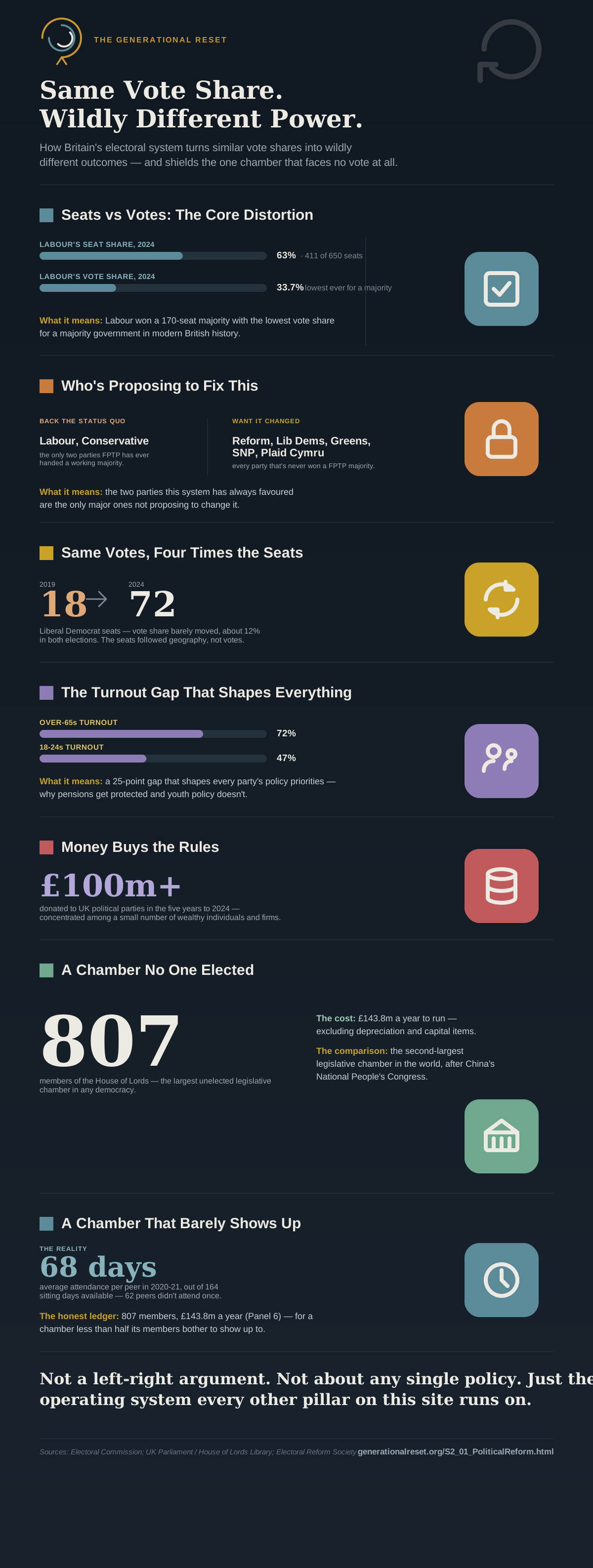
The United Kingdom's political system was not designed for a multi-party democracy. First-past-the-post was developed in an era of two-party politics, when the winning candidate in each constituency represented a genuine majority or near-majority of local opinion. That world no longer exists. In the 2024 general election, Labour won a 170-seat majority on 33.7% of the vote1 — the lowest vote share for a majority government in modern British history. The system did not malfunction. It worked exactly as designed. The design is the problem.
The consequence is a Parliament that does not reflect the country. Parties with substantial national support — the Liberal Democrats at 12%, the Greens at 7%, Reform at 14% — win seats entirely disproportionate to their vote share, or none at all. Parties that concentrate their votes in the right constituencies win landslides on minorities. The safe seat — a constituency so reliably one party's that the election is effectively decided before it is held — removes competitive pressure from the majority of parliamentary representation. Around 70% of seats are effectively non-competitive. The people who live in them are represented by a fait accompli, not a contest.
Private money in politics2 operates in the same structural space. The problem is not that wealthy donors are individually corrupt — it is that the system creates structural alignment between political decision-making and donor interests without requiring any explicit transaction. A party that receives substantial donations from property developers has an incentive structure, before anyone walks into a meeting, that differs from a party without those donations. The alignment does not need to be consciously maintained. It is baked into the relationships, the personnel, the culture, and the priorities that flow from the funding.
The revolving door between government and the industries that government regulates3 operates the same way. A minister who knows they will join a financial services firm after office, a regulator who expects to move into the sector they regulate — the incentive to take decisions that serve those future employers does not require corruption. It requires only that human beings respond to the incentives in front of them. The current system provides those incentives and then acts surprised when the outcomes follow.
2. The Steel Man — The Strongest Case Against Change
The Generational Reset takes counter-arguments seriously. The following represent the strongest objections to Political Renewal, and honest responses to them.
'First-past-the-post produces strong, stable governments that can act decisively'
This is the most defensible argument for the current system, and it deserves a serious answer. FPTP does tend to produce majority governments with clear mandates, and coalition governments under PR can be unstable, as Italy and Israel demonstrate. The UK's post-war record includes governments that enacted major structural change — the welfare state in 1945, privatisation in the 1980s — that might have been harder to deliver under coalition politics.
The honest response is that stability and legitimacy are not the same thing. A government with 33.7% of the vote enacting major structural change has stability but not democratic legitimacy in any meaningful sense. And the countries with the most successful long-term policy records — Scandinavia, Germany, the Netherlands — are coalition democracies. Their stability comes not from strong majority governments but from cross-party consensus built through proportional representation. The UK's 'strong' governments have produced thirty years of inconsistent economic strategy, a housing crisis four decades in the making, and an NHS that lurches between crisis and managed decline. The stability argument cannot survive the evidence. Nor does it need to survive on foreign comparisons alone — the Scottish Parliament and Northern Ireland Assembly have run on proportional systems for over two decades without producing Italy- or Israel-style instability (see 3.1 below).
'PR leads to extremist parties gaining influence'
This is an empirical claim that can be tested. The countries with the longest records of proportional representation — Germany, the Netherlands, Scandinavia — have not seen systematic extremist gains that FPTP countries have avoided. Germany's Basic Law contains specific provisions to exclude parties below 5% of the vote, and this threshold has proven effective. The UK's own experience under FPTP has not prevented the rise of UKIP and Reform as forces that reshaped mainstream party platforms without winning seats proportionate to their vote.
The more fundamental point: if a significant portion of the electorate holds views that the established parties are not representing, a democratic system should reflect that — within the rule of law — rather than suppressing it through electoral mechanics. The representation of diverse views, including difficult ones, is not a bug in democracy. The violent suppression of legitimate political representation is a much greater risk than proportionality.
'The public has already rejected PR in the 2011 referendum'
The 2011 referendum was on the Alternative Vote — a preferential but not proportional system — presented in a campaign widely acknowledged to have been poorly argued on both sides, during a period of intense hostility to the coalition government that had proposed it. It was not a referendum on proportional representation. The question of what the UK's electoral system should be has not been the subject of a well-informed, properly argued public debate. The case in this pillar is that it should be.
3. The Case for Change
3.1 Proportional Representation
The evidence for proportional representation is not ideological — it is empirical. Across comparable democracies, proportional systems produce measurably better outcomes on a range of metrics: higher voter turnout4, greater representation of women and minorities in parliament, stronger citizen trust in political institutions5, more consistent long-term policy, and lower levels of political polarisation.
The specific system matters less than the principle. Germany's Additional Member System, the Single Transferable Vote used in Scottish local elections and Irish parliamentary elections, and party list systems used across Europe all represent significant improvements on FPTP in terms of representational accuracy.6 The choice between them involves genuine trade-offs — local representation versus proportionality, coalition stability versus voter expressiveness — that should be subject to informed public debate rather than party preference.
This is not a hypothetical for the UK specifically — it is already domestic practice. The Scottish Parliament and the London Assembly have used the Additional Member System since they were created in 1999 and 2000; the Northern Ireland Assembly has used the Single Transferable Vote since 1998, and Northern Ireland's local elections since 1973; Scotland's local elections moved to STV in 2007. Wales went further still: from the 2026 election, the Senedd replaced AMS with a fully proportional closed-list system.7 None of this has produced the coalition instability critics of Westminster PR warn about (see the Steel Man above) — it has produced decades of functioning devolved government. The case for PR at Westminster does not rest only on Germany or Scandinavia. Evidence that it works is already generated inside the UK's own political system.
Introduce a proportional or mixed electoral system for Westminster elections, chosen through a citizens' assembly with a mandate to recommend a specific model. The choice of system — STV, AMS, or a party list variant — should be made by a body representative of the public, not by the parties that benefit from the current arrangement. The assembly's recommendation should be subject to a referendum with a well-funded, balanced public information campaign.
In the 2024 general election, Labour won 63% of seats (411 of 650) on 33.7% of the vote1 — the lowest vote share for a majority government in modern British history. Around 70% of seats are effectively non-competitive, decided before polling day. The Liberal Democrats won four times as many seats in 2024 as in 2019 on a near-identical ~12% vote share, purely because of where those votes fell. 27 of the world's 30 most stable democracies use proportional or mixed electoral systems — the UK is the outlier, not the model.
Safe seats remove the one mechanism — competitive electoral pressure — that would otherwise align an MP's incentives with their constituents' interests rather than with donors, industry connections, or simple inertia. This is this project's own connecting argument, not a finding any single source states on its own: because roughly 70% of seats face no real contest, most MPs answer to party selectorates and existing interests rather than a genuinely persuadable electorate — which is why structural reforms proposed elsewhere in this project run into the same wall regardless of which party holds office, since the electoral mechanics protecting the status quo don't change when governments do.
The causation above justifies more than one response, not only full proportional representation: keep first-past-the-post and rely on the "strong, stable government" case set out in the Steel Man above; adopt the Alternative Vote, a preferential but non-proportional system already put to a UK-wide referendum in 2011 and rejected, in a campaign this pillar's own Steel Man calls poorly argued on both sides; or introduce full proportional representation, with the specific system — STV, AMS, or a party list variant — left to citizens' assembly deliberation rather than dictated in advance, since the pillar itself states the choice between them involves genuine trade-offs.
Choosing full PR over AV or the status quo reflects a value judgement this pillar makes explicitly: that a Parliament accurately reflecting how people actually voted matters more than the administrative simplicity and habitual stability of strong single-party government, even though stable majority government has itself delivered major reform in the past — the 1945 welfare state, 1980s privatisation — as the Steel Man above concedes. A reader who weighs decisive single-party government more heavily than proportional accuracy, or who judges the transition costs of changing the system as outweighing the benefit, is not wrong on the evidence — they are weighing the same facts against a different value about what makes a government legitimate.
Introduce a proportional or mixed electoral system for Westminster, chosen by a citizens' assembly and confirmed by referendum. The falsification test below is what would show electoral reform isn't actually the deliverability mechanism this pillar claims it is.
3.2 Private Money in Politics
The case for removing private money from politics rests on a structural argument, not a claim that every donation is corrupt: private funding creates alignment between political decision-making and donor interests without requiring any explicit transaction, and that alignment systematically distorts policy in ways the public cannot easily detect or challenge.
The alternative — complete public funding of qualifying political parties, with strict caps on individual donations, equal airtime requirements, and comprehensive spending limits — is not radical. It is the norm across most European democracies. The objection that public money should not fund political parties misses the point: the question is not whether politics should be funded but by whom. The current system funds politics through private money with structural strings attached. The alternative funds it through public money with democratic accountability.
Cap individual political donations at £500 per year, introduce full public funding for all parties clearing 2% of the national vote, mandate equal broadcasting time for all qualifying parties during election campaigns, and require real-time public disclosure of all donations above £100.
P3The revolving door between government and regulated industries to be closed through a five-year cooling-off period enforced by an independent statutory body with genuine sanctioning powers.
3.3 Expanding the Franchise
Votes at 16 is not a radical proposition. It is the law in Scotland and Wales for devolved elections8, in Austria, Germany, Belgium, Malta9, and a growing number of democracies. The argument against it — that 16-year-olds lack the maturity to vote — is not supported by evidence, applies more convincingly to many adults who currently vote, and is conspicuously applied only to the franchise question and not to the many other legal rights and responsibilities that 16-year-olds carry.
The honest argument for votes at 16 in the context of this project is structural: 16 and 17-year-olds are directly affected by housing costs, education debt, employment precarity, and environmental degradation. They have no representation in the decisions that will shape the decades they will live through. Adding approximately 1.5 million voters whose interests are directly opposed to the status quo changes the electoral arithmetic of every major structural issue this project addresses.
Reduce the voting age to 16 for all UK elections. Introduce automatic voter registration at 16. Establish a programme of civic education in schools that is genuinely non-partisan — covering how the political system works, how public spending is allocated, and how to evaluate political claims — as a statutory component of the national curriculum.
3.4 Citizen Assemblies and Direct Democracy
The citizens' assembly model — selecting a body representative of the public through stratified random sampling, giving it access to expert evidence and genuine deliberative time, and asking it to make recommendations on structural questions — has a strong track record. Ireland's abortion referendum and equal marriage legislation both emerged from citizens' assemblies. The UK's Climate Assembly produced thoughtful, evidence-based recommendations that cut across partisan lines.
The application of this model to structural questions — the voting system, the pension settlement, the housing system — is specifically appropriate because these are questions where elected politicians face structural conflicts of interest. A Parliament of property-owning MPs cannot be expected to reform the housing system without external mandate. A Parliament dependent on pensioner votes cannot reform the triple lock without democratic cover. Citizens' assemblies provide both the mandate and the political cover that structural reform requires.
Establish a permanent Citizens' Assembly Commission with a rolling mandate to examine structural policy questions referred to it by Parliament or triggered by public petition. Assemblies to be stratified by age, region, gender, and socioeconomic background. Their recommendations to be subject to parliamentary debate within six months and, where they recommend constitutional or structural change, to a public referendum.
4. The House of Lords — An Institution Designed to Resist This Project
The House of Lords is the second largest legislative chamber in the world after the Chinese National People's Congress. It costs £143.8 million a year. Its members are not elected. Most serve for life. And it has a greater structural interest in preventing the reforms argued for in this project than any other institution in the United Kingdom.
That last point deserves to be stated plainly. The Generational Reset argues for redistribution of inherited wealth, reform of the planning system that has generated enormous property windfalls, transparency in the financial interests of those in public life, and structural change to the political system that has protected all of the above. The House of Lords is populated by people who are, in aggregate, among the primary beneficiaries of exactly those arrangements. They did not compete for their positions. They owe them to birthright, religious office, or prime ministerial patronage. They have no constituency to answer to and no electoral consequence for their votes. The institution is not a neutral participant in the debate this project is trying to have.
4.1 The Numbers
| Metric | Value |
|---|---|
| £143.8m | Annual cost of the House of Lords in 2023-24 — excluding depreciation and capital items |
| 807 | Members as of 2025 — the largest unelected legislative chamber in any democracy |
| £361 | Tax-free daily attendance allowance claimable by each peer for each sitting day |
| 68 days | Average attendance per peer in 2020-21, out of 164 official sitting days available — fewer than half |
| 62 | Peers who did not attend for a single day in 2020-21, some of whom still claimed allowances |
| 115 | Lords who failed to speak at all during the 2016-17 session — one in seven — claiming an average of £11,091 each |
| 1 | Peer who claimed almost £50,000 in attendance expenses covering every sitting day — without ever speaking or tabling a written question |
| 18% | Peers aged over 80 — nearly three times the proportion in the general adult population |
| 26 | Church of England bishops with automatic seats — one per 88,500 Christmas church attendees, in a secular country of 48.2 million voters |
| 0 | Peers who face electoral consequences for any vote they cast |
4.2 The Patronage Problem
Life peers are appointed by the Crown on the advice of the Prime Minister. In practice, successive prime ministers have used the appointments process to reward donors, allies, and party loyalists — creating a chamber that, despite having no electoral mandate, is packed with party-political appointees whose primary loyalty is to the leader who placed them there. Boris Johnson appointed 86 peers in three years, including donors, former advisers, and political allies. The House of Lords Appointments Commission exists to advise on propriety but has no power to block prime ministerial nominations.
The consequence is a chamber that is simultaneously presented as a source of independent expertise and scrutiny, and structured in practice as a resource for executive power. When a government has appointed enough peers, it can pass legislation through the Lords with minimal resistance. When it has not, it cannot. The independence of the chamber is a function of arithmetic, not principle.
4.3 The Conflict of Interest at Scale
The Public Office Covenant pillar argues that mandatory financial disclosure is necessary because conflicts of interest in public life operate structurally rather than individually — you do not need explicit corruption when the interests of decision-makers are systematically aligned with the decisions they make. The House of Lords is the purest expression of this structural problem in British public life.
A chamber that includes significant numbers of property developers, financial services professionals, former energy sector executives, and individuals with substantial inherited wealth, voting on planning reform, financial regulation, energy policy, and inheritance tax — without any obligation to declare or recuse — is not a scrutiny chamber. It is a structural conflict of interest given a constitutional role. The Covenant's transparency requirements apply here more directly than anywhere else in the political system. They are also, notably, not currently required of peers.
4.4 What Should Replace It — An Open Question
The Generational Reset does not claim to have solved the constitutional design problem that replacing the Lords presents. It is a genuinely hard problem and reasonable people disagree about the answer. What can be stated clearly are the principles that any replacement must satisfy — and the options that deserve serious consideration.
Principles any replacement must satisfy
-
Democratic legitimacy — members must derive their position from some form of public mandate, selection, or transparent appointment process insulated from prime ministerial patronage
-
Fixed terms with no renewal — five years is a reasonable working model. Temporary service preserves the expertise argument without creating a permanent second chamber political class. It is closer to jury service or a citizens' assembly than to a career, and it changes the incentive structure entirely
-
A scrutiny function, not a competing legislative mandate — the chamber's constitutional role should be review, amendment, and the power to require the Commons to think again, not the initiation of legislation or the confidence of the government
-
Composition that draws on expertise across public life — education, health, public service, business, civil society, science — from a pool wider and more representative than current institutional leadership structures
-
No prime ministerial patronage — appointments, elections, or selections must be governed by a process independent of the executive
-
Size proportionate to function — a scrutiny chamber of 200 to 300 members is more than adequate for its constitutional role. 807 is not a scrutiny chamber. It is a subsidy programme.
Options for serious consideration
An elected second chamber is the most democratically obvious answer. Election by proportional representation, on a regional basis, with staggered five-year terms. The objection is that an elected second chamber with its own mandate creates the conditions for institutional deadlock and erodes the scrutiny function — elected members pursue their own platforms rather than scrutinising the Commons'.
A functional chamber — elected from defined pools representing education, health, public services, business, and civil society — addresses the expertise problem while maintaining democratic legitimacy through election. The Irish Seanad operates on a version of this principle, though it is widely regarded as having underdelivered on its original intention. The critical design questions are who defines the pools, how representation within them is made genuinely diverse, and how conflicts of interest are managed when sector representatives vote on legislation directly affecting their sectors. Five-year non-renewable terms are essential to this model — they prevent the emergence of career politicians within the functional chamber while preserving genuine operational expertise.
A reformed appointed chamber — with a genuinely independent appointments commission, insulated from prime ministerial direction, drawing on a much wider pool than current life peer appointments — preserves the expertise argument without the mandate conflict of an elected second chamber. It does not, however, solve the democratic legitimacy problem.
Abolition, moving to a unicameral system as in New Zealand and the Nordic countries, concentrates scrutiny in the Commons and eliminates the constitutional ambiguity of an unelected chamber with genuine legislative power. The scrutiny function moves to properly resourced parliamentary committees with genuine independence and investigatory power. This option is most coherent when combined with proportional representation — a unicameral Parliament elected by PR, with strong committee structures, is a more democratically legitimate arrangement than the current bicameral system where one chamber has no mandate at all.
The one thing that is not a serious option is the status quo. An 807-member unelected chamber costing £143.8 million a year, populated substantially by prime ministerial patronage appointments, whose members claim tax-free attendance allowances while failing to speak, vote, or contribute — and who have the greatest structural interest of any institution in the country in preventing the reforms this project argues for — isn't a second chamber. It's a problem tolerated for a century because the people with the power to change it are the people it benefits.
5. Counter-Arguments — The Strongest Objections
'Political Renewal is a distraction from the real issues'
This is the most common objection and it inverts the logic. Political Renewal is not a distraction from the NHS, housing, or welfare — it is the precondition for addressing them. Every structural reform proposed in every other pillar of this project has been known, evidenced, and argued for, in some cases for decades. The Dilnot social care proposals date to 2011. The case for PR has been made since the early twentieth century. Proportional systems have better outcomes than FPTP in the countries that use them. The question is not why these reforms have not been argued. It is why they have not been implemented. The answer is political structure.
'Changing the electoral system would be permanently destabilising'
The transition to a new electoral system involves genuine complexity and some period of adjustment. This is a real cost. It needs to be weighed against the cost of the current system: thirty years of inconsistent economic strategy, a housing crisis four decades in the making, a welfare system that has drifted from its purpose without democratic mandate to correct it. The costs of transition are bounded and short-term. The costs of the status quo are unbounded and compounding.
'Politicians will never vote to change the system that elected them'
This is the strongest practical objection, and it is why this pillar proposes citizens' assemblies rather than parliamentary commissions as the mechanism for designing change. The recommendation of a citizens' assembly has democratic legitimacy that a parliamentary vote on the same question lacks. A referendum on a citizens' assembly recommendation — particularly one proposing a change supported by a clear majority of the public — creates political conditions under which even a Parliament elected under FPTP can deliver change without self-immolation.
Cross-Pillar Dependencies
Political Renewal is not one pillar among many. It is the structural precondition for the deliverability of every other pillar. The following connections are explicit rather than implied.
| Pillar | Connection |
|---|---|
| Public Office Covenant | The Covenant is the internal complement to this pillar's external reforms. Political Renewal removes the structural capture of the system from outside — private money, distorted representation. The Covenant removes the internal capture — conflicts of interest, the revolving door, the normalisation of self-enrichment in office. Together they close the loop. |
| Economy | The UK's chronic underinvestment in productive capital, infrastructure, and regional development is not primarily an economic failure — it is a political one. Short electoral cycles, donor interests aligned with financialisation, and safe seats insulated from economic consequences in disadvantaged regions all produce the same outcome: no twenty-year economic strategy is ever sustained long enough to compound. PR and longer-horizon coalition governance is the structural enabler of the Economy pillar's patient capital argument. |
| NHS | NICE thresholds, the social care paralysis, and the GP workforce shortfall have all been politically manageable under FPTP because the costs fall on the politically under-represented and the benefits of change would be diffuse and long-term. Electoral reform changes the political calculus of NHS funding decisions by removing the safe-seat insulation that allows the status quo to persist without electoral consequence. |
| Education | No education strategy in the UK has been sustained through more than two parliaments. The five-year electoral cycle is the primary reason that twenty-year reforms — professionalising teaching, investing in early years, building a genuinely comprehensive system — cannot compound into structural change. PR, by producing coalitions with shared medium-term agendas, changes the time horizon of education investment decisions. |
| Defence | Defence procurement failures — Ajax, Nimrod, Type 45 power systems — persist partly because the MoD is insulated from democratic accountability in ways that a properly functioning Parliament would correct. Independent acquisition authority and transparent programme reporting require the political accountability mechanisms this pillar establishes. |
| Public Debt | The Generational Debt Statement — requiring politicians to acknowledge the intergenerational transfer in every budget — requires a Parliament willing to impose obligations on itself. The structural current-account balance target requires cross-party commitment that PR makes structurally more achievable than under a system producing alternating majority governments with opposed fiscal ideologies. |
| Energy | Long-term energy infrastructure decisions — North Sea transition, grid investment, offshore wind industrial strategy — require political commitment beyond the five-year cycle. The independent mandates that protect these investments from electoral reversal are more credible when the political system that creates them has structural incentives toward longer time horizons. |
| Welfare | The welfare system's skew toward older, wealthier voters is the most direct expression of the electoral arithmetic this pillar addresses. The triple lock, the two-child benefit cap, the Local Housing Allowance freeze — all reflect the voting weight of specific demographics under FPTP. Proportional representation, votes at 16, and citizen assemblies with age-stratified selection are not peripheral welfare reforms. They are the mechanism by which the welfare system's democratic distortion can be corrected. |
| Criminal Justice | The collapse of legal aid, the court backlog, and the prison population record all reflect political decisions that impose costs on people with low political voice. Under FPTP, criminal justice spending is the first to be cut and the last to be restored because those who bear the consequences — defendants, victims in deprived communities, people released without rehabilitation — do not form a decisive electoral bloc in marginal seats. |
| Housing | The housing crisis has persisted for four decades not because the solutions are unknown but because the people who would implement them — property-owning MPs in constituencies of homeowning voters — face no electoral incentive to do so. PR eliminates safe seats. Votes at 16 adds 1.5 million voters directly harmed by housing costs. These are not rhetorical connections. They are the specific mechanism by which the housing crisis has been politically maintained. |
7. Proposals for Change
The following represent the core proposals of this pillar. They are not a programme for government — they are the case for structural change that this project invites the public to consider, challenge, and build upon.
-
Introduce proportional representation for Westminster elections through a citizens' assembly process, with the assembly's recommendation subject to a public referendum. The specific system — STV, AMS, or party list — to be chosen through deliberation, not party preference.
-
Cap individual political donations at £500 per year. Introduce full public funding for parties clearing 2% of the national vote. Mandate real-time disclosure of all donations above £100. Enforce equal broadcasting time during election campaigns.
-
Close the revolving door through a statutory five-year cooling-off period between government positions and roles in regulated industries, enforced by an independent body with genuine sanctioning powers.
-
Reduce the voting age to 16 for all UK elections with automatic registration at 16. Introduce statutory non-partisan civic education as a component of the national curriculum.
-
Establish a permanent Citizens' Assembly Commission with a mandate to examine structural policy questions, stratified to represent the full age, regional, gender, and socioeconomic diversity of the UK. Recommendations subject to parliamentary debate within six months and to referendum where they propose constitutional change.
-
P6 Introduce fixed-term Parliaments with a genuine five-year cycle insulated from prime ministerial dissolution for political advantage. Separate the executive dissolution power from the parliamentary mandate.
-
Require mandatory publication of all ministerial meetings with external parties, all lobbying contacts, and all decisions where a minister has a potential financial conflict of interest — within 30 days of the meeting or decision.
Political Renewal is not the most glamorous argument in this project. It does not promise immediate change in any specific policy area. What it promises is that the changes argued for in every other pillar become deliverable — rather than being known, evidenced, argued, and repeatedly prevented by a system that was never designed to allow them. That is the argument. The reader is invited to challenge it.
The Generational Reset is a non-partisan, public-interest project. It is not affiliated with any political party, does not accept corporate funding, and publishes all its work under open licence for public discussion and adaptation.
For public discussion. Not affiliated with any political party. | generationalreset.org
The Generational Reset | S2_01: Political Renewal | For public discussion. Not affiliated with any political party. | generationalreset.org