THE GENERATIONAL RESET
Section Three: The Wider Conversation. The structural choices Britain faces about what kind of economy it wants to be — and what it would take to get there.
This document sits in Section Three — The Wider Conversation — rather than Section One, because the economy pillar is not primarily an account of how the current budget is spent. It is a structural argument about what Britain's economy is organised to do, and what it would need to change to do something different. It is more contested, more forward-looking, and more fundamental than the spending analysis in Section One. It is also the pillar on which every other pillar's long-term viability ultimately depends.
Executive Summary
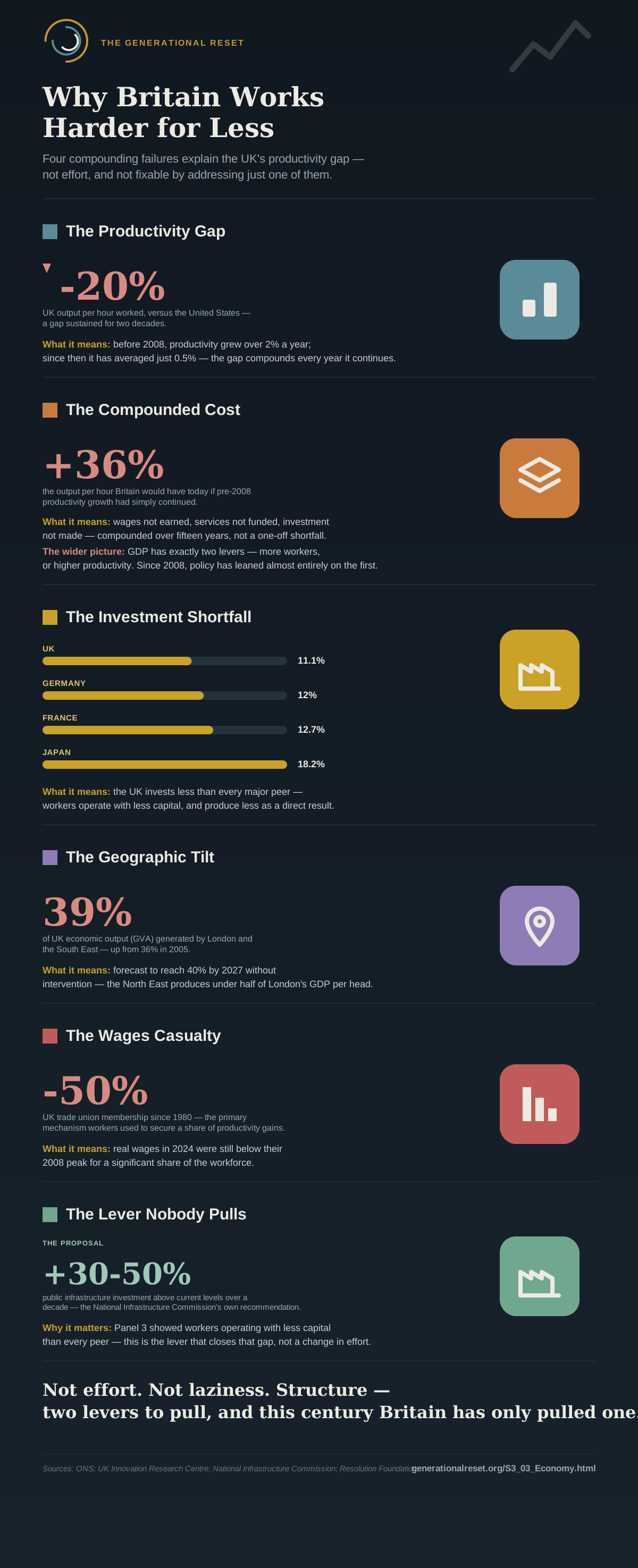
The United Kingdom has a productivity problem. Output per hour worked sits roughly 20% below the United States and lags France, Germany, and the Netherlands by comparable margins. Before 2008, productivity was growing at over 2% per year. Since then it has averaged 0.5%. If the pre-crisis trend had continued, output per hour would now be more than 36% higher than current estimates. That 36% represents wages not earned, public services not funded, and investment not made — compounded over fifteen years.
This pillar makes five arguments. First, that the productivity failure has four structural causes that reinforce each other: chronic underinvestment, a financial system organised around short-term returns, a long tail of low-productivity firms serving low-income local markets, and extreme regional concentration. Second, that the Norway comparison — a country that extracted comparable North Sea revenues and now holds a $2.2 trillion (around £1.7 trillion) sovereign wealth fund while the UK has nothing — is not a historical curiosity but the clearest available illustration of the choice between an economy organised for long-term shared prosperity and one organised for short-term distributed returns. Third, that the UK's regional divergence — London and the South East generating 39% of national output and growing — is not inevitable but is the consequence of specific policy choices that can be changed. Fourth, that wages, work, and the collapse of collective bargaining are where all of these structural failures land on actual people. Fifth, that the institutional reforms required — patient capital vehicles, regional investment mandates, a wages compact — are not novel but are the UK's version of what comparable economies have built and maintained for decades.
The economy pillar is the structural foundation beneath every other pillar in the Generational Reset. The productivity gap, the regional divergence, the wages crisis, and the ownership failure are not economic problems that sit alongside social problems. They are the mechanism through which social problems are generated, sustained, and reproduced across generations.
Key Proposals
Route Crown Estate offshore wind lease revenue into the Sovereign Wealth Mechanism. Not a separate British Wealth Fund — the same Sovereign Wealth Mechanism already proposed in the Public Debt pillar, joining as a third funding stream alongside depleting-asset revenue and inheritance tax receipts. Finite national assets converted into permanent financial assets, not consumed in the present.
Reform pension fund regulation to require minimum UK productive investment. Statutory allocations to infrastructure, housing, and early-stage technology — with statutory teeth, not voluntary Mansion House commitments.
Introduce a National Infrastructure Mandate. Infrastructure spending per head converging across regions over fifteen years, with legally binding regional floors and independent audit of Treasury allocation decisions.
Launch a Clean Energy Industrial Strategy. Capturing the manufacturing value of UK offshore wind by conditioning contracts on UK-manufactured content and building supply chain skills in coastal communities.
Create a Sectoral Fair Pay Agreement system. Minimum terms by sector negotiated between employer associations and trade unions, with statutory backstop authority for the Low Pay Commission where negotiation fails.
Embed the capital-versus-current spending distinction in primary legislation. OBR-certified economic return as the test, alongside committing to infrastructure investment 30–50% above current levels over a decade.
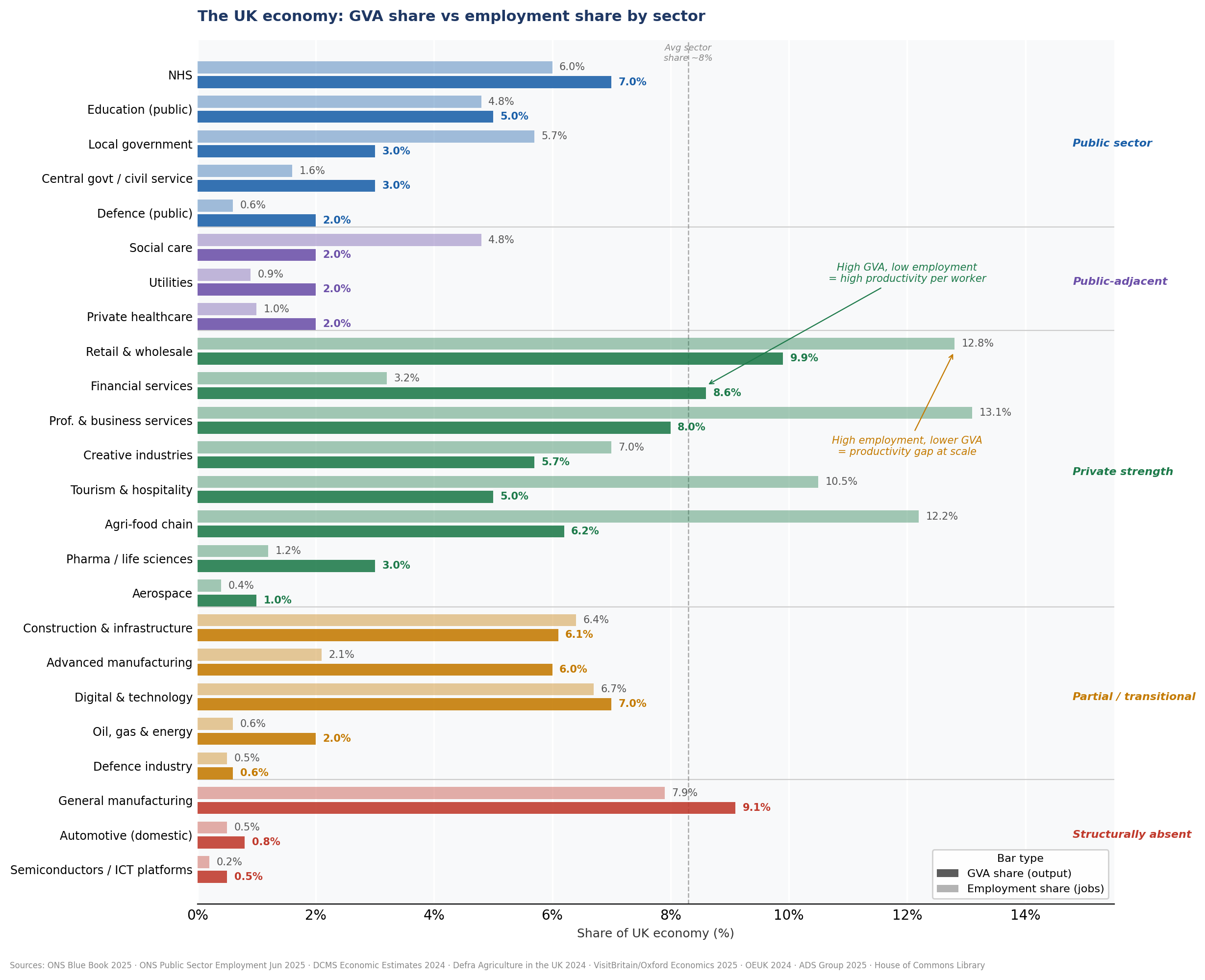
How to read this chart: the darker bar is each sector's share of the UK's total economic output (GVA); the lighter bar is its share of jobs. When the darker bar is bigger than the lighter one, that sector produces more economic value than its headcount alone would suggest — a high-productivity sector. When the lighter bar is bigger, the opposite is true: more people work in it than its output alone would suggest.
1. The Honest Diagnosis — Four Compounding Failures
The UK's productivity failure is four compounding structural failures, not one problem with one cause, each of which makes the others worse.
1.1 Chronic Underinvestment
UK companies invest 11.1% of GDP — behind Japan at 18.2%, France at 12.7%, and Germany at 12%.1 Compared to workers in the United States, Germany, France, and the Netherlands, UK workers have access to a third less capital per hour worked.2 In manufacturing, the capital intensity gap is 47% below peer countries. A country that does not equip its workers cannot expect them to outperform countries that do. It's arithmetic, not a mystery. The consequence runs through every sector: hospitals with crumbling infrastructure, schools with outdated equipment, businesses operating on technology two generations behind their competitors.
1.2 Financialisation
The UK's financial sector is the second largest in the world. It is also, in significant ways, structurally disconnected from the productive economy it is supposed to serve. Private equity does not primarily create value by making companies more productive. It creates returns by restructuring ownership, loading companies with debt, extracting fees, and selling at a multiple. British pension funds — which hold enormous pools of long-term capital that in Germany, France, and Norway are deployed into infrastructure and industrial investment — were progressively pushed toward liquid, lower-return assets. The result is a circle: underinvestment produces low productivity, low productivity produces weak returns, weak returns reduce the justification for investment.
1.3 The Firm Dispersion Problem
The UK has a long tail of low-productivity businesses that drags on the aggregate — not because they are managed poorly, but because they serve local markets whose purchasing power is too weak to sustain higher-value activity. Local services firms — restaurants, shops, hairdressers — account for 94% of the bottom third of businesses when ranked by productivity. These firms are not a management problem. They are a wages and demand problem, and they are a direct consequence of the regional divergence.
1.4 Regional Concentration
London and the South East generate 39% of UK GVA, a share that has grown from 36% in 2005 and is forecast to reach 40% by 2027 without intervention.3 The North East produces GDP per head less than half of London's. R&D investment in the North East, North West, and East Midlands each declined by 11-12% between 2022 and 2024, while London's grew by 15%. These are not independent problems. They are the same problem viewed from four angles simultaneously. The agglomeration dynamics that compound advantage in London are self-reinforcing without deliberate counter-investment.
UK output per hour has sat roughly 20% below the United States for two decades. UK business investment is 11.1% of GDP — lowest in the G7 after Canada, against Germany's 12%, France's 12.7%, and Japan's 18.2%.1 London and the South East generate 39% of national GVA, up from 36% in 2005.3 Local services businesses make up 94% of the bottom third of firms by productivity. UK trade union membership has fallen from over 50% of the workforce in 1980 to under 20% today.
Each of these facts could be read as a separate problem with its own separate fix. This project's own connecting argument, not a finding any single source states on its own: they reinforce each other in a specific cycle. Underinvestment weakens returns, which reduces the case for further investment. Regional concentration starves local markets of purchasing power, which caps what local firms can charge and pay, which is the firm-dispersion problem described above. Collapsed collective bargaining means productivity gains that do occur flow disproportionately to capital rather than wages, weakening local demand further. A policy that raises investment without addressing regional demand, or raises regional infrastructure spending without restoring wage-setting power, is treating one node in a self-reinforcing loop as if it were the whole loop.
The causation above is compatible with several different responses, not only this pillar's comprehensive one: address underinvestment alone through patient capital reform, on the theory that capital deepening will eventually lift wages and regional output as a downstream effect; address regional concentration alone through infrastructure investment, on the theory that redistributing opportunity will pull investment and wage growth with it; restore collective bargaining alone, on the theory that wage-led growth will force productivity-raising investment; or, as this pillar proposes, treat all four as one interlocking problem requiring simultaneous intervention.
Choosing simultaneous, comprehensive reform over a single-lever strategy reflects a value judgement about risk and sequencing, not something the evidence alone settles: it accepts a larger, harder-to-sell reform programme now against the alternative of a politically easier single-lever reform that this pillar's own causation argument predicts would underperform. A reader who judges that a single credible lever, delivered well, is more achievable than a four-part programme delivered partially is not wrong on the evidence — they are weighing the same interdependency against a different tolerance for political risk.
The six-proposal package below (patient capital institutions, pension fund reform, a National Infrastructure Mandate, a Clean Energy Industrial Strategy, a Sectoral Fair Pay Agreement system, and capital-spending discipline in law) addressing underinvestment, regional concentration, and collapsed wage-setting power together, not as separate initiatives. The falsification test below is what would show the compounding-failures diagnosis itself is wrong, not just that one proposal underperforms.
2. What Britain Actually Has — The Steel Man
2.1 Financial Services — World-Class, Structurally Problematic
London is the world's second-largest financial centre. Financial services contribute £209 billion in GVA — 8.6% of the total economy — and employ 1.1 million people at above-average wages. The UK leads the G7 in financial services' share of economic output. This is a genuine, globally competitive strength. The pillar's argument is not that financial services should be diminished but that the financial system should be reoriented toward productive investment — which would strengthen rather than weaken the sector's long-run contribution.
2.2 Pharmaceuticals — Genuinely World-Class, Dangerously Concentrated
AstraZeneca and GSK are genuinely world-class research enterprises. Together they account for the UK’s only two entries in the global top 100 R&D investors — at 14th and 33rd respectively.4 The life sciences sector accounts for roughly 25% of all UK business R&D spending. The COVID-19 vaccination programme demonstrated the institutional capability of both the sector and the NHS infrastructure that interfaces with it.
The structural risk is severe: two companies account for 88% of the sector’s entire R&D spend. If either restructures, relocates its research to the United States or Switzerland, or enters a difficult period, the UK’s single credible R&D strength effectively disappears. A national industrial base cannot safely rest on the investment decisions of two corporate boards.
2.3 Creative Industries — A Consistent Outperformer
The UK’s creative industries contributed £124 billion in GVA in 2023 — 5.7% of total output — and grew four times faster than the wider economy between 2023 and 2024. The UK is the world’s third-largest exporter of creative services, behind only the United States and Ireland. Music, film and television production, games, and advertising are sectors where the UK has genuine, sustained, globally recognised excellence. The UK is Europe’s largest film and high-end television production location outside the United States, attracting £4.8 billion of inward investment in 2024 alone.
The qualification is distributional. Over half of creative industry output is generated in London. The sector’s employment and economic activity are as geographically concentrated as financial services. And over half of the film and television investment is driven by US streaming money, not domestic industrial strategy — which means the foundation is partially borrowed rather than structurally owned.
2.4 Aerospace — Mid-Tier Strength with Regional Anchoring
The UK is the world’s second-largest aerospace industry by turnover, exporting 70% of output and generating £52.5 billion in exports annually. Rolls-Royce is a genuinely world-class aero-engine manufacturer. BAE Systems is a significant defence prime. The sector is unusual among UK industries in being both genuinely competitive internationally and geographically distributed — its major employment footprints in Bristol, Derby, Lancashire, and the Clyde anchor regional economies in ways that financial services and creative industries do not.
The honest assessment is that the UK is a strong mid-tier player, not a dominant one. Rolls-Royce sits at 227th in the global R&D investor rankings — behind Airbus, Boeing, RTX, Lockheed Martin, Thales, and Safran. The sector is a genuine asset; it is not the source of industrial renewal that the scale of the UK’s structural problems requires.
3. The Norway Comparison
Norway discovered North Sea oil at approximately the same time as the United Kingdom. Both extracted broadly comparable revenues over roughly the same decades. Both are mid-sized northern European democracies with broadly comparable political cultures and institutional stability. The resource was, in essence, the same resource. What differed was the institutional decision about what to do with the revenues.
Norway in 1990 established the Government Pension Fund Global — initially the Petroleum Fund — with a simple mandate: surplus petroleum revenues would be invested internationally, compounding for the benefit of future generations. As of 2025, it holds over $2.2 trillion (approximately £1.7 trillion) in assets — equal to 1.5% of every listed company on earth, and approximately four times Norway’s entire GDP. It generates returns that now exceed the annual oil and gas revenues that feed it, making it self-sustaining beyond the North Sea’s operational life. Every Norwegian citizen has, in effect, $390,000 of sovereign wealth working on their behalf.5
The UK made a different decision — not once, but consistently over three decades. Between 1980 and 1989, the Thatcher governments received £166 billion in North Sea tax revenues in real terms. They used it to support current spending: covering the costs of industrial restructuring, meeting the unemployment benefit bill generated by deindustrialisation, and funding income tax cuts. As Tony Blair acknowledged in 1987, North Sea oil was “utterly essential to Mrs Thatcher’s electoral success.” It also funded the welfare costs of the communities destroyed by the economic restructuring it financed. The receipts were large, the moment was brief, and it passed without any institutional mechanism being built to hold and compound the proceeds.
The counterfactual is not speculative. Had just 10% of UK North Sea tax receipts been put into a fund from 1980 onwards, invested at a modest 3% nominal return, the fund would have been generating £24 billion a year by 2008. At 20% of revenues and a 5% return, the pot would be generating £66 billion annually — equivalent to the entire NHS England budget, generated passively, in perpetuity, from money that instead paid for tax cuts that have since been partially reversed.
3.1 Financialisation — What the Economy Is Actually Organised to Do
The Norway comparison illustrates one specific structural failure. A broader structural failure underlies it: the UK economy has, over the last forty years, been progressively reorganised to generate returns for those who already hold financial and property assets, rather than to generate productive output that creates broadly shared prosperity. This process — financialisation7 — is not a conspiracy. It is the compounded result of a series of individually rational decisions, each made in response to short-term incentives, none made with a view to what the economy would look like forty years later.
Private equity does not primarily create value by making companies more productive. It creates returns by restructuring ownership, loading companies with debt, extracting fees, and selling at a multiple. The underlying business may or may not be better when the cycle is complete. The financial return is largely independent of whether it is. British pension funds — which in theory hold the long-term capital that could fund the kind of twenty-year infrastructure and industrial investment that anchors economies like Germany’s — were progressively pushed from the 1990s towards bonds and liquid financial assets, away from patient, illiquid investment in infrastructure and industry. The result is that the UK has the long-term capital it needs sitting in pension funds — and a financial system designed to keep it there rather than deploy it into the productive economy where it is needed. Canada’s pension funds — the Maple Eight — have become some of the world’s most sophisticated long-term investors precisely because they were structured to invest in infrastructure and private equity rather than gilts. The UK made the opposite structural choice.
4. The Sectoral Picture — Where Britain Competes and Where It Is Absent
The UK’s economic structure tells a more specific story than the aggregate figures. Across the major sectors, a consistent pattern emerges: strong positions in services that generate concentrated returns, partial positions in industries with genuine industrial depth, and structural absence from the sectors that will dominate the next fifty years. The chart below maps every major sector by its share of GDP output against its share of employment. The gap between the two bars is the most important single visual in this pillar: where the output bar significantly exceeds the employment bar, the sector is high-productivity — generating more value per worker. Where employment exceeds output, the sector is operating at lower productivity. The pattern tells the structural story of the UK economy more clearly than any summary statistic.
Figure 1: UK sectors by GVA share (output) and employment share — darker bar = GVA, lighter bar = jobs. Source: ONS Blue Book 20258 and sector-specific sources.
4.1 Where the UK Leads
Financial services generate £209 billion in GVA and employ 1.1 million people, with London ranked as the world’s second-largest financial centre.9 The creative industries contribute £124 billion annually, growing four times faster than the wider economy, making the UK the third-largest global exporter of creative services. Professional and business services employ 4.5 million people — the largest private sector employment category alongside retail. Tourism and hospitality together account for around 5% of GDP and employ 3.6 million people. Aerospace, second globally by turnover, exports 70% of its output. These are real strengths. The consistent limitation they share is geographic concentration: over half of creative industry output, and the great majority of financial and professional services activity, is generated in London and the South East.
4.2 Where the UK Is Absent
ICT software and platforms represent 24.9% of all global private R&D investment, with US firms contributing 77% of that share. The UK’s highest-ranked ICT firm globally is BT at 389th — a legacy telecoms infrastructure business, not a technology innovator. There is no UK equivalent of SAP, Salesforce, Ericsson, or any major software platform.
Semiconductors present a specific variant of this absence. The UK has Arm — a world-class chip design firm — but Arm licenses intellectual property; it does not manufacture. The UK has effectively zero fabrication capacity. While the Netherlands has ASML, which produces the lithography machines that every chip manufacturer on earth depends on, and Germany has Infineon and Zeiss, the UK’s position in the semiconductor value chain is: design a small slice, manufacture none of it, and depend entirely on others for physical production.
Automotive is the most instructive comparison with Germany. Germany’s automotive sector alone accounts for 34.2% of all R&D investment by the top 800 EU-headquartered companies. The UK’s highest-ranked automotive R&D investor is Aston Martin at 553rd — a low-volume luxury brand. Jaguar Land Rover is Indian-owned. Mini and Rolls-Royce are German-owned. The manufacturing capacity exists in some form; the R&D investment — and the decisions about where future products are developed — sits elsewhere. General manufacturing’s share of UK GVA has halved over thirty years to 9.1%. Germany and France both remain above 20%. This is a policy choice, made repeatedly and rarely named as such — not an inevitable feature of a modern service economy.
4.3 The AI Exposure Problem
The UK’s economic model is built on services — financial services, professional services, legal, consulting, back-office operations — that are precisely the sectors most exposed to AI-driven displacement of cognitive work. The UK has a large workforce in knowledge-work roles that AI is actively automating, and relatively little of the manufacturing, engineering, or deep-tech industrial base that would provide alternative pathways.
The financial services sector — the UK’s crown jewel — leads the G7 in AI skills adoption. This is cited as a strength. But a financial sector that leads in AI adoption is a financial sector that is actively automating its own workforce faster than anyone else. The UK is, in effect, world-leading at eliminating its own highest-paid jobs without an industrial base large enough to absorb the people displaced. The clean energy sector remains the most acute current opportunity. The UK is the world’s second-largest offshore wind capacity builder and imports most of the turbines, blades, and subsea cables. The industrial capture decision — whether the UK builds the manufacturing base to supply its own clean energy infrastructure — is being made now, largely by default.
5. The Wages and Work Problem
All of the structural failures described above land, ultimately, on the people who work. The productivity gap means wages that do not reflect what workers are capable of producing. The regional divergence means that the work available in much of the country cannot sustain a decent standard of living. The financialisation of the economy means that returns from growth accrue increasingly to those who own assets rather than those who work for wages.
Real wages in 2024 were still below their 2008 peak for a significant share of the workforce. The collapse of collective bargaining — trade union membership fell from over 50% of the workforce in 1980 to under 20% today — removed the primary mechanism through which workers historically secured a share of productivity gains. The gig economy and zero-hours contracts have transferred risk from employers to workers in ways that prevent the long-term investment in skills and commitment to employers that high-productivity economies require.
The retail and hospitality sectors illustrate the structural nature of the problem. Retail and wholesale account for 9.9% of GVA and 12.8% of all jobs — the largest private sector employment base in the economy. 21.6% of hospitality workers are paid the minimum wage, the highest proportion of any sector. These sectors cannot raise productivity through management improvement because their productivity ceiling is set by the purchasing power of the local market they serve. Low wages produce low productivity, and low productivity justifies low wages. The circle cannot be broken from within the sector. It requires intervention at the level of the macro-economy: regional investment that raises local demand, wage floor increases that redistribute purchasing power, and public services that reduce the cost of living for low-income workers.
6. The Strongest Case Against Reform
'The Norwegian model worked because Norway is Norway'
Norway had the political institutions, the national consensus, and the geographical isolation from a major continental market that allowed it to make long-term decisions without being immediately punished by capital flight or competitive disadvantage. The UK is a large, open economy deeply integrated into global financial markets. The Liz Truss episode illustrated how quickly markets can make their views known. This argument deserves genuine respect. It does not settle the question. Germany's KfW, France's Caisse des Depots, Canada's Maple Eight pension funds all operate in open, market-integrated economies and all direct long-term capital into productive investment. The UK's institutional gap is policy, not fate.
'Productivity strategies have always failed — what makes this different?'
The UK has launched numerous productivity strategies since 2010. None has materially closed the gap. The Generational Reset's answer is that the failure of previous attempts has been institutional rather than strategic — but that claim is only credible if it names what specifically failed, not just that something did. Three precedents, and the specific mechanism behind each:
The Green Investment Bank was privatised in 2017 for £2.3bn. Government kept a "special share" meant to protect its green mission, but that share can only block a change to GIB's stated purpose — it carries no power to veto individual investments. The Public Accounts Committee called this "deeply regrettable": under private ownership, only around 40% of the renamed Green Investment Group's support went to UK projects, the rest to the wider European market.10 A protected charter without investment-level teeth is not a real constraint. The British Business Bank has never been capitalised anywhere near the scale of its most-cited comparator: £4.9bn in assets against KfW's €540.7bn — roughly a hundredth of the size.11 This is not simply a lack of political will that could be reversed by a braver Chancellor: KfW is legally exempt from classification as a credit institution under German banking law, so its borrowing sits outside Maastricht/ESA public debt accounting: the German state can capitalise it at scale without the number appearing in Germany's headline public debt. The British Business Bank carries no equivalent exemption — its capitalisation shows up directly against UK Public Sector Net Debt, the number the OBR and the gilt market watch. Any UK proposal to fund an institution "like KfW" has to either accept that fiscal visibility or explicitly design around it, not wish it away. The UK Infrastructure Bank, launched 2021 with £22bn to deploy, managed only £1bn across ten deals in its roughly three years of independent operation before being absorbed — deals the Public Accounts Committee described as "conventional" (solar farms, broadband) rather than the higher-risk, private-capital-averse projects it existed to unlock — and operated without any performance measure beyond a financial return target, so there was no way to define success short of not losing money.12 It was absorbed into the National Wealth Fund in October 2024, which has since deployed £3.6bn in its first year alone — a genuinely faster pace — but Parliament's own Treasury Committee has found it still cannot robustly demonstrate "additionality": that its money is crowding in investment that would not otherwise have happened, rather than substituting for it.13 Faster deployment has not yet answered the question that sank its predecessor.
The reform programme here has to answer to all three lessons specifically, not just gesture at "institutional inadequacy": investment-level governance safeguards, not a charter purpose alone (the GIB lesson); an explicit position on how patient capital is classified against public debt, since KfW-scale capitalisation is a fiscal-accounting choice as much as a political one (the British Business Bank lesson); and mandatory, independently-audited additionality reporting from day one, not a target added after a decade of unanswered scrutiny (the UK Infrastructure Bank / National Wealth Fund lesson).
'Deindustrialisation was necessary — the UK cannot rebuild a manufacturing base'
A serious case exists that the UK's deindustrialisation was economically rational. This argument is substantially correct about mass manufacturing. It is substantially wrong about the sectors that matter for the next fifty years. Semiconductors, clean energy technology, advanced materials, and aerospace systems are not industries that will migrate to low-wage economies. They will locate where the right combination of skills, infrastructure, and institutional support exists. The UK's absence from these sectors is not inevitable.
Cross-Pillar Dependencies
| Pillar | Connection |
|---|---|
| Education | The skills mismatch data — 40% of UK workers in roles misaligned to their qualifications, the worst in the OECD14 — feeds directly into the productivity analysis here. The UK Skills Framework is a joint Education-Economy instrument and must be co-designed and co-funded. FE funding restoration is simultaneously an education equity intervention and an economic productivity intervention. |
| NHS | Low wages and insecure work are primary drivers of the health outcomes gap, the mental health crisis, and the preventable hospitalisation rate. The wages and work compact is simultaneously a health policy. The NHS workforce crisis is partly a wages and working conditions failure that the economy pillar's structural wage reforms are needed to address. |
| Welfare | The economy pillar's regional divergence analysis and wages data are the economic mechanism generating the child poverty statistics in the Welfare pillar. The two-child benefit cap, inadequate in-work benefits, and zero-hours employment are welfare instruments attempting to manage economic outcomes that require structural Economic Renewal to address at source. |
| Housing | The land value capture framework connects directly to the Sovereign Wealth Mechanism this pillar's Crown Estate offshore wind stream now feeds into. The NHC is the vehicle through which land value is captured and reinvested in productive social infrastructure. The 95% inheritance tax on all wealth at death closes both exits through which housing wealth has been accumulated intergenerationally. |
| Defence | The industrial base argument runs through both pillars. Procurement decisions that prioritise domestic supply chains are simultaneously industrial policy and regional economic policy. BAE Systems, Rolls-Royce, the shipyards: these are anchoring employers that high-wage regional economies are built around. |
| Public Debt | Low GDP growth makes debt ratios worse even if the nominal debt stock is flat. Growth is not an alternative to fiscal discipline but its most reliable complement. The r less than g dynamic is the most powerful debt reducer available — and it requires the structural Economic Renewal this pillar proposes. This pillar's Crown Estate offshore wind lease revenue, previously proposed here as a standalone British Wealth Fund, now routes into Public Debt's Sovereign Wealth Mechanism as a third funding stream rather than duplicating it under a separate name — see Public Debt Reform 4. |
| Energy | The clean energy industrial strategy connects directly to the Energy pillar. The North Sea's skilled energy workforce — whose oil and gas skills are transferable to offshore wind and subsea operations — is the human capital asset that bridges the transition. The economy pillar must ensure industrial strategy delivers on the jobs and regional development commitment. The National Wealth Fund's £599m co-investment in the Wylfa SMR programme (April 2026) is the NWF functioning correctly as a catalytic co-investor — distinct from the Sovereign Wealth Mechanism this pillar's offshore wind lease revenue now feeds (Public Debt Reform 4), which operates on a sovereign compounding model with no principal withdrawal for current spending. |
| Political Renewal | The UK's chronic underinvestment in productive capital reflects a five-year political cycle that cannot sustain twenty-year economic strategies. PR and longer-horizon coalition governance is the structural enabler of the Economy pillar's patient capital argument. The institutional reforms proposed here are more credible when the political system that creates them has structural incentives toward longer time horizons. |
| Public Office Covenant | The financialisation diagnosis — a political class with significant financial interests in asset-price appreciation — is the economic context for the conflicts of interest the Covenant addresses. The Covenant's transparency requirements are, in part, the precondition for the economy pillar's reforms being politically possible. |
| Criminal Justice | The regional economic deprivation documented here — concentrated insecure work, wage stagnation — is the economic mechanism generating demand on the criminal justice system in the communities most affected. Economic Renewal and justice reform are not sequential. They are simultaneous requirements. |
8. Proposals for Change
The following represent the evidence-based proposals of this pillar, put forward for public discussion and challenge. These are structural choices, not programme commitments. The Generational Reset invites challenge, additional evidence, and better arguments.
Patient Capital — Building the Institutions
-
P1 Route Crown Estate offshore wind lease revenue into the Sovereign Wealth Mechanism (Public Debt Reform 4) as a third funding stream, rather than establishing a separate British Wealth Fund under an independent governance mandate of its own. Not available for current spending. Principal withdrawal requires cross-party support. The institutional expression of the principle that finite national assets must be converted into permanent financial assets, not consumed in the present — now pursued through one institution rather than two.
-
Recapitalise the British Business Bank and the National Wealth Fund (which absorbed the UK Infrastructure Bank in October 2024) at a scale genuinely comparable to KfW, with an explicit government position on classifying that capital outside Public Sector Net Debt where the investment is asset-backed — rather than accepting a fraction of KfW's scale as fiscally inevitable — making long-term, below-market-rate loans to strategic industries and providing patient debt capital that commercial banks will not supply. Require independently-audited additionality reporting from the outset, not retrofitted after a decade of unresolved scrutiny.
-
P2 Reform pension fund regulation to require minimum allocations of defined benefit and contribution assets to productive UK investment — infrastructure, housing, and early-stage technology — with statutory teeth rather than voluntary Mansion House commitments.
Regional Investment
-
P3 A National Infrastructure Mandate requiring infrastructure spending per head to converge across regions over a fifteen-year programme, with legally binding regional floor requirements and independent audit of Treasury capital allocation decisions.
-
The UK Skills Framework — proposed in the Education pillar — operationalised as a regional economic instrument, with each combined authority maintaining a real-time skills needs register matched against local FE and apprenticeship provision.
-
P4 A Clean Energy Industrial Strategy that captures the manufacturing value of the UK's offshore wind capacity — conditioning contracts on UK-manufactured content, providing capital for supply chain development, and building skills pipelines in coastal communities adjacent to offshore fields.
Wages and Work
-
P5 A Sectoral Fair Pay Agreement system extending beyond individual employment contracts to establish minimum terms by sector, negotiated between employer associations and trade unions, with statutory backstop authority for the Low Pay Commission to set binding sectoral floors where negotiation fails.
-
A simplified two-category worker status system — employee or self-employed — with a genuinely independent classification tribunal and employer burden of proof, ending the exploitation of the current three-category structure to deny employment rights.
-
Restore collective bargaining coverage toward the levels of comparable European economies over a twenty-year programme, through legislative facilitation rather than compulsion.
Government Capital Spending
-
P6 Embed the capital investment versus current spending distinction in primary legislation — borrowing for productive investment that generates future returns is qualitatively different from borrowing to fund current consumption. The distinction must be enforced, not merely stated, with OBR certification of expected economic return as the test.
-
P6 Commit to increasing public infrastructure investment to the National Infrastructure Commission's recommended levels — 30-50% above current levels over a decade — with regional equity requirements built into the capital allocation framework.
The economy pillar does not stand alone. The productivity gap, the regional divergence, the wages crisis, and the ownership failure are the mechanism through which social problems are generated, sustained, and reproduced across generations — not economic problems that merely sit alongside them. Getting the economy right is the same argument as the rest of this project, viewed from a different angle, not a separate precondition for it.
The Generational Reset is a non-partisan, public-interest project. It is not affiliated with any political party, does not accept corporate funding, and publishes all its work under open licence for public discussion and adaptation.
For public discussion. Not affiliated with any political party. | generationalreset.org
The Generational Reset | S3_03: The Economy | For public discussion. Not affiliated with any political party. | generationalreset.org