Executive Summary
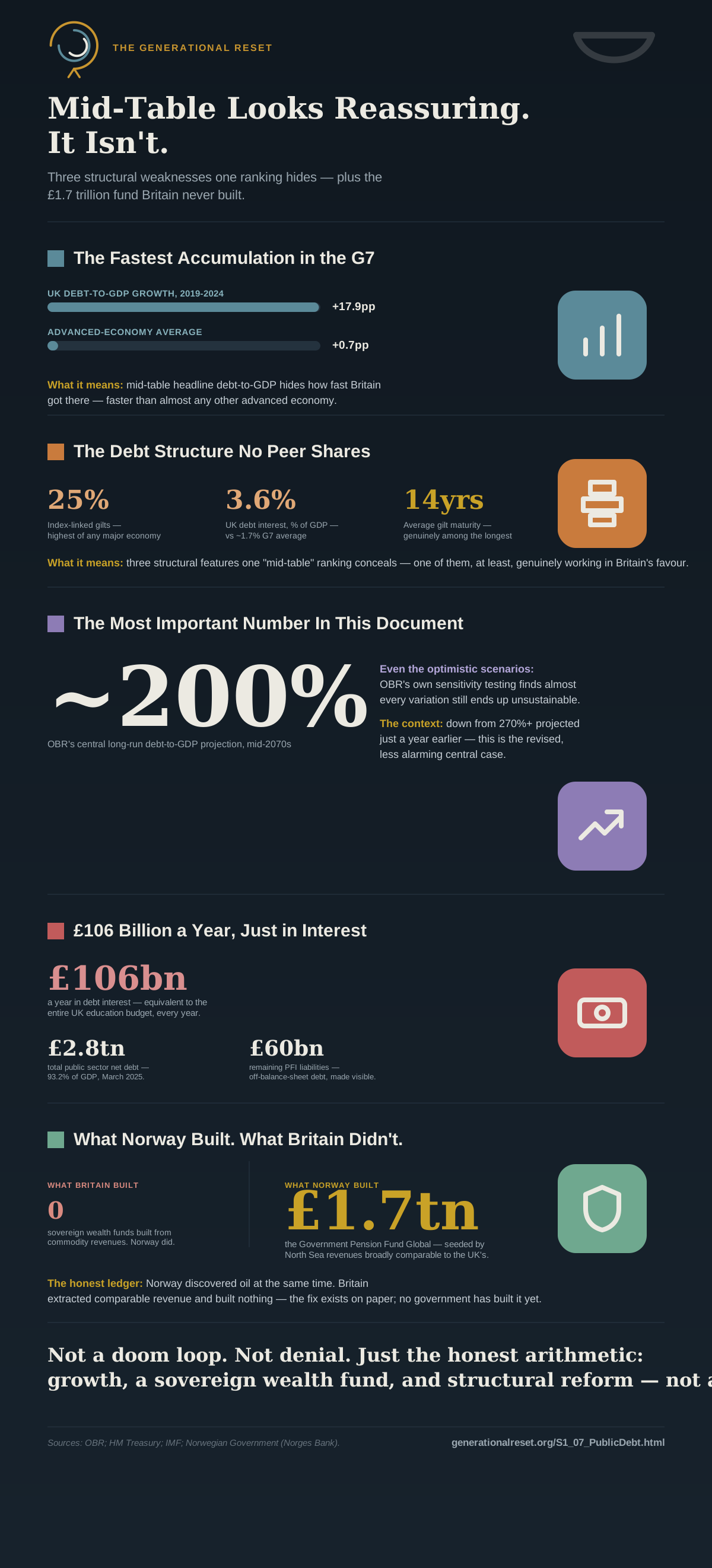
The United Kingdom's public debt stands at approximately £2.8 trillion — 93.2% of GDP. Debt interest payments reached £106 billion in 2024-25, equivalent to the entire education budget, and are projected to rise further.1 Without structural reform, the OBR's own long-run modelling puts central-case debt at around 200% of GDP by the mid-2070s — down from the 270%+ the OBR itself was projecting just a year earlier, but the OBR's own scenario testing finds "almost all" plausible variations on that central case, including notably more optimistic ones, still put the public finances "at some point" onto an unsustainable path.2
This pillar makes five arguments. First, that the UK's debt problem is structurally different from and worse than its headline G7 ranking suggests — because of the rate of accumulation, the unusually high proportion of inflation-linked debt, the cost of borrowing, and a structural current-account deficit that means the UK borrows even for day-to-day spending. Second, that the answer is not austerity — the record of 2010-2019 shows that cutting public services to hit debt targets creates its own long-run fiscal costs. Third, that economic growth is the most powerful debt reducer available and must be pursued alongside fiscal consolidation. Fourth, that a Sovereign Wealth Mechanism — seeded by real revenues from depleting assets, not by borrowing — is the structural change that would have prevented the current position and must now be built. Fifth, that a Corporate Infrastructure Compact, connecting business contribution to infrastructure investment, addresses the structural market failure that has left UK public infrastructure chronically underinvested.
This pillar does not propose a target debt-to-GDP ratio by a specific date. Arbitrary numerical targets have been set and broken eight times since 2011. What matters is the structural changes that determine whether debt rises or falls over a generation.
Key Proposals
Embed the capital-versus-current spending distinction in primary legislation. With OBR certification of economic return criteria for all borrowing classified as capital investment.
Require a plain-English Generational Debt Statement at every Budget. Debt trajectory over 10, 25, and 50 years with OBR-mandated confidence intervals, and a requirement that elected officials acknowledge the intergenerational implications.
Reduce index-linked gilt issuance toward European peer levels. A published Debt Management Office target moving toward 5–10% of new issuance over 15 years.
Establish a Sovereign Wealth Mechanism. Seeded by a rising share of revenues from depleting and time-limited assets, plus Crown Estate offshore wind lease revenue, governed independently on the Norges Bank model — with first-loss and return guarantees explicitly prohibited.
Introduce a Corporate Infrastructure Levy. Tiered, on companies above £100 million annual turnover, ring-fenced to the Sovereign Wealth Mechanism with a legally mandated infrastructure investment mandate.
Make structural current-account balance a legally binding target by 2035. With automatic parliamentary review if structural borrowing exceeds 1% of GDP for three years, and an explicit, OBR-enforced prohibition on PFI-style mechanisms.
1. The Honest Diagnosis
The UK's fiscal position sits in mid-table among G7 economies by headline debt-to-GDP.3 That comparison is misleading. Three structural features make the UK's position significantly worse than the ranking suggests.
First, the rate of accumulation. Between 2019 and 2024, UK gross debt rose by 17.9 percentage points — against an average of just 0.7 percentage points across advanced economies. The UK added debt faster than almost anyone else during that period. Second, inflation-linked exposure. Approximately 25% of UK gilts are index-linked — the highest share of any major economy by a significant margin.4 When inflation spiked in 2022-23, UK interest costs surged in ways that French, German, and US debt did not. This is a structural vulnerability that no other G7 economy replicates at this scale. Third, the structural current-account deficit. The UK borrows even for day-to-day spending, not just investment. Most comparable economies, whatever their total debt level, are closer to current balance on day-to-day spending.
2. The Norway Comparison — The Road Not Taken
Norway discovered North Sea oil at approximately the same time as the United Kingdom. The UK extracted broadly comparable revenues over roughly the same period. Norway built the Government Pension Fund Global — now worth approximately £1.7 trillion (around $2.2 trillion), as of end-20256 — by investing a defined proportion of oil revenues rather than spending them. The fund generates returns that fund Norwegian public spending. Norway has no structural current-account deficit. Its debt interest bill is negligible relative to GDP.
The UK spent its North Sea revenues.7 It ran current-account deficits throughout the period of peak extraction. It accumulated debt. It now pays £106 billion a year in interest — equivalent to what Norway's fund generates in investment returns. The contrast is not incidental. It is the central story of UK fiscal policy over the past forty years, and the primary reason this pillar proposes a Sovereign Wealth Mechanism as its central structural reform.
3. The Steel Man for Current Policy
'Debt-financed investment is not the same as debt-financed consumption'
This argument is sound and the Generational Reset accepts it. A government that borrows to build infrastructure, fund education, or invest in the energy transition may generate future economic returns that more than offset the interest cost. The current government's fiscal framework, which distinguishes the current budget from capital investment, is a more defensible position than blanket debt reduction. The Generational Reset's Reform 1 embeds this distinction in primary legislation rather than convention.
'Nominal debt comparisons obscure what matters: debt sustainability'
Correct as far as it goes. The UK has one of the deepest and most liquid sovereign bond markets in the world. Gilt maturities are among the longest of any major economy. These are genuine structural advantages. But they do not change the structural exposure to index-linked debt, the rate of accumulation, or the OBR's long-run projection. The sustainability argument justifies gradualism, not inaction.
'Austerity has a record too'
The period 2010-2019 offers a live experiment. The UK achieved modest reductions in the deficit-to-GDP ratio at significant cost: real wage stagnation, public service deterioration, regional divergence, and arguably the political conditions that produced Brexit. The OBR itself has noted that repeated fiscal tightening was repeatedly undone by shocks. The lesson is not that debt doesn't matter. It is that the method of reduction matters as much as the target. This is why this pillar does not propose austerity.
4. Rejected Instruments — And Why
4.1 Debt Monetisation
Modern Monetary Theory correctly identifies that a sovereign currency issuer cannot become insolvent in its own currency. The binding constraint is not an accounting identity but productive capacity: creating money generates excess demand and prices rise. In the UK's specific circumstances — an open economy heavily dependent on imported goods and energy, with inflation expectations still sensitive after the 2022-23 experience — monetisation would trigger currency depreciation and imported inflation in ways that would fall hardest on those with the least financial resilience. The theoretical coherence of MMT does not translate into a safe operational choice for the UK.
4.2 Financial Repression
Deliberately engineering below-market interest rates or above-target inflation to erode the real value of debt has a long historical record. It transfers wealth from savers to the state. It is rejected here not as a concept but as a deliberate policy mechanism. The reforms in this pillar aim to create the conditions for r less than g organically through growth, without requiring the Bank of England's independence to be compromised or savers to be taxed through inflation without parliamentary authority.
4.3 First-Loss Guarantees and PFI-Style Mechanisms
The Private Finance Initiative transferred £60 billion in contingent liabilities to the public balance sheet for assets whose capital value has long since depreciated.8 Any Sovereign Wealth Mechanism capitalisation that involves government underwriting private returns is PFI by another name. The Generational Reset explicitly prohibits first-loss guarantees and return guarantees as SWM funding mechanisms. The PFI lesson must be explicit, not implied.
5. The Proposed Reforms
Reform 1: Separate Capital Investment from Current Spending in Law
The current government's fiscal charter distinguishes the current budget from capital spending, but this distinction has been applied inconsistently. The Generational Reset proposes embedding this distinction in primary legislation, with the OBR required to certify that any borrowing classified as capital investment meets published criteria for expected economic return. This prevents the 'investment' label being used to exempt politically convenient current spending from fiscal discipline while ensuring that genuine long-term investment is not constrained by current-account rules.
Embed the capital investment versus current spending distinction in primary legislation. Require OBR certification of economic return criteria for all borrowing classified as capital investment. Prevent reclassification without explicit parliamentary vote.
Reform 2: A Generational Debt Transparency Statement
Every Budget and Autumn Statement to include a plain-English Generational Debt Statement setting out: the current debt stock, interest cost, and trajectory; the projected debt per working-age person over 10, 25, and 50 years under current policy; the share of current spending being borrowed and passed to future taxpayers; and the OBR's long-run demographic projection and its implications. This is a transparency obligation, not a borrowing constraint. The public cannot hold governments accountable for fiscal decisions they cannot see.
Reform 3: Reduce Index-Linked Gilt Exposure
The UK's reliance on index-linked gilts — approximately 25% of the stock — is a structural vulnerability no other major economy replicates. The Generational Reset proposes that the Debt Management Office set an explicit, published target to reduce index-linked gilt issuance as a share of new issuance over 15 years — moving toward a mix closer to European peers at typically 5-10% index-linked. This is a flow policy, not a forced redemption of existing stock. The 15-year horizon is deliberate: gradual transition minimises market disruption and gives pension funds time to adjust their hedging strategies.
Reform 4: A Sovereign Wealth Mechanism
The UK currently receives revenues from North Sea licences, spectrum auctions, bank levies, and occasional windfall taxes — and spends them as general revenue in the year of receipt. The Generational Reset proposes that a defined proportion — initially 20%, rising to 50% over a decade — of revenues from time-limited or depleting assets be ring-fenced into a Sovereign Wealth Mechanism. Not a spending fund but a debt-reduction and future-investment reserve. Norway's Government Pension Fund Global, seeded by North Sea revenues, is now worth approximately £1.7 trillion. The UK equivalent does not exist because the revenues were spent rather than saved.
The SWM must be capitalised through real revenues — commodity revenues, public asset transfers, spectrum proceeds — not through borrowing. First-loss guarantees and return guarantees are explicitly prohibited as capitalisation mechanisms. The governance model follows the Norges Bank approach: independent board, published investment mandate, OBR-audited annual accounts, and a legally mandated infrastructure investment mandate that specifies the categories of public good the SWM is required to fund.
One institution, not several. As the inheritance tax reform in Economic Renewal ramps up, its receipts are naturally lumpy year to year — a small number of large estates settling in any given year can swing the total substantially, in a way that depleting-asset revenues (North Sea, spectrum) mostly do not. Rather than standing up a second fund to manage that volatility, a defined share of inheritance tax receipts is routed into this same SWM once the transition reaches Stage 2 scale, under the identical governance and no-guarantee rules already set out above. The SWM's role for that revenue stream is specifically to smooth its volatility, not to hold it as permanent capital the way depleting-asset revenue is held — the two funding streams share one institution and one set of governance rules, not one purpose. The two-jar distinction in the Two-Jar Fiscal Framework working paper applies here: depleting-asset revenue behaves like Jar Two capital; smoothed IHT receipts behave more like a buffer for volatile ordinary revenue, and the SWM's mandate should treat them accordingly rather than blending the two into a single balance.
A third stream joins for a different reason. The Economy pillar previously proposed a separate "British Wealth Fund," seeded by Crown Estate offshore wind lease revenue, built on the same design principles as this SWM — independent governance, no current-spending access, converting a national asset return into permanent capital. Rather than stand up a second, near-identical institution under a different name, that revenue now routes into this same SWM as a third funding stream. It differs in character from both existing streams: not depleting like North Sea and spectrum revenue, and not lumpy like inheritance tax receipts, but a steady and likely growing royalty income as offshore wind capacity expands. It sits on the permanent-capital side of the SWM's mandate alongside the depleting-asset stream, not the volatility-smoothing side reserved for inheritance tax — three streams, two purposes, one institution.
Establish a Sovereign Wealth Mechanism seeded by a defined proportion of revenues from depleting and time-limited assets, plus Crown Estate offshore wind lease revenue — previously proposed as a separate British Wealth Fund in the Economy pillar, now folded into this institution as a third funding stream rather than run as a second, near-identical fund. Governed independently on the Norges Bank model. Investment mandate published, legally binding, and OBR-audited. Explicitly prohibited from using first-loss guarantees or government return guarantees as capitalisation mechanisms. From Stage 2 of the inheritance tax transition (see Economic Renewal §4), a defined share of inheritance tax receipts also routes into the same SWM, specifically to smooth the revenue's year-to-year volatility — one institution serving three funding streams and two distinct purposes under one governance framework, not three separate funds. This is the structural change that would have prevented the current fiscal position. It must now be built — belatedly — to prevent its repetition.
UK public debt stands at £2.8tn (93.2% of GDP), with debt interest payments of £106bn in 2024-25 — equivalent to the entire education budget.1 Norway's Government Pension Fund Global, seeded by North Sea revenues broadly comparable to the UK's own, is now worth approximately £1.7 trillion.6 The UK extracted comparable revenues over the same period and spent them as general revenue rather than saving any share of them.7
Norway and the UK started from comparable resource endowments and diverged only in institutional choice, not in the resource itself — this is the project's own connecting argument built on the facts above, not a finding any single source states on its own. The absence of any ring-fencing mechanism meant depleting-asset revenue was treated identically to any other year's tax receipts, available for whatever spending pressure was largest at the time; the £106bn annual interest bill is presented here as the accumulated cost of that institutional gap, not of the underlying resource being smaller or less valuable than Norway's.
The causation above is compatible with responses well beyond a sovereign wealth mechanism, two of which this pillar itself names and rejects directly in §4: debt monetisation, coherent in Modern Monetary Theory's own terms but rejected here as unsafe for an import-dependent open economy with inflation expectations still sensitive after 2022-23; and financial repression — engineering below-market rates to erode debt's real value — rejected as a deliberate transfer from savers to the state. A third option this pillar doesn't formally reject but structurally continues past unless changed: keep treating depleting-asset revenue as ordinary annual receipts, the status quo that produced the current position.
Choosing a ring-fenced, independently-governed SWM over monetisation, financial repression, or continuing to spend depleting-asset revenue as general receipts reflects a value judgement this pillar makes explicitly: that binding a future government's hands — via independent governance and an explicit no-guarantee rule — is worth the loss of near-term fiscal flexibility, because that same flexibility is what allowed North Sea revenue to be spent the first time. A reader who trusts future governments to exercise that flexibility responsibly, or who judges monetisation's inflation risk as overstated for the UK's specific circumstances, is not wrong on the evidence — they are weighing the same facts against a different value about how much discretion the state should retain.
A Sovereign Wealth Mechanism seeded by a rising share of depleting and time-limited asset revenue — 20% initially, rising to 50% over a decade — plus Crown Estate offshore wind lease revenue and, from Stage 2 of the inheritance tax transition, a volatility-smoothing IHT stream; governed independently on the Norges Bank model with first-loss and return guarantees explicitly prohibited. The falsification test below is what would show the institutional protections aren't actually holding.
Reform 4b: The Corporate Infrastructure Compact
Companies operating in the UK externalise a significant portion of the infrastructure costs they consume. They benefit from publicly educated workers without bearing the full cost of that education. They use roads, power grids, digital infrastructure, and the NHS without internalising their contribution to demand on those systems. This is a structural market failure and one of the reasons UK public infrastructure has been chronically underinvested relative to peers.
The Generational Reset proposes a tiered Corporate Infrastructure Levy — applied to companies above £100 million annual turnover — with the rate linked to sector-specific infrastructure dependency. Energy-intensive manufacturers, large logistics operators, data centres, and financial services consume infrastructure differently and should contribute accordingly. The surplus above the current corporation tax rate flows directly into the SWM with a legally mandated infrastructure investment mandate. The return to companies is not a cash rebate — it is a more productive operating environment.
Reform 5: End Structural Current-Account Borrowing by 2035
The OBR projects the current budget moving into surplus by 2030-31 under current plans — but this has been projected and missed repeatedly. The Generational Reset proposes that structural current-account balance become a legally binding target enforced through automatic stabiliser mechanisms: if the OBR certifies that structural borrowing on the current account will exceed 1% of GDP for three consecutive years, a mandatory parliamentary review is triggered — requiring an explicit vote on any deviation. This is not austerity by default. It is accountability by design. Escape clauses for certified national emergencies must be defined in legislation rather than at ministerial discretion to prevent abuse.
6. What This Is Not
This pillar does not propose austerity. Cuts to public services to hit an arbitrary debt number is not the reform proposed here. The track record of 2010-2019 shows that austerity without structural reform creates its own long-term fiscal costs through underinvestment, lower productivity, and reduced economic participation. The Generational Reset targets structural causes: the index-linking problem, the absence of a sovereign wealth mechanism, the conflation of investment and consumption, the political invisibility of intergenerational debt transfer, and the failure of corporations to contribute to the infrastructure their businesses depend upon.
7. Counter-Arguments
'A Sovereign Wealth Mechanism is just borrowing to invest, with extra steps'
The distinction that matters is not whether the state is spending money — under both borrowing and the SWM, it is — but whether that spending converts into a permanent financial asset earning a return, or is simply consumed and gone. The SWM is seeded by real revenues: a rising share of depleting-asset income, Crown Estate offshore wind lease revenue, the Corporate Infrastructure Levy, and a share of inheritance tax receipts from the Economic Renewal pillar. None of that requires issuing new debt, and first-loss and return guarantees are explicitly prohibited by design. Debt-financed investment adds a liability with no offsetting asset. The SWM adds an asset that can outlive the revenue stream that seeded it — which is exactly what Norway's £1.7 trillion fund is.
'Norway's fund worked because North Sea oil revenue was booming when it was built — the UK is proposing the same idea decades after its own oil boom ended, with little revenue left to seed it'
True of oil specifically, and this pillar does not pretend otherwise — North Sea Exchequer revenue is a fraction of its 2008 peak. But the SWM is not built on oil and gas alone: it pools revenue from Crown Estate offshore wind leases, a genuinely new and growing income stream Norway never had access to when it built its own fund, alongside the Corporate Infrastructure Levy and a share of inheritance tax receipts from the wealth transfer already underway. The UK missed its oil-era window. That is not the same as having missed every window since.
'A Corporate Infrastructure Levy on large companies will simply be passed through to workers and consumers, the same way other business taxes are'
This is a real economic risk, not one to wave away — taxes that formally land on a company's balance sheet routinely pass through to wages and prices to some degree. Three things distinguish this proposal from an equivalent flat tax rise, though. It applies only above a £100 million turnover threshold, concentrating any pass-through pressure on the firms best able to absorb it rather than smaller employers. It is ring-fenced specifically to the infrastructure investment those same large employers depend on to operate, rather than disappearing into general taxation. And unlike ordinary tax revenue, every pound raised converts into a permanent SWM asset rather than being spent once. Some pass-through is likely. Leaving the infrastructure investment gap unfunded has its own pass-through cost, in higher long-run borrowing rates and slower growth.
Cross-Pillar Dependencies
| Pillar | Connection |
|---|---|
| Political Renewal | The Generational Debt Statement — requiring politicians to acknowledge the intergenerational transfer in every budget — requires a Parliament willing to impose obligations on itself. The structural current-account balance target requires cross-party commitment that proportional representation makes structurally more achievable than under a system producing alternating majority governments with opposed fiscal ideologies. |
| Public Office Covenant | Elected officials approving budgets that transfer debt to future generations should be required to acknowledge that transfer explicitly. The Covenant's transparency and accountability principles extend naturally to fiscal decision-making via the Generational Debt Statement. |
| NHS | NHS capital backlog at £15.9 billion is a direct contributor to the long-run debt trajectory. An ageing population's health costs are the largest single driver of the OBR's ~200% of GDP long-run projection. Healthcare reform that shifts toward prevention and reduces demand growth is essential to long-run fiscal sustainability. The Corporate Infrastructure Compact explicitly funds health infrastructure. |
| Education | Productivity growth is the most durable long-run debt reducer. A better-educated workforce generates higher tax revenues and lower welfare costs. The SWM's infrastructure mandate should include skills infrastructure as a primary investment category. |
| Welfare | Welfare spending — particularly the state pension triple lock — is a large and growing current-account cost. The structural balance target in Reform 5 cannot be met without explicit decisions in the Welfare pillar about long-run pension and benefit trajectories. These two pillars must be read together on the fiscal arithmetic. |
| Economic Renewal | From Stage 2 of the inheritance tax transition, a defined share of IHT receipts routes into this pillar's SWM alongside its original depleting-asset revenue — one institution, two funding streams, used for two distinct purposes (permanent capital from depleting assets; volatility-smoothing for IHT receipts). This is a shared institution, not a shared purpose — the SWM's investment mandate should keep the two streams accounted separately even while pooling their governance. |
| Economy | Low GDP growth makes debt ratios worse even if the nominal debt stock is flat. The Economy pillar must be read alongside this one — growth is not an alternative to fiscal discipline but its most reliable complement. The r less than g dynamic is the most powerful debt reducer available. Economy's previously separate British Wealth Fund proposal (Crown Estate offshore wind lease revenue) is now folded into this pillar's SWM as a third funding stream, rather than run as a second, near-identical institution — see Reform 4 above. |
| Housing | Land value capture is a revenue mechanism directly relevant to the SWM. The 116x uplift from agricultural to residential planning permission is currently a private windfall. Redirecting a portion of it into the SWM is one of the largest available fiscal reforms that requires no new taxation — only the redirection of publicly created value. |
| Energy | The SWM's primary funding source includes commodity and windfall revenues. The fiscal regime for new North Sea licences should include the SWM contribution as a condition of licensing, not as an afterthought. Energy pillar and Public Debt pillar must be co-designed on North Sea transition revenue. |
| Defence | Resilient digital and physical infrastructure funded by the SWM has dual-use value for national security. The Corporate Infrastructure Compact's investment mandate should be coordinated with the Defence pillar's infrastructure requirements. |
| Criminal Justice | The MoJ received the largest proportional real-terms cut of any department between 2007 and 2024. The downstream costs of that underinvestment — welfare claims, NHS demand, lost productivity from reoffending — appear across multiple budget lines. The Public Debt pillar's framework should make these downstream costs explicit. |
9. Proposals for Change
The following represent the evidence-based proposals of this pillar, put forward for public discussion and challenge.
-
Embed the capital investment versus current spending distinction in primary legislation, with OBR certification of economic return criteria for all borrowing classified as capital investment.
-
Require a plain-English Generational Debt Statement at every Budget and Autumn Statement, setting out debt trajectory over 10, 25, and 50 years, with OBR-mandated confidence intervals. Require elected officials to acknowledge the intergenerational implications.
-
Set an explicit, published Debt Management Office target to reduce index-linked gilt issuance as a share of new issuance over 15 years, moving toward European peer levels of 5-10%.
-
Establish a Sovereign Wealth Mechanism seeded by a defined proportion of revenues from depleting and time-limited assets — initially 20% rising to 50% over a decade. Governed independently on the Norges Bank model. First-loss guarantees and return guarantees explicitly prohibited as capitalisation mechanisms.
-
Introduce a tiered Corporate Infrastructure Levy on companies above £100 million annual turnover, ring-fenced to the SWM with a legally mandated infrastructure investment mandate covering skills, health infrastructure, energy grid, and digital connectivity.
-
Make structural current-account balance a legally binding target by 2035, with automatic parliamentary review triggered if the OBR certifies structural borrowing exceeding 1% of GDP for three consecutive years. Escape clauses for certified national emergencies defined in legislation, not at ministerial discretion.
-
Publish an explicit prohibition on PFI-style mechanisms — first-loss guarantees and return guarantees — as instruments of public investment, with OBR required to flag any proposed mechanism that replicates PFI economics under a different name.
The UK's debt position is the accumulated arithmetic of a series of individually defensible decisions, none of which was made with a view to what the fiscal position would look like forty years later. Norway made different choices with comparable resources and built a £1.7 trillion sovereign wealth fund. The UK paid £106 billion in interest last year. The lesson is not complicated. The reform is.
The Generational Reset is a non-partisan, public-interest project. It is not affiliated with any political party, does not accept corporate funding, and publishes all its work under open licence for public discussion and adaptation.
All figures sourced from ONS, OBR, and IMF (2025-26 fiscal year and March 2026 Economic and Fiscal Outlook unless otherwise stated) | For public discussion. Not affiliated with any political party. | generationalreset.org
The Generational Reset | S1_07: Public Debt | For public discussion. Not affiliated with any political party. | generationalreset.org