Executive Summary
The United Kingdom's commitment to universal healthcare — free at the point of use, available to all regardless of income — is correct. It was right in 1948. It is right now. No serious argument has been made against the founding principle, and this pillar does not make one.
The problem is not the strategy. The problem is that Britain has never properly funded it, never fixed the structural failures that prevent it from working, and never been honest with the public about the gap between what the NHS is promised and what it can actually deliver.
This pillar makes five arguments. First, that the NHS is genuinely underfunded relative to comparable countries — a gap that is a policy choice, not an economic inevitability. Second, that it is also structurally inefficient relative to its own funding level — underfunding and underperformance compound each other and must be addressed together. Third, that the social care failure is not a separate problem but the upstream cause of a significant proportion of NHS dysfunction, and that a quarter-century of political cowardice on this question has made it dramatically more expensive. Fourth, that the immigration debate around the NHS is almost entirely backwards — the data shows immigrants use fewer services, contribute fiscally, and staff the system at a level that makes it viable. Fifth, that the honest conversation the public deserves — about how much of collective national income to devote to health, and through what mechanism — has never been had.
None of this requires abandoning the NHS or introducing charges at the point of use. It requires honesty, structural reform, and the political courage to fund what we have consistently promised.
Key Proposals
Fund the NHS honestly. Raise per capita health spending over a defined parliamentary term toward French levels, with a published trajectory and independent verification of progress.
Bring social care into a national funding framework. Legislate a cap on lifetime care costs, raise and index the means test threshold, and fund the transition through a hypothecated social care levy.
Fund the Long Term Workforce Plan in full. Named, verified milestones; expanded clinical placement capacity before student numbers rise; published annual retention targets tied to working conditions.
Fix the GP system structurally. Extend minimum consultation time, fund the transition away from the collapsing partnership model, and significantly expand Pharmacy First as a genuine first-contact tier.
Fix the institutional infrastructure. A statutory independent NHS Procurement Authority, NICE's independence protected in primary legislation, and an IT investment plan toward genuine interoperability.
Remove the tax subsidy for employer-provided private healthcare. End corporation tax deductibility of premiums and the benefit-in-kind NI exemption, and reinvest the revenue in NHS capacity — not a ban, a level playing field.
1. The Honest Diagnosis
The NHS isn't failing for want of commitment — the public's attachment to it is genuine and cross-party. It's failing because the gap between what it's promised and what it's funded to deliver has been allowed to grow, year by year, beneath a layer of political performance that treats honest diagnosis as a form of betrayal.
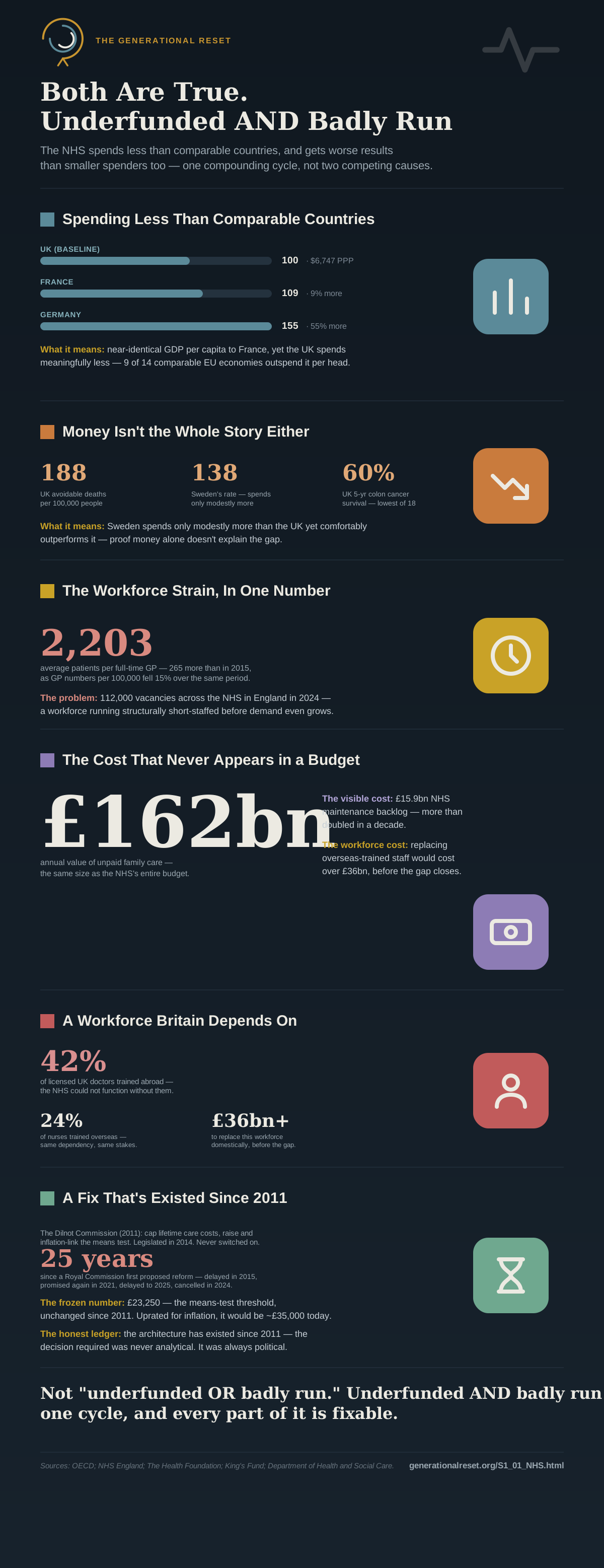
The international data makes the underfunding argument clearly. France — near-identical GDP per capita — spends roughly 9% more per person on health ($7,367 vs $6,747 PPP, OECD's latest figures). Germany spends 55% more through public funding. Nine of the fourteen comparable EU economies spend more per head than the UK. The UK's capital investment in health infrastructure ranks near the bottom of the OECD. These are not small differences. They accumulate into the backlog, the waiting lists, the crumbling buildings, and the IT systems that cannot talk to each other.
But underfunding is not the complete explanation — and intellectual honesty requires saying so. Sweden spends modestly more than the UK and consistently outperforms it on avoidable mortality, preventable hospital admissions, cancer survival, and GP satisfaction. Germany spends dramatically more and achieves middling outcomes. The UK spends mid-table and gets below-table results — which means that some of the failure is structural, not just financial.
Both things are simultaneously true: underfunded and underperforming. The political debate has treated these as competing claims. They are compounding failures that reinforce each other in a specific cycle. Capital starvation produces operational inefficiency. Operational inefficiency wastes resource. Wasted resource creates political resistance to further investment.
The UK spends 9% less per capita on health than France, a country with near-identical GDP per capita ($6,747 vs $7,367 PPP), and 55% less than Germany.1 Yet Sweden, which spends only modestly more than the UK, consistently outperforms it: UK avoidable mortality stands at 188 per 100,000 against Sweden's 138, and the UK's five-year colon cancer survival rate (60%) is the lowest of 18 OECD comparator countries.2
Money alone doesn't explain the outcomes gap — Sweden's example rules that out directly. But underfunding doesn't explain it alone either: UK capital investment in health infrastructure ranks near the bottom of the OECD, producing a £15.9bn maintenance backlog3 and IT systems that cannot share records across 9.1% of patient interactions. This project's own connecting argument, not a finding any single source states on its own: capital starvation produces operational inefficiency; operational inefficiency wastes the resource that is available; wasted resource then fuels the political case against funding the system properly — one compounding cycle, not two separate, competing failures.
The causation above is compatible with several different responses, not only this pillar's own: fund the current model to French levels without structural reform; reform the system's structure and processes without material extra funding — the framing this pillar's own opening explicitly rejects; or move away from general-taxation funding toward a social insurance model closer to France's or Germany's, an option this pillar addresses directly and calls "genuinely mixed" on the evidence.
Choosing to fund and reform simultaneously, while keeping general-taxation funding and free-at-point-of-use, reflects a value judgement this pillar makes explicitly rather than presenting as settled by the evidence alone: that removing the cost barrier to care matters enough to defend general taxation as the funding mechanism, even though this pillar's own data shows France's different funding mechanism achieves better outcomes per pound spent. A reader who weighs funding-mechanism efficiency more heavily than universal, barrier-free access is not wrong on the evidence — they are weighing the same facts against a different value.
Raise per-capita health spending toward French levels over a defined parliamentary term while simultaneously funding the structural fixes named elsewhere in this pillar — social care, workforce retention, procurement and IT — on the theory that funding alone or reform alone would each independently fail to break the compounding cycle. The falsification test below is what would show this specific combined, simultaneous approach isn't working.
2. What the NHS Actually Is — The Steel Man
The case for the NHS — made honestly and in full — is stronger than the public discourse of crisis typically acknowledges. Before the structural failures are named, the genuine achievements deserve to be stated plainly.
2.1 The Founding Principle Remains Correct
Healthcare free at the point of use, available to all regardless of income, is one of the most civilised commitments a society can make. No other design so completely removes the barrier of cost from the decision to seek medical help. The NHS's consistently high ranking on equity and access in international comparisons — including from the generally critical Commonwealth Fund4 — reflects this. The point-of-use cost barrier that deters people in the United States, burdens French patients with upfront payments, and charges German patients a co-payment for each GP visit does not exist in Britain. That is a genuine achievement.
2.2 Genuine Clinical Excellence
The NHS contains pockets of genuine clinical excellence that rival any health system in the world. Its trauma care is among the best in existence — the Major Trauma Centre network has materially reduced mortality from serious injuries. Its organ transplant programmes, specialist cancer centres, and infectious disease response — demonstrated most dramatically during COVID-19 — represent institutional capability built over decades. The COVID-19 vaccination programme was one of the most successful mass public health operations in the world. The UK vaccinated its adult population faster than any comparable nation, using the NHS's existing infrastructure and trusted patient relationships. No system of fragmented insurers and competing providers could have done it at that speed and scale.
2.3 The Workforce That Carries It
1.55 million people work in the NHS — the largest employer in Europe. The majority entered their profession from a genuine commitment to care. That reservoir of commitment has been systematically depleted by two decades of real-terms pay restraint, impossible workloads, and administrative burden — but it has not been exhausted. The international workforce that has joined the NHS — 42% of licensed doctors trained abroad5, 24% of nurses6 — is part of this asset. Their contribution is measurable in millions of patient contacts and unmeasurable in institutional culture.
2.4 The NICE Model
The National Institute for Health and Care Excellence is a genuine world-class institution. It makes explicit, evidence-based, publicly transparent decisions about which treatments the NHS will fund using the Quality-Adjusted Life Year as a standardised measure of benefit. It has been adopted as a reference model by Ireland, the Netherlands, Belgium, and Scandinavia. It demonstrates what the NHS can achieve when an institution is given clear authority, a defensible methodology, genuine power to make decisions, and independence from short-term political pressure.
3. The Funding Reality
3.1 What the UK Actually Spends
NHS England's budget in 2024/25 is approximately £165 billion. Including Scotland, Wales, and Northern Ireland, total UK public health expenditure reaches approximately £242 billion. Measured as a share of GDP, the UK spends 11.1% on health — broadly comparable to France and the Netherlands. But this headline comparison conceals a critical distinction: the UK's spending is tilted heavily toward current account — wages, drugs, consumables — with capital investment near the bottom of the OECD. Systems that invest consistently in infrastructure do not accumulate a £15.9 billion maintenance backlog3 or run IT so fragmented that 9.1% of patient interactions involve presenting at a hospital with no access to prior records.
3.2 What the Gap Produces
The gap between UK spending and peer-country spending translates directly into outcomes. Avoidable mortality — deaths preventable through timely healthcare — stands at 188 per 100,000 in the UK, against 138 in Sweden. The UK's five-year colon cancer survival rate is 60%, the lowest of 18 OECD comparators. These are not marginal statistical differences. They represent tens of thousands of preventable deaths each year.
4. The Workforce Crisis
4.1 The Numbers
The NHS in England had approximately 112,000 vacancies in 2024. The GP workforce has fallen by 15% in qualified full-time-equivalent terms per 100,000 population since 2015. The average GP now has 2,203 registered patients — 265 more than in 2015. The Long Term Workforce Plan, published in 2023, acknowledges the scale of the problem but its funding has not been confirmed beyond the first year.
4.2 The International Recruitment Dependency
42% of licensed doctors in the UK qualified abroad.5 24% of nurses trained overseas.6 Around 66% of new doctors joining the register in 2024 were internationally trained. The NHS could not function without this workforce. Replacing the overseas-trained clinical workforce domestically would cost approximately £22.6 billion in medical training costs alone, plus approximately £14.1 billion for nurses — a combined total equivalent to more than 20% of the entire annual NHS England budget, before accounting for the decade-long gap in supply during which the system would be operating with catastrophic shortages. The immigration debate around the NHS consistently ignores this arithmetic.
4.3 The Retention Crisis
The leaver rate has averaged 11% since 2011. More than half of NHS leavers are voluntary resignations. The 2024 NHS staff survey found 42% of medical and dental staff experience work-related stress, 30% feel burnt out, and 63% regularly work beyond their rostered hours. Training more people into a system with 11% annual attrition will not close the gap. It produces an expensive treadmill where the training pipeline fills one end of a leaking bucket. The retention environment — working conditions, administrative burden, pay, career development — must be addressed simultaneously with pipeline expansion.
Fund the Long Term Workforce Plan with named, verified milestones — not aspirational targets. Expand clinical placement capacity before increasing student numbers. Treat retention as a system metric with the same seriousness as recruitment: attrition targets, published annually, with accountability for the working conditions that drive them.
5. Social Care — The Failure That Powers Every Other Failure
Social care isn't a separate issue from the NHS crisis — it's the upstream cause of a significant proportion of it. And unlike the other failures documented here, which are largely failures of execution or resource allocation, the social care failure is predominantly a failure of political will, sustained across every government of every party for more than a quarter of a century.
5.1 The NHS Impact
In February 2024, an average of 13,662 patients were stuck in hospital every day7 despite being medically fit to leave — in some trusts, one in three beds. The direct cost of those delayed discharges has risen from an estimated £1.89 billion in 2022/23 to £2.7 billion in 2025/26, up 7.5% on the year before.7 Those occupied beds represent cancelled operations, growing waiting lists, and secondary care capacity consumed by people who should be in care homes or at home with a support package.
5.2 The Funding Reality
Between 2010 and 2023, local authority spending on adult social care grew by 12.3% — an average of 1% per year — against inflation rates far higher. The Health Foundation's REAL Centre models two distinct funding scenarios, not one trajectory: a "meet demand only" scenario reaching £8.3bn of underfunding by 2032/33, and a more ambitious "meet demand plus improve access and fund the full cost of care" scenario reaching £18.4bn.11 Median care worker pay in the independent sector was £12.00 per hour in March 2025 — 56 pence above the National Living Wage. 8.3% of social care roles were vacant in 2023/2412 — approximately 131,000 vacancies, roughly three times the rate in the wider economy.
5.3 The Political History
Tony Blair's government established the Royal Commission on Long Term Care in 1997. The Dilnot Commission published its recommendations in 2011. The Care Act 2014 legislated a version of those reforms. Implementation was delayed in 2015, promised again in 2021, delayed to 2025, and cancelled in July 2024. The means test threshold has been frozen at £23,250 since 2011 — a figure that would be approximately £35,000 if uprated for inflation. Average monthly care costs are now £5,000. The political economy of this failure is precise: social care reform costs money upfront and delivers benefits dispersed across multiple departments, multiple years, and multiple electoral cycles.
A national funding framework for social care — bringing it out of local authority means-testing into a nationally funded, universally available entitlement with a cap on lifetime care costs, a means test threshold uprated and indexed to inflation, and a minimum fee rate set nationally. The Dilnot framework is the right architecture. It has been identified, agreed, and legislated for over a decade. The decision required is not analytical. It is political.
6. Immigration and the NHS — What the Data Actually Shows
The narrative that immigrants burden the NHS is one of the most persistent and least evidenced claims in British public life. The honest picture has three components — demand, fiscal contribution, and workforce — and all three point in the same direction.
6.1 Demand
The most comprehensive analysis found that migrants use inpatient hospital services around half as much as UK-born residents of the same age and gender in the years following arrival. Health tourism — people coming specifically to use NHS services without contributing — was estimated to cost approximately 0.3% of total annual health spending. 32% of UK adults believe immigrants use NHS services more than the UK-born population. 70% believe immigrants place extra pressure on the NHS. The evidence consistently shows the opposite.
6.2 Fiscal Contribution
Migrants on work, family, or study visas pay the Immigration Health Surcharge — £1,035 per person per year in 2024. The government raised £1.7 billion in surcharge revenue in 2023/24 and £6.9 billion since 2015.13 Migrants in employment also pay income tax and National Insurance. The OBR projects that higher net migration leads to lower deficits and debt, primarily because incoming migrants are more likely to be of working age and contributing to public finances.
6.3 Workforce
42% of licensed doctors in the UK qualified abroad. 24% of nurses trained overseas. Replacing this workforce domestically would cost over £36 billion in training costs before accounting for the decade-long supply gap. The net QALY impact of a restrictive immigration policy on the NHS would be negative — not because immigrants consume fewer resources, but because the workforce loss would reduce the system's total capacity to deliver care to the entire population.
7. Private Healthcare — The Structural Exit Argument
Private healthcare in Britain is overwhelmingly an employment benefit rather than a consumer choice, which means access to it tracks employment type, sector, and seniority rather than individual preference or healthcare need. In 2024, 7.6 million people held private medical insurance, up from 6.7 million in 2020. 4.8 million are covered through employer-provided schemes — the highest in more than 30 years of data collection. Health insurers processed a record £4 billion in claims in 2024. The explicit driver cited by industry: businesses stating they can no longer rely on the NHS to ensure the good health of their employees.
The structural argument is this: when those with the greatest political voice — senior professionals, business owners, well-connected employees — can partially exit the public system, the political pressure for its improvement dissipates. They still pay taxes that fund the NHS. They simply do not use it, and therefore have a reduced personal stake in its performance. This is the same structural dynamic the Education pillar identifies in private schooling. The partial exit of the politically influential reduces the pressure for improvement that their full presence would create.
The Generational Reset does not propose banning private healthcare. It proposes removing the tax advantages that currently subsidise it — corporation tax deductibility of employer premiums, and the benefit-in-kind NI exemption — and reinvesting the revenue in NHS capacity. The steelman for the existing arrangement is that employer healthcare reduces NHS demand and keeps people in work. The honest response is that this benefit accrues primarily to higher earners while the NHS deteriorates for everyone else.
8. Procurement and IT — The Infrastructure of Failure
8.1 Procurement
The NHS spends approximately £30 billion a year through procurement. It is one of the largest purchasing organisations in the world. In theory, that scale confers enormous negotiating power. In practice, the NHS consistently fails to use it. NHS Supply Chain — the central procurement body — covers only around 40% of NHS purchasing. The remainder is procured locally, by individual trusts, at prices that vary by as much as 34% for identical products. The government's own estimates suggest poor procurement costs the NHS £1 billion or more annually.
8.2 IT and Electronic Patient Records
NHS trusts now choose from 40 different approved electronic patient record suppliers. Those systems frequently cannot communicate with each other. On over 11 million occasions — 9.1% of all patient interactions — patients presented to a hospital using a different EHR system than at their previous attendance. Clinicians cannot see prior test results, medication histories, or diagnoses. Tests are repeated. Errors are made. Nearly 30% of clinicians' working hours are spent navigating fragmented systems rather than engaging with patients.
8.3 NICE — The Exception That Proves the Rule
NICE represents what the rest of NHS procurement lacks: clear institutional authority, a publicly defensible methodology, genuine power to say no to suppliers, and independence from short-term political pressure. The December 2025 pharmaceutical pricing deal — raising the NICE threshold by 25% under pressure from the US government and pharmaceutical industry, at an estimated long-term cost of close to £64 billion — is a warning. An institution whose independence depends on political protection is an institution whose independence can be compromised.
Establish a statutory independent NHS Procurement Authority with genuine power to set and enforce purchasing standards across trusts. Protect NICE's methodological independence explicitly in legislation: future threshold changes must be made through transparent evidence review of NHS opportunity cost, not through bilateral commercial or political negotiation.
9. Counter-Arguments
'The NHS just needs more money — structural reform is a distraction'
Underfunding is real and documented. But the international evidence does not support the proposition that money alone closes the gap. The UK already spends 11.1% of GDP on health — comparable to France and the Netherlands in aggregate. The outcomes gap reflects structural inefficiency as well as financial inadequacy. Both need to be addressed. Treating reform as opposition to investment misreads the argument.
'Reducing immigration will free up NHS capacity'
The data does not support this. Migrants use NHS services at approximately half the rate of UK-born residents in their early years of residence. They pay the Immigration Health Surcharge and contribute through income tax and National Insurance. They constitute 42% of licensed doctors and 24% of nurses. The net effect of significant immigration reduction on NHS capacity would be negative — the workforce loss would exceed the demand reduction. Reducing immigration would make the waiting list problem worse, not better.
'A social insurance model would work better than tax funding'
The evidence on social insurance models is genuinely mixed. Germany's system costs 55% more per capita than the UK's and achieves middling outcomes. France's model achieves better outcomes but with significant administrative overhead and patient co-payments. The founding principle — free at the point of use — is worth protecting. The funding mechanism question is legitimately open. The honest answer is that any mechanism capable of delivering adequate funding would be an improvement on the current political cycle of underfunding.
Cross-Pillar Dependencies
| Pillar | Connection |
|---|---|
| Political Renewal | The five-year political cycle is the primary reason social care reform has failed for 25 years. NICE threshold politicisation and GP workforce targets missed without consequence — both are sustained by political incentive structures the Political Renewal pillar addresses. PR and longer-horizon coalition governance changes the time horizon of NHS investment decisions. |
| Public Office Covenant | Private healthcare holdings among MPs and ministers setting NHS policy, NICE thresholds, and private sector regulation represent structural conflicts of interest. Mandatory financial disclosure makes these visible and politically costly — changing behaviour without requiring proof of intent. |
| Education | CAMHS reform and child mental health workforce expansion are prerequisites for the Education pillar's mental health practitioner in every primary school commitment. The healthcare pillar must deliver the workforce; the education pillar provides the access point. Health visitor numbers are an NHS workforce problem with direct educational consequences. |
| Welfare | The disability caseload cannot be reduced without clearing NHS waiting lists. In 2024, 7.6 million people were on NHS waiting lists. People waiting years for treatment cannot work and claim disability benefits while they wait. The OBR and IFS have both identified waiting list clearance as one of the most cost-effective long-run welfare savings available — not because it removes entitlement, but because it removes the health condition preventing employment. |
| Economy | Low wages and insecure work are primary drivers of the health outcomes gap, the mental health crisis, and the preventable hospitalisation rate. The wages and work compact is simultaneously a health policy. The NHS workforce crisis is itself partly a wages and working conditions failure that the Economy pillar's structural wage reforms are needed to address. |
| Housing | Housing is a primary social determinant of health. The mental health consequences of housing insecurity, the developmental harm to children in temporary accommodation, the physical health consequences of cold, damp, and overcrowded homes — all generate NHS cost that housing reform would prevent. 130,000 children in temporary accommodation is an NHS demand problem as well as a housing one. |
| Public Debt | NHS capital backlog at £15.9 billion is a direct contributor to long-run debt trajectory. An ageing population's health costs are the largest single driver of the OBR's long-run debt projection. Healthcare reform that shifts toward prevention and reduces demand growth is essential to long-run fiscal sustainability. |
| Criminal Justice | One million police hours per year are consumed by mental health welfare checks and Section 136 detentions. 72% of prisoners have two or more mental health conditions. NHS mental health capacity is a direct criminal justice input. The criminal justice system cannot address reoffending driven by untreated mental illness without the healthcare system addressing its upstream causes. |
| Energy | NHS estate is one of the largest energy consumers in the public sector. Energy efficiency investment in NHS buildings connects the Energy pillar's net zero programme to NHS capital backlog reduction and running cost reduction simultaneously. |
11. Proposals for Change
The following represent the evidence-based proposals of this pillar, put forward for public discussion and challenge. They are not a programme for government — they are the case the evidence supports.
-
P1 Fund the NHS honestly — increase per capita health spending over a defined parliamentary term toward French levels, with a published trajectory, independent verification of progress, and an explicit account of what the funding gap currently costs in patient outcomes.
-
Bring social care into a national funding framework — legislate a cap on lifetime care costs, raise and index the means test threshold, set minimum fee rates nationally, and fund the transition through a hypothecated social care levy. The Dilnot architecture is available. The decision required is political.
-
Fund the Long Term Workforce Plan with named, verified milestones. Expand clinical placement capacity before increasing student numbers. Publish annual retention targets with accountability for working conditions.
-
P4 Fix the GP system structurally — extend minimum consultation time, fund transition away from the collapsing partnership model, and significantly expand Pharmacy First as a genuine first-contact tier.
-
Establish a statutory independent NHS Procurement Authority with genuine power to set and enforce purchasing standards, ending the governance middle ground of responsibility without authority.
-
Protect NICE's independence in primary legislation — future threshold changes through transparent evidence review, not bilateral commercial or political pressure.
-
Invest in NHS IT infrastructure toward genuine interoperability — open standards, 100% EPR coverage with data sharing, and a funded plan to reduce the 30% of clinical time consumed by navigating fragmented systems.
-
Remove the tax advantages that subsidise employer-provided private healthcare — corporation tax deductibility of premiums and the benefit-in-kind NI exemption — and reinvest the revenue in NHS capacity. Not a ban. A level playing field.
-
Publish an honest annual NHS performance report to Parliament — comparing UK outcomes against peer systems, tracking progress against stated commitments, and naming the gap between political promise and operational reality.
The question for the NHS is not whether the strategy is right. Universal healthcare, free at the point of use, is the correct commitment for a civilised society. The question is whether Britain has the institutional honesty and political courage to fund it, fix it, and tell the public the truth about what it costs and what it delivers. The evidence in this pillar says it can. The history of the past twenty-five years says it has not.
The Generational Reset is a non-partisan, public-interest project. It is not affiliated with any political party, does not accept corporate funding, and publishes all its work under open licence for public discussion and adaptation.
For public discussion. Not affiliated with any political party. | generationalreset.org
The Generational Reset | S1_01: The National Health Service | For public discussion. Not affiliated with any political party. | generationalreset.org