This document sits in Section Four — Forces Shaping Britain’s Future. Artificial intelligence is not a technology story. It is a political economy story: about who captures the gains, who bears the costs, and why the absence of democratic discussion about both is not an accident.
Executive Summary
Something without precedent in modern economic history is underway. The productive value of human cognitive labour — the foundation on which the UK’s tax system, welfare state, and social contract were built — is being systematically transferred to a small number of private corporations, the overwhelming majority of them American, at a pace and scale that no democratic institution has debated, authorised, or constrained.
This is not a forecast. It is the current position. Microsoft’s Copilot is deployed across the UK’s largest employers. Google’s Gemini is embedded in productivity tools used by millions of UK workers. Amazon Web Services hosts the AI infrastructure on which UK businesses run.1 The displacement of cognitive labour has begun. The income tax base it sustained is beginning to erode. The profits flow to American shareholders. The UK receives the productivity gain and loses the wage income simultaneously — a structural transfer with no political name and no democratic response.
This pillar makes four arguments. First, that AI is not primarily a technology question but a political economy question: the central issue is not what AI can do, but who owns it, who captures its returns, and on whose terms it is deployed. Second, that the silence around these questions is not an oversight — it is the predictable consequence of those who benefit from the current trajectory having every incentive to frame it as technical progress rather than political choice. Third, that the UK faces a specific and acute version of this problem: an economy concentrated in the service sectors most exposed to AI displacement, with limited industrial base to absorb the consequences, and no strategic framework for the transition. Fourth, that the window for establishing the democratic terms on which AI operates in Britain is closing. The decisions being made now — on data centre location, AI procurement in public services, the absence of an AI sovereign wealth mechanism, the treatment of AI productivity gains in the tax system — will compound for decades.
The Generational Reset does not oppose AI. It opposes the absence of democratic choice about it.
Key Proposals
Establish a standing AI and Economic Transition Commission. Independent of government and the technology sector, with a statutory mandate to model displacement scenarios and require the OBR to publish AI displacement analysis at each fiscal event.
Initiate a Citizens' Assembly on AI and the Economy. The first democratic process asking the British public to deliberate on the terms under which AI should operate in the UK economy and public services.
Establish an AI Productivity Levy funding a UK AI Sovereign Fund. Captures a portion of the productivity gain before it leaves the UK economy and invests it in the skills and infrastructure the displacement period requires.
Close the AI licensing-fee tax avoidance route. UK businesses' subscription and licensing fees paid to Irish or US holding companies currently generate no UK corporation tax on the productivity value transferred.
Treat data centre location as industrial policy, not a passive planning outcome. Proportional grid reinforcement contributions and binding UK skills development obligations as a condition of planning consent and location agreements.
Fund public sector transition and require human review of high-stakes AI decisions. A Transition Fund for retraining displaced workers, and mandatory human review with published accuracy and bias auditing for benefits, immigration, and sentencing decisions.
1. The Honest Diagnosis
The United Kingdom has built its post-industrial economy on cognitive labour. Financial services, professional services, legal, consulting, technology, back-office operations, and the public sector workforce that administers a complex state — these are the sectors that employ the UK’s working-age population at scale and generate the income tax base on which the welfare state and public services depend. They are also precisely the sectors where AI is displacing human cognitive work fastest.
This is not a coincidence. AI systems are most economically attractive where labour costs are highest relative to the cost of automation. Cognitive work — analysis, drafting, summarisation, coding, customer interaction, pattern recognition — is high-cost and, it turns out, highly automatable. The UK’s comparative advantage in services is simultaneously its greatest exposure.
The mechanism of transfer is specific and traceable. When an AI system automates a role previously performed by a UK worker, a chain of consequences follows. The worker loses income and ceases to generate income tax and National Insurance. The employer captures a productivity gain. The AI subscription or licensing fee — the financial expression of that productivity gain — leaves the UK economy entirely, flowing to an American technology company. The net effect is a transfer of economic value from UK labour income to US capital income. At the scale now underway, it functions as a mechanism for pumping money out of the UK economy and into the hands of a small number of American capital owners. No democratic body has named this. No institution has been asked to respond to it.
2. The Steel Man
2.1 Productivity Growth Is Real and Valuable
The case for AI adoption is not confected. Genuine productivity growth — getting more output from the same or fewer inputs — is how living standards rise. If AI makes doctors more effective, teachers less burdened with administration, engineers faster at design iteration, and small businesses less constrained by back-office overhead, those are real improvements. Dismissing them in favour of a purely distributional critique would be wrong, and the Generational Reset does not do so.
2.2 Public Services Could Be Transformed
The NHS appointment backlog, the benefits assessment process, the criminal justice case queue, the planning application delay — all of these are partly administrative failures that AI could address directly. A state that can process, route, and respond at AI speed is a state that could deliver better outcomes with existing resources. The argument for using AI to improve public services is not a cover for privatisation. It is a genuine opportunity that deserves honest engagement.
2.3 New Industries Will Emerge
Historical technology transitions destroyed old labour markets and created new ones. The mechanisation of agriculture did not produce permanent mass unemployment — it produced the industrial workforce. The computerisation of routine information processing did not produce permanent mass unemployment — it produced the knowledge economy. AI may follow the same pattern. The question is whether the transition is managed on terms that distribute the gains broadly, or whether it is left to market forces that will concentrate them narrowly.
3. The Transfer Mechanism — How It Actually Works
3.1 Capital Without Location
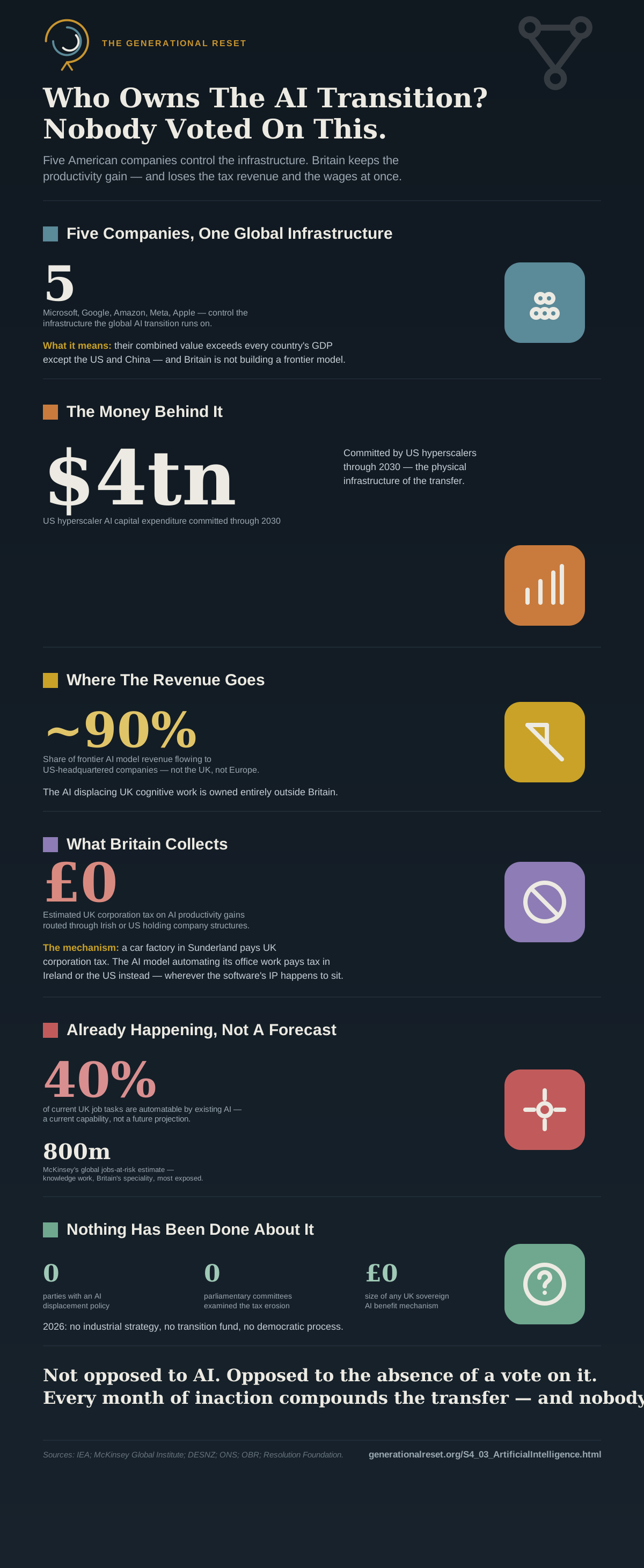
Previous waves of automation displaced labour in specific places — the factory, the mine, the mill. The capital that replaced that labour was physically located, locally taxed, and subject to national economic policy. A car factory in Sunderland generates corporation tax in the United Kingdom. The AI model that automates tasks in that factory’s management office generates corporation tax in Ireland or the United States, depending on where the intellectual property is held.2
This is the central structural feature of the AI displacement problem: the capital is not just mobile — it is structurally designed to be stateless. The intellectual property sits in a holding company. The computation runs in a data centre that may be physically in the UK but whose returns flow offshore. The productivity gain accrues to the UK business. The subscription fee leaves the UK. The tax generated by that transaction is minimal.
3.2 The Concentration Problem
Five companies — Microsoft, Google, Amazon, Meta, and Apple — control the infrastructure on which the global AI transition is being built. Their combined market capitalisation exceeds the GDP of every country except the United States and China. The AI models that are automating UK cognitive work are owned by these five companies. The data centres that run them are owned by these five companies. The cloud infrastructure that delivers them is owned by these five companies.
This level of concentration in a single technology transition has no modern precedent. The internet required infrastructure that was, at least partly, nationally distributed. AI requires frontier model training that only five organisations in the world currently have the capital and compute to perform. The UK is not — and will not become — a frontier model developer. The question is not how Britain competes at the frontier. It is what sovereign terms Britain can establish for the deployment of frontier AI on British soil and in British institutions.
3.3 The Public Sector as Accelerant
Government is the largest buyer of services in the UK economy. As AI procurement accelerates in the public sector — in benefits processing, legal aid, healthcare triage, revenue and customs, schools, local government — the state becomes one of the largest agents of AI-driven labour displacement in the country. This is not inherently wrong. But it is happening without a framework for what happens to the displaced workers, how the productivity gains are accounted for in public spending decisions, or what the implications are for the income tax base that funds the public sector itself. The state is simultaneously the largest potential beneficiary of AI efficiency and the institution most exposed to the fiscal consequences of the income tax erosion that results.
4. The Democratic Silence
The most significant fact about AI’s economic impact is the absence of any democratic process to address it. This is not an accident.
The companies capturing the gains from AI deployment have every incentive to frame the transition as technical inevitability rather than political choice. Technical inevitability requires adaptation. Political choice requires debate, constraint, and the possibility of different outcomes. The framing of AI as something that ‘happens’ — like weather, or the tides — rather than something being built and deployed by specific actors with specific interests, is the most important piece of political work being done in the technology sector today.
The UK government’s response has been to establish an AI Safety Institute3 — a body focused on existential risk from superintelligent AI — while leaving the immediate, current, and ongoing displacement of cognitive labour, the erosion of the income tax base, and the concentration of AI gains in American capital entirely unaddressed. Safety from hypothetical future AI is a legitimate concern. It is also, conveniently, not a constraint on the deployment of present AI. The focus on long-run safety risk has served, whether intentionally or not, to crowd out discussion of present distributional harm.
No party in the last general election published a policy on AI income displacement. No parliamentary committee has examined the structural erosion of the income tax base from AI automation.4 No public institution has been asked to model the transition financing implications of a rapid shift away from labour income as the primary tax base. No democratic mandate exists for the largest economic transfer in a generation.
Five companies — Microsoft, Google, Amazon, Meta, and Apple — control the AI infrastructure automating UK cognitive work; their combined market capitalisation exceeds the GDP of every country except the US and China. When a UK business licenses an AI system, the subscription fee and the intellectual property behind it typically sit in an Irish or US holding company, generating minimal UK corporation tax on the productivity value transferred.2 No party in the last general election published a policy on AI income displacement, and no parliamentary committee has examined the structural erosion of the income tax base from AI automation.4
Previous automation waves displaced labour in physically located, locally taxed capital — a factory floor. AI is structurally different: the capital is stateless, so the same event that erodes UK wage income also erodes the UK tax base built on it, with the productivity gain flowing untaxed to a small number of American shareholders — this project's own connecting argument, not a finding any single source states on its own. How fast this happens is genuinely uncertain — credible estimates range from 15% to 60% of roles displaced, over timeframes from 5 to 30 years — but the direction and mechanism are not in serious dispute, and no UK institution currently has the mandate to track or respond to either.
The causation above is compatible with responses well beyond this pillar's own: trust that the market creates new jobs faster than AI displaces them, as previous technology transitions eventually did — the pillar's own Counter-Argument 1 engages this directly rather than dismissing it; attempt to restrict or slow domestic AI deployment itself, a position this pillar explicitly does not take; or establish binding regulatory terms without new taxation, closer to the EU AI Act's approach. This pillar proposes a fourth path: don't restrict deployment, but build democratic oversight and fiscal capture into it now.
Choosing active institutional response now over waiting for market self-correction reflects a value judgement, not something the evidence alone settles: that the cost of a transition period falling on displaced workers today matters enough to act before the pace of displacement is fully known, even at the risk of designing institutions for a transition that turns out slower or smaller than feared. A reader who trusts the historical pattern — that previous transitions eventually produced net job growth — more than the risk of acting on incomplete information is not wrong on the evidence; they are weighing the same genuine uncertainty against a different tolerance for waiting.
Establish a standing AI and Economic Transition Commission with a statutory mandate to model displacement and publish annual income-tax-base erosion assessments, alongside an AI Productivity Levy capturing a share of AI-driven revenue before it leaves the UK economy. The falsification test below is what would show the urgency behind this specific institutional response, not the general case for eventual reform, was overstated.
5. The UK’s Specific Exposure
5.1 A Service Economy in the Wrong Place
The UK’s deindustrialisation was a policy choice, made over decades, that concentrated the economy in financial and professional services. That concentration produced growth, but it also produced a workforce heavily exposed to the AI transition and an industrial base too small to absorb the people displaced from cognitive work. Germany, with its larger manufacturing sector, faces AI displacement of a different kind — physical automation of production — which moves more slowly and for which retraining pathways are better understood. The UK faces displacement of cognitive work, which moves at software speed.
5.2 The Energy Demand Interaction
AI data centres are among the highest-intensity electricity consumers on the planet. A single large AI training cluster consumes as much power as a mid-sized town. The UK is a preferred hyperscaler location — language, legal system, time zone, political stability — and the major US technology companies have committed billions to UK data centre expansion. This creates a direct interaction with the energy transition: the clean grid the UK is building and paying for through consumer energy bills will partly power American AI infrastructure, whose returns flow to American shareholders. UK ratepayers fund the transition; US capital captures the cheap clean power. This is the same transfer mechanism operating in physical infrastructure.
5.3 The Public Services Dilemma
The NHS, the benefits system, local government, and the courts face enormous pressure to adopt AI to manage backlogs and reduce costs. The productivity gains are real. But each AI deployment in a public service is also a displacement of public sector employment — employment that generates income tax, National Insurance, and pension contributions, and provides livelihoods in communities where public sector work is often the primary source of stable employment. The fiscal case for AI in public services is less straightforward than it appears once the tax base implications of the resulting displacement are properly accounted for.
6. Counter-Arguments
‘The market will create new jobs faster than AI displaces them — it always has’
This is historically the strongest argument, and it deserves serious engagement rather than dismissal. Technology transitions have historically created more jobs than they destroyed — but over timescales of decades, through enormous social disruption, and with the new jobs often requiring different skills, in different places, from different people than those displaced. The industrial revolution produced net employment growth. It also produced child labour, urban squalor, and decades of immiseration before the gains were broadly shared. ‘It will work out eventually’ isn’t a transition policy — it’s an instruction to the displaced to wait.
‘The UK cannot and should not try to control global AI development’
This conflates two different questions. No one is arguing that the UK should attempt to stop AI development globally. The argument is that the UK should establish democratic terms for AI deployment within its own economy and public institutions — on data, on tax, on displacement support, on procurement conditions. Every other major economic jurisdiction is doing exactly this. The EU AI Act establishes binding requirements. The United States has executive orders on AI in federal procurement. The suggestion that the UK uniquely cannot shape the terms on which AI operates domestically is not a statement about the limits of British power. It is a statement about the limits of political will.
‘AI will make the public services better and save money — that’s the priority’
The efficiency gains from AI in public services are real and worth pursuing. The question is whether they are pursued within a framework that accounts for the displacement costs, the fiscal feedback effects, and the democratic legitimacy of the decisions being made. Efficiency without a framework is not reform. It is a series of procurement decisions made by officials who face no accountability for the distributional consequences.
Cross-Pillar Dependencies
| Pillar | Connection |
|---|---|
| Economic Renewal | The inheritance tax argument is directly strengthened by AI displacement. If income from labour is being systematically transferred to returns on capital — the capital being the AI models owned by a handful of American corporations — then a tax system built on labour income is structurally obsolete. The shift to asset and inheritance taxation is not merely philosophical. It is a response to the structural change AI is driving in who earns what and how. |
| Political Renewal | The democratic silence on AI is partly a consequence of the political system the Political Renewal pillar addresses. Short electoral cycles incentivise short-term responses. Private money in politics creates structural proximity between government and the technology companies lobbying to shape AI regulation. Proportional representation and longer institutional mandates are preconditions for the multi-decade policy frameworks the AI transition requires. |
| Public Office Covenant | The revolving door between government and the technology sector — ministers and senior officials moving to advisory or executive roles at Microsoft, Google, Amazon, and their UK counterparts — is one of the least examined conflicts of interest in British public life. The Covenant’s disclosure requirements and cooling-off periods apply directly to those shaping AI procurement, regulation, and the absence of an AI displacement policy. |
| NHS | AI in healthcare triage, diagnostics, and administration represents a genuine opportunity to reduce the appointment backlog and improve outcomes. It also represents a displacement of healthcare administrative labour and a procurement relationship with the same five companies that dominate the rest of the AI market. The NHS is the UK’s largest employer. Its AI procurement decisions are, at scale, macroeconomic decisions. |
| Education | The skills pipeline for a post-AI economy is fundamentally different from the one the education system currently produces. The displacement of routine cognitive tasks does not reduce the demand for education — it changes what education needs to deliver. Critical judgement, interpersonal capability, creative synthesis, and the capacity to work with AI systems rather than in competition with them are the relevant skills. The Education pillar’s curriculum reform argument is inseparable from the AI transition. |
| Welfare | AI displacement of cognitive labour will produce a structural increase in the number of people whose skills have been made economically obsolete faster than retraining can compensate. The welfare system is not designed for this. Universal Credit was designed for a labour market of cyclical unemployment — people temporarily between jobs in a market that wants to employ them. Structural technological displacement is a different problem requiring a different institutional response. |
| Energy | AI data centre energy demand is the fastest-growing new load on the UK grid. The hyperscalers locating data centres in Britain are consuming electricity from a clean grid built and paid for by UK consumers and taxpayers. The energy pillar’s grid investment case and the AI pillar’s industrial strategy argument must be co-designed: data centre location agreements should include grid investment contributions as a condition of planning consent. |
| Public Debt | The income tax base erosion from AI displacement has direct and compounding fiscal consequences. If the OBR’s long-run projections do not include a scenario for significant AI-driven labour income reduction, they are not modelling the economy as it will exist. The fiscal framework must be stress-tested against the AI displacement scenario — not as a worst case, but as a central case for planning purposes. |
8. Proposals for Change
The following represent the evidence-based proposals of this pillar, put forward for public discussion and challenge.
Democratic Framework
-
P1 Establish a standing AI and Economic Transition Commission — independent of both government and the technology sector — with a statutory mandate to model AI displacement scenarios, publish annual assessments of income tax base erosion, and make binding recommendations on transition policy.
-
P1 Require the OBR to publish AI displacement scenario analysis as part of each fiscal event, with explicit modelling of labour income reduction under fast, central, and slow displacement assumptions.
-
P2 Initiate a Citizens’ Assembly on AI and the Economy — the first democratic process in which the British public is asked to deliberate on the terms under which AI should operate in the UK economy and public services.
Tax and Sovereignty
-
P3 Establish an AI Productivity Levy — a tax on the revenue generated by AI systems deployed in UK businesses above a threshold size, applied at point of subscription or licensing fee payment, capturing a portion of the productivity gain before it leaves the UK economy.
-
P3 Create a UK AI Sovereign Fund, capitalised by the AI Productivity Levy, with a mandate to invest in the skills, infrastructure, and transition support required for the displacement period.
-
P4 Close the structural tax avoidance route by which AI subscription and licensing fees paid by UK businesses to Irish or US holding companies generate no UK corporation tax on the productivity value transferred.
Data Centre and Infrastructure
-
P5 Require any AI data centre above a defined electricity consumption threshold to contribute proportionally to grid reinforcement costs in their region as a condition of planning consent.
-
P5 Negotiate data centre location agreements that include binding UK skills development obligations, apprenticeship commitments, and ring-fenced corporation tax arrangements — treating data centre location as an industrial policy decision, not a passive planning outcome.
-
Include AI data centre demand forecasts explicitly in National Grid ESO future energy scenarios and grid investment planning.
Public Sector Deployment
-
P6 Require that all AI procurement in the public sector above a defined contract value include an explicit displacement impact assessment — modelling the tax base and employment consequences of the roles being automated, not just the efficiency gains.
-
P6 Establish a Public Sector AI Transition Fund, funded from the efficiency savings generated by AI deployment in public services, ring-fenced for the retraining and redeployment of displaced public sector workers.
-
P6 Prohibit the deployment of AI systems in high-stakes public service decisions — benefits entitlement, immigration status, criminal sentencing recommendations — without explicit human review at each decision point and published accuracy and bias auditing.
The Generational Reset does not oppose AI. The technology is here. The productivity gains are real. The public service improvements are achievable. The argument is simpler and harder: that the largest transfer of wealth and power in a generation is happening without a democratic mandate, and that the window for establishing one is closing. Every month of inaction compounds the transfer. The political silence is itself a choice, made by default, on behalf of a small number of private actors, at the expense of everyone else — not neutrality.
Sources: IEA, Electricity 2024 Report | McKinsey Global Institute, The Future of Work After COVID-19, 2021 | DESNZ, AI in the UK Economy 2025 | ONS, Labour Force Survey 2024 | Office for Budget Responsibility, Fiscal Risks and Sustainability Report 2024 | Resolution Foundation, Stagnation Nation 20235 | UK AI Safety Institute, Annual Report 2025
The Generational Reset is a non-partisan, public-interest project. Not affiliated with any political party. | generationalreset.org
The Generational Reset | S4_03: Artificial Intelligence | For public discussion. Not affiliated with any political party. | generationalreset.org