Executive Summary
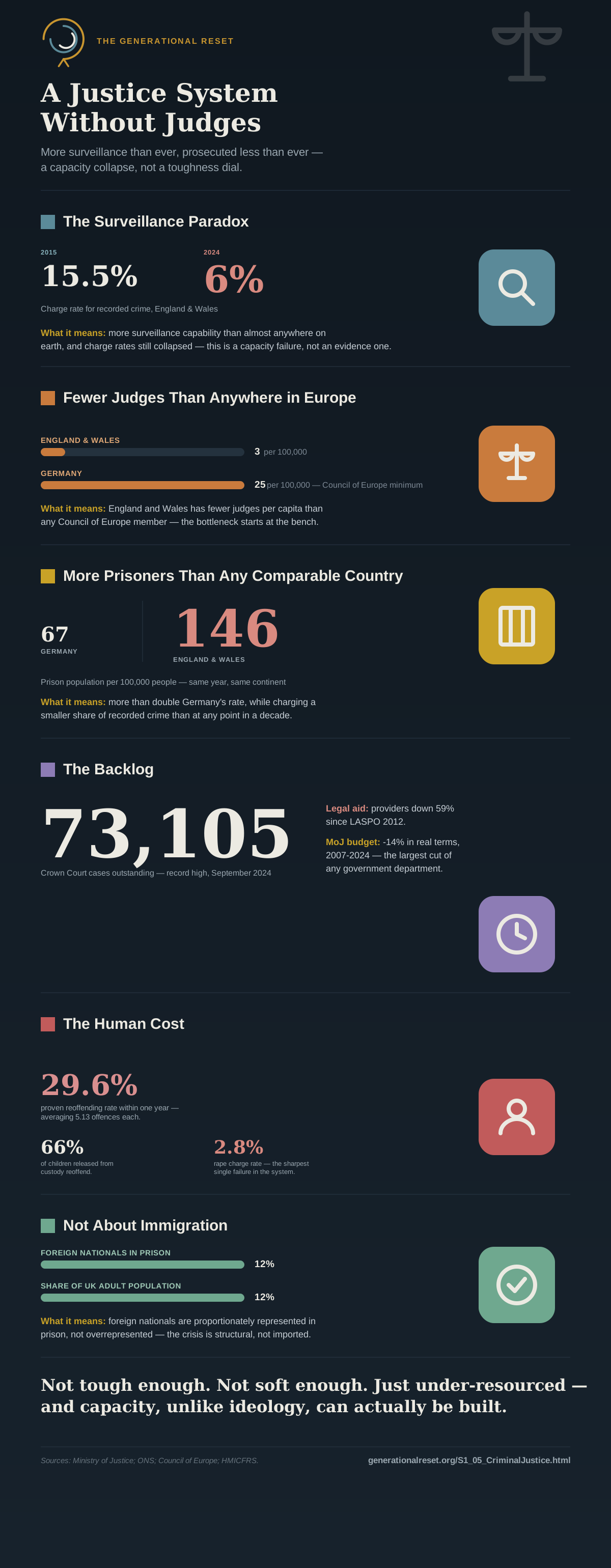
England and Wales operates a criminal justice system whose structural failures are documented, quantified, and politically tolerated. The charge rate for recorded crime has collapsed from 15.5% in 2015 to approximately 6% today.1 Nearly one in three people released from custody reoffend within a year.2 The Crown Court backlog stands at a record 73,105 outstanding cases.3 Legal aid providers have fallen by 59% since 2012.4 And England and Wales imprisons more people per capita than any comparable country in Western Europe — while achieving worse rehabilitation outcomes than almost all of them.
This pillar makes a single overarching argument: the criminal justice crisis is a structural failure of system design, not a failure of toughness, leniency, or immigration policy. The pipeline from policing through prosecution through courts through rehabilitation has been allowed to decay at every joint, while spending has been concentrated at the front end — policing — and the containment end — prison building — leaving the processing capacity that converts recorded crime into justice chronically under-resourced.
There is a surveillance paradox at the heart of this failure that has never been properly named in political discourse. England and Wales has more CCTV per capita than almost any country on earth. Every financial transaction is logged. Mobile phones place suspects geographically with near-certainty. We know more about criminal activity than at any point in human history. We prosecute less of it, and the reason is capacity, not evidence — there's no shortage of evidence, only of people to process it.
This pillar also addresses the claim that immigration drives criminal justice failure. The data is unambiguous. Foreign nationals constitute 12% of the prison population against 12% of the adult population.5 When controlled for age and sex, non-citizens are actually underrepresented in prison relative to British citizens. England and Wales imprisons a lower proportion of foreign nationals than Germany, France, Belgium, or Austria. The criminal justice crisis is structural, not imported.
Key Proposals
Triple Crown Court sitting days over five years. A funded plan to clear the 73,105 case backlog and establish a maximum 12-month wait from charge to trial.
Create a statutory disclosure management framework. Mandatory AI-assisted review of digital evidence, with published bias audits and independent oversight.
Restore legal aid as a public good. An immediate uplift to criminal legal aid rates — down 28% in real terms since 2008 — plus minimum provider coverage requirements to fix advice deserts.
Legislate a rehabilitation spending floor. A minimum share of the HMPPS budget, rising to 15% over a parliament, so rehabilitation is funded rather than what's left after custody costs.
Set a statutory neighbourhood policing floor. A minimum of 15% of all officers in genuine neighbourhood roles, independently verified by HMICFRS.
Implement the Lammy Review in full. A published timetable and annual parliamentary accountability, plus mandatory equality impact assessments at each decision point with published outcomes by ethnicity.
1. The Honest Diagnosis
1.1 The Surveillance Paradox
The most revealing single fact about England and Wales's criminal justice failure is one that receives almost no attention in mainstream political discourse. In 2015, 15.5% of recorded crimes resulted in a charge or summons. By 2024 that figure had fallen to approximately 6%. Over the same period, the surveillance infrastructure expanded dramatically: more CCTV coverage than almost anywhere in the world, universal digital financial records, mobile phone location data accurate to metres, facial recognition deployed operationally. If insufficient evidence were the binding constraint on prosecution, this trajectory should have moved in the opposite direction. It did not.
The disclosure crisis is the specific legal mechanism. The Criminal Procedure and Investigations Act requires full disclosure of all relevant material to the defence. As digital evidence volumes have exploded — phones containing 50,000 messages, cloud backups, social media archives — the disclosure obligation has become practically unmanageable with current staffing. Cases have collapsed not because defendants were innocent but because the prosecution could not complete disclosure. The surveillance paradox isn't a technology failure — it's a resourcing failure wearing a technology mask.
The charge rate for recorded crime collapsed from 15.5% in 2015 to approximately 6% by 20241, during the same period surveillance capability expanded dramatically — near-universal CCTV coverage, digital financial records, mobile phone location data. England and Wales has 3 judges per 100,000 population against Germany's 256, and the Crown Court backlog stands at a record 73,105 outstanding cases3. CPS spending totals £1.1bn against a £19.5bn policing budget — a ratio of 1:187.
If insufficient evidence were the binding constraint on prosecution, the charge rate should have risen alongside surveillance capability, not collapsed — this is this project's own connecting argument, not a finding any single source states on its own. The imbalance in where money is spent, concentrated at the two ends (policing and prisons) while processing capacity is starved in the middle, explains why more evidence produces fewer charges: the pipeline that turns evidence into prosecutions doesn't have the judges, prosecutors, or disclosure staff to process it.
The causation above is compatible with responses other than this pillar's own, both directly engaged in the Steel Man below: toughen sentencing and enforcement further, on the theory that harsher consequences alone would restore deterrence even without fixing the processing pipeline; import the Nordic rehabilitative model wholesale, on the theory that outcomes would improve by adopting Nordic sentencing philosophy directly — a claim this pillar's own Steel Man calls only partially valid given the different social context; or, as this pillar proposes, invest specifically in the pipeline stages that convert evidence into charges.
Choosing pipeline investment over further toughening or wholesale Nordic import reflects a value judgement this pillar makes explicitly: that restoring consistent consequences through processing capacity is a more honest and evidence-based route to deterrence than either doubling down on sentence length or transplanting a different country's sentencing philosophy without adapting it to local institutional capacity. A reader who judges that tougher sentencing alone would restore deterrence regardless of charge rates, or that Nordic-style rehabilitation should be adopted more directly despite this pillar's own reservations about transferability, is not wrong on the evidence — they are weighing the same diagnosis against a different theory of what actually deters.
Triple Crown Court sitting days over five years, restore CPS capacity — prosecutors, digital forensics specialists, disclosure management staff — and establish a statutory disclosure management framework, treating the charge rate itself as the primary metric this investment is meant to move. The falsification test below is what would show pipeline investment isn't actually the lever that raises the charge rate.
1.2 The Spending Misallocation
England and Wales does not underspend on criminal justice as a proportion of GDP. Total public order and safety spending runs at approximately 1.8% of GDP, marginally above the EU average. The problem is the allocation, not the headline number. Policing absorbs approximately 43% of total criminal justice spending. Prisons and probation take 16%. Courts and tribunals receive 5%. Legal aid receives 5%, having been cut by 28% in real terms since 2008. Prevention and rehabilitation are a residual — what remains after custody costs are met.
England and Wales has 3 judges per 100,000 inhabitants — the minimum of any country in the Council of Europe. Germany has 25. France has 11. The Netherlands has 16.6 The Crown Court backlog of 73,105 cases is not a mystery. You cannot clear cases without judges to hear them. The minimum judicial capacity in Europe combined with the largest prison population in Western Europe is the predictable consequence of a system that invests in containment and neglects the processing that would make containment unnecessary, not an accident.
1.3 The Pipeline Failure
The criminal justice pipeline has four stages where failure compounds: policing, prosecution, courts, and rehabilitation. At the policing stage, neighbourhood policing — the visible, deterrent, community-trust-building function — has been reduced to 8% of the officer workforce. Police time has been progressively absorbed by the mental health crisis — consuming an estimated one million officer hours per year8 — and a shift in the crime mix toward fraud, sexual offences, and stalking, categories significantly more resource-intensive to investigate. At the prosecution stage, CPS spending totals £1.1 billion against a policing budget of £19.5 billion — a ratio of 1:18.7 At the courts stage, the 73,105 case backlog means victims wait years for resolution. At the rehabilitation stage, the 29.6% reoffending rate means the system is generating demand for itself.
1.4 The Structural Inequality Dimension
The criminal justice system does not fail equally. The Lammy Review documented clearly that Black, Asian, and mixed-heritage people are overrepresented at every stage of the criminal justice process in ways not explained by offending rates alone. Black defendants are 29% more likely to be remanded in custody than White defendants facing the same charges.9 Children from Black backgrounds serve average custodial sentences nearly twice as long as White children. Almost a decade after the Lammy Review, its core recommendations have been largely unimplemented.
The legal aid collapse has a direct distributional consequence. The 59% fall in legal aid providers since 2012 has created advice deserts — large geographic areas where people entitled to publicly funded legal representation cannot access it. The consequence falls disproportionately on those in poverty, in housing crisis, experiencing domestic abuse, or navigating immigration status. Your access to justice in England and Wales increasingly depends on your ability to pay for it.
2. The Steel Man — The Strongest Case Against Change
'Longer sentences and tougher enforcement deter crime'
Deterrence theory is not wrong. Visible policing in high-crime areas demonstrably reduces crime in those areas. The charge rate collapse from 15.5% to 6% is itself an argument for enforcement — a 94% no-consequence rate is a significant incentive to offend. The steel man is strongest on the argument that restoration of the prosecution pipeline is itself the deterrence reform: not softer sentences but more consistent consequences. The Generational Reset agrees with this diagnosis. The disagreement is about where investment should be directed to achieve it.
'Nordic comparisons don't apply to England and Wales'
Norway's prison population is small and its social fabric relatively intact. Importing a Nordic model into a society with significantly greater inequality, urban density, and ethnic diversity is not self-evidently applicable. This is partially valid. It is why this pillar does not propose importing Nordic policy wholesale. It proposes applying the principle — invest in the pipeline, not just the containment — adapted to the specific institutional context of England and Wales. Scotland's domestic experience with presumption against short sentences provides a closer comparator.
3. What Other Countries Show Us
3.1 The Nordic Model
Finland, Norway, and the Netherlands consistently achieve lower reoffending rates with prison populations between one third and one half the size of England and Wales. The explanation is specific policy choices: investment in pre-sentence diversion, mandatory treatment for addiction and mental health conditions, employment and housing support on release, and community supervision that provides genuine support rather than surveillance alone. Norway's Bastoy prison has a two-year reoffending rate of approximately 16%, against England and Wales's 29.6% at one year.10
3.2 Germany — Judicial Capacity
Germany has 25 judges per 100,000 inhabitants against England and Wales's 3. Its prison population is 67 per 100,000 against England and Wales's 146.11 Its proportion of foreign nationals in prison — 38% against 12% — is higher, not lower, reflecting a higher-immigration society that nonetheless achieves better justice outcomes. The German model demonstrates that high immigration and effective criminal justice are compatible. The determining factor is not who is in the system but how well the system is resourced and configured.
3.3 Scotland — A Domestic Comparator
Scotland's justice system has pursued a more explicitly rehabilitative approach, particularly for short sentences. The presumption against sentences of three months or less has reduced the short-sentence prison population without producing the crime increases critics predicted. Scotland's reoffending outcomes remain imperfect but the direction of travel — using custodial sentences for those who genuinely need containment, not as a default for minor offences — is supported by the evidence.
4. Counter-Arguments
'This is soft on crime. Victims want justice, not rehabilitation theories'
The current system is failing victims more comprehensively than any rehabilitation programme has. A 6% charge rate means 94% of victims see no prosecution. A 29.6% reoffending rate means the system is producing future victims at scale. Toughness that generates 73,000 backlogged cases and a record reoffending rate isn't an effective victim policy — it's a posture.
'More rehabilitation means releasing dangerous people early'
Rehabilitation investment and public protection are not in conflict. The argument for employment support, housing, addiction treatment, and mental health provision on release is precisely that it reduces the 29.6% reoffending rate — which means fewer future victims. The Generational Reset isn't proposing to reduce sentences for serious offences — it's proposing to ensure the sentence period is actually used to reduce the probability of reoffending.
'Legal aid restoration is a subsidy for criminals, not a public good'
The majority of legal aid spending funds the representation of defendants — people presumed innocent until proven guilty, a principle the justice system depends on for its legitimacy. The claim that legal aid funds criminals conflates the accusation with the verdict. The deeper question is whether a justice system in which access to legal representation depends on wealth is a justice system at all.
'The Lammy Review was published in 2017. If it hasn't been implemented in nine years, why would it be now?'
Because the political incentive structure has not changed — which is precisely this pillar's point. The people making the decisions are not experiencing the disparity. They are not being stopped and searched. The Generational Reset argues that making implementation legally binding with parliamentary accountability changes the political dynamic in ways that voluntary commitment does not.
Cross-Pillar Dependencies
| Pillar | Connection |
|---|---|
| NHS | The mental health crisis is consuming an estimated one million hours of police time per year. 72% of prisoners have two or more mental health conditions. The criminal justice system cannot address reoffending driven by untreated mental illness without the healthcare system addressing upstream causes. These are not parallel crises. One is generating the other. |
| Education | 90% of people who have been in prison have a history of persistent or severe school absence. School exclusions — concentrated in the most disadvantaged communities — are the primary pipeline into county lines exploitation. The education pillar's commitments on SEND, mental health provision, and exclusion reduction are a direct input into youth justice outcomes. |
| Welfare | Child poverty is the single strongest predictor of youth offending. The welfare pillar's analysis of in-work poverty, housing precarity, and the two-child benefit cap directly generates the conditions that draw young people into criminal exploitation. Criminal justice reform without welfare reform addresses symptoms rather than causes. |
| Housing | Housing instability is one of the strongest predictors of reoffending. People released from prison without stable accommodation reoffend at dramatically higher rates. Reentry housing provision — coordinated between NHC, HMPPS, and local authorities — is a direct criminal justice reform mechanism. |
| Economy | The regional divergence documented in the Economy pillar — concentrated deprivation, insecure work, wage stagnation — is the economic mechanism generating demand on the criminal justice system in the most affected communities. Economic Renewal and justice reform are not sequential. They are simultaneous requirements. |
| Public Debt | The MoJ received the largest proportional real-terms cut of any department between 2007 and 2024. The downstream costs — welfare claims, NHS demand, lost productivity from reoffending — represent a debt to the rest of the budget that the Public Debt pillar's framework should make explicit. |
| Political Renewal | The LASPO legal aid collapse, the decade of MoJ cuts, the Lammy Review recommendations unimplemented for nine years — all are failures of political will sustained across parties over multiple parliaments. They persist because the people experiencing them have the least political voice. Political Renewal that restores accountability is the precondition for justice reform that lasts. |
| Public Office Covenant | If AI tools are deployed in criminal justice — for evidence processing, risk assessment, or enforcement — the transparency and accountability principles of the Covenant apply directly. Algorithmic decisions affecting liberty require the same standards of public accountability as any other exercise of state power. |
| Defence | Veterans are overrepresented in the prison population. The criminal justice system's failure to route veterans into therapeutic rather than custodial pathways is a documented systemic failure requiring explicit cross-pillar action between MoJ, MoD, and the NHS. |
| Housing (reentry) | Housing instability is the primary driver of reoffending post-release. People leaving prison without accommodation reoffend at dramatically higher rates. Coordinated reentry housing is where this pillar and the Housing pillar must be explicitly co-designed. |
6. Proposals for Change
The following represent the evidence-based proposals of this pillar, put forward for public discussion and challenge.
Restore the Prosecution Pipeline
-
P1 A funded five-year plan to triple Crown Court sitting days, beginning immediately, to address the 73,105 case backlog and establish a maximum waiting time of 12 months from charge to trial.
-
Immediate investment in Crown Prosecution Service capacity — prosecutors, digital forensics specialists, and disclosure management systems — funded in part through hypothecated automated enforcement revenue.
-
P2 A statutory disclosure management framework: mandatory use of AI-assisted review tools for digital evidence, with published bias audits and independent oversight.
-
Full implementation of the Leveson Review recommendations on court efficiency with mandatory six-monthly reporting to Parliament on backlog progress.
Restore Legal Aid as a Public Good
-
P3 A funded legal aid restoration programme: minimum provider coverage requirements by local authority area, with financial incentives for firms establishing provision in advice deserts.
-
P3 Immediate uplift to criminal legal aid rates, which have fallen 28% in real terms since 2008.
-
A civil legal aid restoration fund specifically targeting housing, domestic abuse, and immigration — the areas where LASPO cuts have been most damaging.
Rebalance the Criminal Justice Budget
-
P4 A legislated requirement that rehabilitation spending constitutes a minimum percentage of the total HMPPS budget, rising over a parliament to 15%, ensuring rehabilitation is a funded programme rather than what remains after custody costs are met.
-
Full hypothecation of automated road enforcement revenue — speed camera fines — to criminal justice processing capacity.
-
P5 A statutory neighbourhood policing floor: minimum 15% of all officers in genuine neighbourhood roles, independently verified by HMICFRS.
Address Structural Inequality
-
P6 Full implementation of the Lammy Review recommendations with a published timetable and annual parliamentary accountability on progress.
-
P6 Mandatory equality impact assessments at each decision point — stop and search, charge, remand, sentencing — with published outcomes by ethnicity and mandatory explanation for persistent disparity.
-
A dedicated youth justice investment fund focused on diversion before charge for under-18s, county lines exploitation support, and community-based alternatives to custody.
Establish AI and Digital Evidence Governance
-
A statutory Criminal Justice AI Authority: an independent body with the mandate to approve, audit, and publish performance data on all AI tools used in criminal justice before deployment.
-
A binding prohibition on population-level predictive policing tools until a public governance framework has been established through primary legislation.
-
Mandatory annual bias audits for all AI tools deployed in criminal justice, with automatic suspension if protected characteristic disparities exceed defined thresholds.
The criminal justice system is not failing because Britain lacks the will to be tough on crime. It is failing because the resources needed to convert recorded crime into justice have been systematically withdrawn from the stages of the pipeline where they would be most effective. The proposals above are rational, not lenient — and the evidence from every comparable system that operates them says they work.
The Generational Reset is a non-partisan, public-interest project. It is not affiliated with any political party, does not accept corporate funding, and publishes all its work under open licence for public discussion and adaptation.
For public discussion. Not affiliated with any political party. | generationalreset.org
The Generational Reset | S1_05: Criminal Justice | For public discussion. Not affiliated with any political party. | generationalreset.org