This document sits in Section Four, Forces Shaping Britain's Future. Its subject is less the technology of artificial intelligence than its political economy: who captures the gains, who bears the costs, and why there has been so little democratic discussion of either.
Executive Summary
Something new in modern economic history is under way. Much of the value of human cognitive work, the base on which the UK's tax system, welfare state and social contract were built, is starting to shift to a small number of private companies, most of them American. It is happening at a pace and scale that no democratic institution has debated, authorised or constrained.
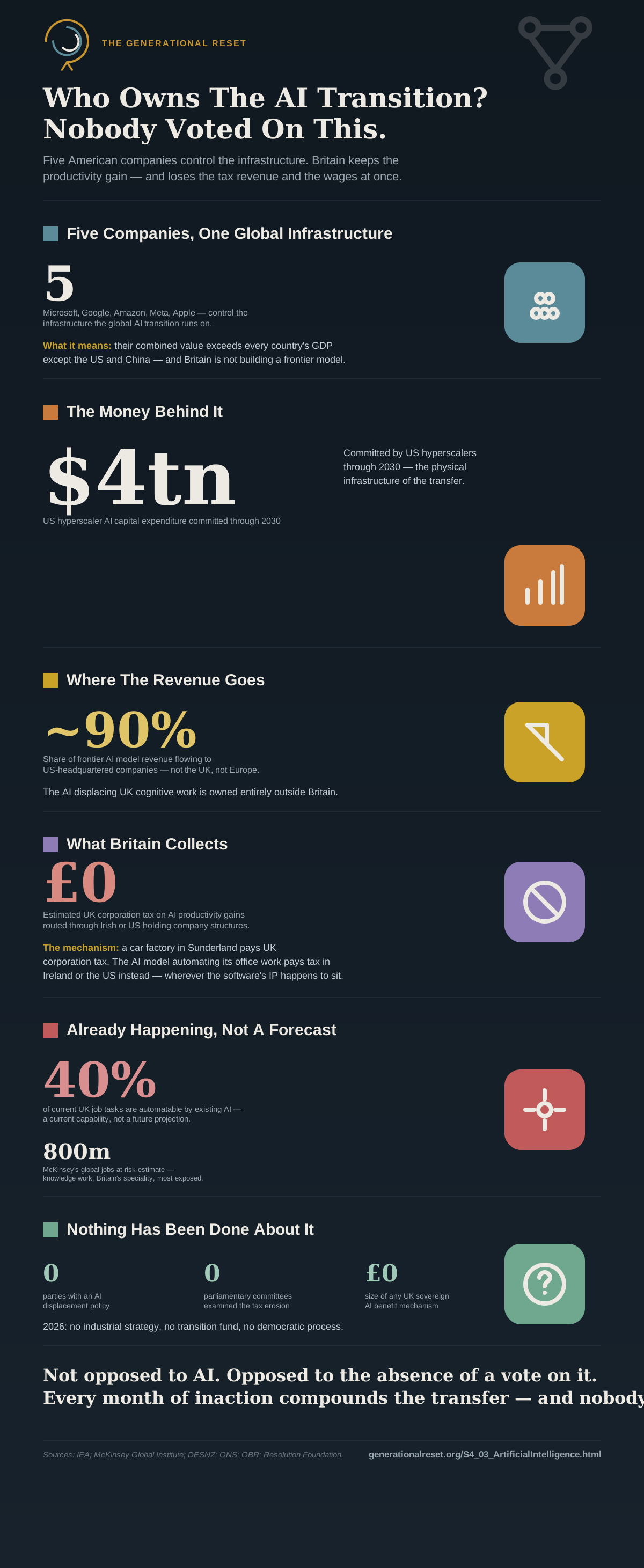
This is already happening. The government's own trial of Microsoft 365 Copilot across 20,000 civil servants found an average saving of 26 minutes a day per user.1 Amazon Web Services and Microsoft each hold 30 to 40% of UK cloud spending, and the Competition and Markets Authority has found that both hold "significant unilateral market power".2 Amazon, Microsoft, Alphabet and Meta plan to spend around $725 billion between them in 2026, most of it on AI data centres and chips.3 As AI takes over tasks people are paid to do, the wages that fund income tax and National Insurance come under pressure, while much of the payment for the software flows to companies whose profits are largely booked and taxed abroad. The UK can gain the productivity and lose part of the wage income at the same time, a shift that has no political name and no democratic response.
This pillar makes four arguments:
- AI is mainly a political economy question, not a technology question. What matters is not what AI can do but who owns it, who captures its returns, and on whose terms it is used.
- The silence around these questions is not an oversight. Those who benefit from the current path have every reason to present it as technical progress rather than political choice.
- The UK faces a specific and acute version of the problem: an economy concentrated in the service sectors most exposed to AI, a small industrial base to absorb the consequences, and no strategic framework for the transition.
- The window for setting the democratic terms on which AI operates in Britain is closing. Decisions being made now, on where data centres go, on AI procurement in public services, on whether any public share of AI gains is captured, and on how AI productivity is treated in the tax system, will compound for decades.
The Generational Reset does not oppose AI. It opposes the absence of democratic choice about it.
Key Proposals
Establish a standing AI and Economic Transition Commission. Independent of government and the technology sector, with a statutory mandate to model displacement scenarios and require the OBR to publish AI displacement analysis at each fiscal event.
Initiate a Citizens' Assembly on AI and the Economy. The first democratic process asking the British public to deliberate on the terms under which AI should operate in the UK economy and public services.
Establish an AI Productivity Levy funding a UK AI Sovereign Fund. Captures a portion of the productivity gain before it leaves the UK economy and invests it in the skills and infrastructure the displacement period requires.
Close the AI licensing-fee tax avoidance route. Subscription and licensing fees paid by UK businesses to Irish or US holding companies reduce UK taxable profits, so much of the productivity value is taxed elsewhere, if at all.
Treat data centre location as industrial policy, not a passive planning outcome. Proportional grid reinforcement contributions and binding UK skills development obligations as a condition of planning consent and location agreements.
Fund public sector transition and require human review of high-stakes AI decisions. A Transition Fund for retraining displaced workers, and mandatory human review with published accuracy and bias auditing for benefits, immigration, and sentencing decisions.
1. The Diagnosis
The United Kingdom built its post-industrial economy on cognitive work. Financial services, professional services, law, consulting, technology, back-office operations, and the public sector workforce that runs a complex state are the sectors that employ much of the working-age population and generate the income tax base that pays for the welfare state and public services. They are also the sectors where AI can take on the most work.
That isn't a coincidence. AI is most attractive where labour is expensive relative to the cost of automating it. Cognitive work such as analysis, drafting, summarising, coding, customer contact and pattern-spotting is expensive and, it turns out, highly automatable. IPPR estimates that 11% of tasks UK workers do are exposed to generative AI today, rising to 59% if businesses integrate it more deeply, with routine administrative, secretarial and customer service work most exposed first.4 The IMF estimates that about 60% of jobs in advanced economies are exposed to AI, of which roughly half could benefit from higher productivity and half could see lower demand and wages.5 The UK's comparative advantage in services is also its greatest exposure.
The mechanism is specific and traceable. When AI takes over work a UK employee used to do, a chain follows. The worker loses income, or the job isn't filled, and income tax and National Insurance fall. The employer gains productivity. Part of the value of that gain is paid out as subscription or licensing fees to a technology company, and for the largest providers much of that revenue is booked outside the UK. The net effect is a shift of economic value from UK wage income towards capital income, much of it American. At scale, this works as a steady flow of value out of the UK economy to a small number of owners. No democratic body has named it, and no institution has been asked to respond to it.
2. The Steel Man
2.1 Productivity Growth Is Real and Valuable
The case for AI adoption isn't invented. Productivity growth, getting more output from the same or fewer inputs, is how living standards rise. If AI makes doctors more effective, frees teachers from paperwork, speeds up engineering design and lifts back-office burdens from small businesses, those are real gains. Dismissing them in favour of a purely distributional critique would be wrong, and the Generational Reset doesn't do that.
2.2 Public Services Could Be Transformed
The NHS appointment backlog, benefits assessments, the criminal courts queue and planning delays are all partly administrative failures that AI could help fix. A state that can process, route and respond at AI speed could get better results from the resources it has. Using AI to improve public services isn't a cover for privatisation. It is a real opportunity that deserves serious engagement.
2.3 New Industries Will Emerge
Past technology transitions destroyed old labour markets and created new ones. Mechanised farming didn't cause permanent mass unemployment; it fed the industrial workforce. Computerising routine information work didn't either; it produced the knowledge economy. AI may follow the same pattern. The question is whether the transition is managed so that the gains are widely shared, or left to market forces that will concentrate them.
3. How the Transfer Works
3.1 Capital Without a Location
Earlier waves of automation replaced workers in specific places: the factory, the mine, the mill. The machines that replaced them were in the UK, taxed locally and subject to national policy. A car factory in Sunderland pays corporation tax in the UK. The AI software used in that factory's offices earns profits that can be booked wherever the company holds its intellectual property, often in Ireland or the United States.6
This is the central feature of the problem. The capital isn't just mobile; it can be largely detached from any one country. The intellectual property sits in a holding company. The computing may run in a data centre in the UK while the returns are booked elsewhere. The productivity gain stays with the UK business, but the fee leaves. Microsoft, for example, was reported to have booked more than £8 billion of UK-generated revenue through its Irish operations over several years, under an arrangement agreed with HMRC; the company says it pays all the tax it owes.7 The OECD's global minimum tax now sets a floor of 15% on large multinationals' profits wherever they are booked, but that is still well below the UK's 25% corporation tax rate.6
3.2 The Concentration Problem
A handful of companies control the infrastructure on which the AI transition is being built. In the UK, AWS and Microsoft each hold 30 to 40% of cloud spending, and the CMA found in 2025 that competition in the market "is not working well".2 Training the most advanced models is concentrated in a small group of mostly American firms, including OpenAI, Anthropic, Google DeepMind and Meta, with Chinese developers the main exception. Amazon, Microsoft, Alphabet and Meta alone plan around $725 billion of capital spending in 2026.3
Few earlier technology transitions have been this concentrated. Much of the internet's infrastructure was built and owned nationally. Frontier AI needs computing on a scale only a few companies in the world can afford. Britain does host one of the leading frontier labs, Google DeepMind in London, but it is owned by Alphabet, and no British-owned company is competing at the frontier. The useful question isn't how Britain competes at the frontier. It is what terms Britain can set for the use of frontier AI on British soil and in British institutions.
3.3 The Public Sector as Accelerator
Government is the biggest buyer of services in the UK economy. As public bodies adopt AI, in benefits processing, legal aid, healthcare triage, HMRC, schools and local government, the state becomes one of the biggest drivers of AI-related job change in the country. That isn't wrong in itself. But it is happening without a framework for what happens to the workers affected, how the savings are counted in spending decisions, or what it means for the income tax base that funds the public sector. The state stands to gain most from AI efficiency and is also most exposed to the fiscal cost if the income tax base erodes.
4. The Democratic Silence
The most striking fact about AI's economic impact is that there is no democratic process for dealing with it. That isn't an accident.
The companies capturing the gains from AI have every reason to present the transition as technical inevitability rather than political choice. Inevitability calls for adaptation. Choice calls for debate, limits and the possibility of a different outcome. Presenting AI as something that "happens", like the weather, rather than something specific companies with specific interests are building and selling, is the most important political work the technology sector does.
The UK government's response has two strands. The AI Safety Institute was renamed the AI Security Institute in February 2025 and refocused on serious security risks such as cyber attacks and criminal misuse. The AI Opportunities Action Plan of January 2025 set out to speed up adoption, and created a Sovereign AI unit with up to £500 million to invest in AI companies.89 Neither strand deals with the distributional questions: the effect on jobs and wages now, the erosion of the income tax base, or the concentration of AI gains in a few foreign companies. Security risks are a legitimate concern, and so is growth. But neither puts any condition on how today's AI is deployed or who benefits from it.
This project found no AI income displacement policy in the main parties' 2024 manifestos, and no select committee report examining the erosion of the income tax base from AI automation; the most relevant inquiry, the Science and Technology Committee's 2024 report on AI governance, focused on regulation and safety.10 No public institution has been asked to model what a rapid shift away from wage income as the main tax base would mean for public finances. No democratic mandate exists for one of the largest economic shifts in a generation.
AWS and Microsoft each hold 30 to 40% of UK cloud spending, and the CMA has found both hold significant market power.2 Amazon, Microsoft, Alphabet and Meta plan around $725bn of capital spending in 2026.3 Large technology companies can book profits where their intellectual property sits, and Microsoft was reported to have booked more than £8bn of UK revenue in Ireland.7 The OECD minimum tax rate of 15% is well below the UK's 25%.6 This project found no 2024 manifesto policy on AI income displacement and no select committee report on AI and the income tax base.10
Earlier automation replaced workers with machines that were located and taxed in the UK. AI is different because the capital is largely detached from any one country, so the same change that erodes UK wage income also erodes the tax base built on it, while much of the gain flows to a small number of foreign shareholders. This connecting argument is this project's own; no single source makes it. How fast it happens is uncertain. IPPR puts current UK task exposure at 11%, rising to 59% in a deeper second wave, and the IMF puts 60% of advanced-economy jobs as exposed, with about half likely to benefit. But the direction and mechanism are not seriously disputed, and no UK institution has a mandate to track or respond to either.
The causation above is consistent with several other responses. One is to trust that the market will create new jobs faster than AI removes old ones, as earlier technology transitions eventually did; Counter-Argument 1 below engages with this directly. Another is to restrict or slow AI adoption in the UK, which this pillar explicitly rejects. A third is binding regulation without new taxes, closer to the EU AI Act. This pillar proposes a fourth path: don't restrict adoption, but build democratic oversight and a public share of the gains into it now.
Choosing to build institutions now rather than wait for the market to correct itself is a value judgement, not something the evidence settles. The judgement is that the cost of the transition falling on displaced workers today matters enough to act before the pace of change is fully known, even at the risk of designing institutions for a transition that turns out slower or smaller than feared. A reader who trusts the historical pattern, that earlier transitions eventually produced more jobs, more than they fear acting on incomplete information is not wrong on the evidence. They are weighing the same uncertainty with a different tolerance for waiting.
Establish a standing AI and Economic Transition Commission with a statutory duty to model job displacement and publish annual assessments of income tax base erosion, alongside an AI Productivity Levy that captures a share of AI-driven revenue before it leaves the UK economy. The falsification test below sets out what would show that the urgency behind this particular response, rather than the general case for eventual reform, was overstated.
5. The UK's Specific Exposure
5.1 A Service Economy in the Firing Line
The UK's deindustrialisation was partly a policy choice, made over decades, that concentrated the economy in financial and professional services. That brought growth, but it also left a workforce heavily exposed to AI and an industrial base too small to absorb people displaced from cognitive work. Germany, with its larger manufacturing sector, faces a different kind of automation, in physical production, which moves more slowly and where retraining routes are better understood. The UK faces automation of cognitive work, which can spread at the speed of a software update.
5.2 The Energy Demand Interaction
AI data centres are among the most power-hungry buildings there are; a large AI training cluster can draw as much electricity as a town. The UK is an attractive location for the big US cloud companies because of its language, legal system, time zone and political stability. In September 2025, US companies pledged £31 billion of UK investment under the US-UK Tech Prosperity Deal, including £22 billion from Microsoft over four years and a supercomputer in Essex.11 The National Energy System Operator expects data centre electricity demand in Great Britain to rise from about 5 TWh in 2025 to about 22 TWh by 2030, roughly fourfold.12 That links AI directly to the energy transition. Grid reinforcement is paid for partly through everyone's energy bills, while the returns from the data centres it serves go mainly to the companies that own them. Who pays for the grid connections and reinforcement that data centres need is a policy choice, and at present it isn't being made explicitly.
5.3 The Public Services Dilemma
The NHS, the benefits system, local government and the courts are under heavy pressure to use AI to clear backlogs and cut costs. The gains are real. But each use of AI in a public service also changes public sector employment, which pays income tax, National Insurance and pension contributions and provides stable jobs in places where the public sector is often the main employer. Once the tax effects of fewer public sector jobs are counted, the fiscal case for AI in public services is less simple than it looks.
6. Counter-Arguments
'The market will create new jobs faster than AI destroys them. It always has'
This is historically the strongest argument, and it deserves serious engagement. Technology transitions have generally created more jobs than they destroyed, but over decades, with great social disruption, and with the new jobs often needing different skills, in different places, done by different people. The industrial revolution produced net job growth. It also produced child labour, urban squalor and decades of hardship before the gains were widely shared. "It will work out eventually" isn't a transition policy. It is an instruction to the displaced to wait.
'The UK can't and shouldn't try to control global AI development'
This mixes up two questions. Nobody is arguing that the UK should try to stop AI development worldwide. The argument is that the UK should set democratic terms for how AI is used in its own economy and public institutions: on data, tax, support for displaced workers and procurement conditions. Other major economies are doing this. The EU AI Act sets binding requirements, and the US federal government has rules on how its agencies use and buy AI. The suggestion that the UK alone can't shape the terms on which AI operates at home isn't a statement about the limits of British power. It is a statement about the limits of political will.
'AI will make public services better and save money. That's the priority'
The efficiency gains from AI in public services are real and worth pursuing. The question is whether they are pursued within a framework that counts the displacement costs, the knock-on fiscal effects and the democratic legitimacy of the decisions. Efficiency without a framework isn't reform. It is a series of procurement decisions made by officials who answer to no one for the distributional consequences.
Cross-Pillar Dependencies
| Pillar | Connection |
|---|---|
| Economic Renewal | AI strengthens the case for the inheritance tax reform. If income is shifting from wages to returns on capital, and that capital is largely AI owned by a few foreign companies, a tax system that leans on wage income will raise less and less. Moving towards taxing assets and inheritance responds directly to that change in who earns what. |
| Political Renewal | The democratic silence on AI partly reflects the political system the Political Renewal pillar addresses. Short electoral cycles reward short-term responses. Private money in politics brings government close to the technology companies lobbying over AI regulation. Proportional representation and longer institutional mandates are preconditions for the multi-decade policy the AI transition needs. |
| Public Office Covenant | The revolving door between government and the technology sector, with ministers and senior officials moving to advisory or executive roles at large technology companies, is one of the least examined conflicts of interest in British public life. The Covenant's disclosure rules and cooling-off periods apply directly to people shaping AI procurement and regulation. |
| NHS | AI in triage, diagnostics and administration is a real chance to cut waiting lists and improve outcomes. It also changes NHS administrative employment and deepens the NHS's reliance on the same few companies that dominate the AI market. The NHS is the UK's largest employer, so its AI procurement decisions are, at scale, economic policy decisions. |
| Education | The skills a post-AI economy needs differ from what the education system produces now. Automating routine cognitive tasks doesn't reduce the need for education; it changes what education must deliver: judgement, interpersonal skills, creative thinking and the ability to work with AI rather than compete with it. The Education pillar's curriculum reform is bound up with the AI transition. |
| Welfare | AI may increase the number of people whose skills lose their market value faster than retraining can keep up. Universal Credit was built for cyclical unemployment, people temporarily between jobs in a labour market that wants to hire them. Lasting technological displacement is a different problem needing a different response. |
| Energy | Data centres are one of the fastest-growing new demands on the UK grid. The Energy pillar's grid investment case and this pillar's industrial strategy should be designed together, with grid investment contributions a condition of planning consent for large data centres. |
| Public Debt | Erosion of the income tax base from AI would have direct and compounding fiscal effects. If the OBR's long-run projections don't include a scenario for significant AI-driven loss of wage income, they are missing a major risk. The fiscal framework should be stress-tested against AI displacement as a central planning case, not only as a worst case. |
8. Proposals for Change
The following are this pillar's evidence-based proposals, put forward for public discussion and challenge.
Democratic Framework
-
P1 Establish a standing AI and Economic Transition Commission, independent of both government and the technology sector, with a statutory duty to model AI displacement scenarios, publish annual assessments of income tax base erosion, and make binding recommendations on transition policy.
-
P1 Require the OBR to publish AI displacement scenarios at each fiscal event, explicitly modelling the loss of wage income under fast, central and slow displacement assumptions.
-
P2 Hold a Citizens' Assembly on AI and the Economy: the first democratic process in which the British public is asked to deliberate on the terms under which AI should operate in the UK economy and public services.
Tax and Sovereignty
-
P3 Introduce an AI Productivity Levy: a charge on payments for AI systems used by UK businesses above a threshold size, collected when subscription or licensing fees are paid, capturing part of the productivity gain before it leaves the UK economy.
-
P3 Create a UK AI Sovereign Fund, funded by the AI Productivity Levy, with a mandate to invest in the skills, infrastructure and transition support the displacement period needs.
-
P4 Close the route by which AI subscription and licensing fees paid by UK businesses to Irish or US holding companies generate little or no UK corporation tax on the value transferred.
Data Centres and Infrastructure
-
P5 Require any AI data centre above a set electricity threshold to contribute proportionally to grid reinforcement costs in its region as a condition of planning consent.
-
P5 Negotiate data centre location agreements that include binding UK skills commitments, apprenticeships and ring-fenced corporation tax arrangements, treating data centre location as industrial policy rather than a passive planning outcome.
-
Include AI data centre demand forecasts explicitly in the National Energy System Operator's future energy scenarios and grid investment planning.
Public Sector Use
-
P6 Require all public sector AI procurement above a set contract value to include a displacement impact assessment, modelling the tax and employment effects of the roles being automated, not just the efficiency gains.
-
P6 Set up a Public Sector AI Transition Fund, paid for from the savings AI generates in public services and ring-fenced for retraining and redeploying displaced public sector workers.
-
P6 Prohibit the use of AI in high-stakes public decisions (benefit entitlement, immigration status, criminal sentencing recommendations) without human review at each decision point and published auditing of accuracy and bias.
The Generational Reset does not oppose AI. The technology is here, the productivity gains are real, and the improvements to public services are achievable. The argument is simpler and harder: one of the largest shifts of wealth and power in a generation is happening without a democratic mandate, and the window for establishing one is closing. Every month of inaction adds to the shift. The political silence isn't neutral. It is a choice, made by default, that suits a small number of private companies at the expense of everyone else.
Sources: McKinsey Global Institute, Jobs Lost, Jobs Gained, 201713; IMF, AI Will Transform the Global Economy, 2024; IPPR, Transformed by AI, 2024; NESO, Clean Power 2030; CMA, Cloud services market investigation, 2025; Resolution Foundation, Stagnation Nation, 202214; DSIT, AI Opportunities Action Plan, 2025.
The Generational Reset is a non-partisan, public-interest project. Not affiliated with any political party. | generationalreset.org
The Generational Reset | S4_03: Artificial Intelligence | For public discussion. Not affiliated with any political party. | generationalreset.org