Executive Summary
Someone who is unwilling to make their financial dealings known is probably not someone you want in power — that's the load-bearing logic of this whole framework, not a rhetorical flourish. The rules do not need to catch bad actors after they have acquired power. The rules themselves become the filter. Those with nothing to hide accept the terms. Those who refuse have already told you something important about their priorities — before a single vote is cast.
Democratic systems have tolerated an implicit bargain for too long: seek public power, keep your private interests separate. The result is a system where personal financial gain and public duty are structurally misaligned — not occasionally and corruptly, but routinely and legally. The politician who holds cryptocurrency while signing executive orders on digital assets. The legislator who trades stocks in sectors they regulate. The minister whose family members benefit from contracts their department awards. None of this requires a conspiracy. It requires only that the rules permit it — and currently, they do.
This pillar sits alongside the Political Renewal pillar. That pillar removes the external capture of politics — private money in elections, the distorted representation of FPTP. This pillar removes the internal capture — conflicts of interest, the revolving door, the normalisation of self-enrichment in office. Together they close the loop. Neither is sufficient without the other.
The Covenant has four components: total financial transparency as a condition of candidacy; strict liability for non-disclosure; severe penalties calibrated to be genuinely prohibitive at any wealth level; and a signed personal declaration that makes acceptance explicit, public, and unambiguous. It's a system design choice that changes who seeks power in the first place, more than it's an anti-corruption measure.
Key Proposals
Require complete financial disclosure as a condition of candidacy. All wealth, assets, holdings, and beneficial ownership interests, cross-verified with tax authorities, with quarterly updates in office and strict personal liability for accuracy.
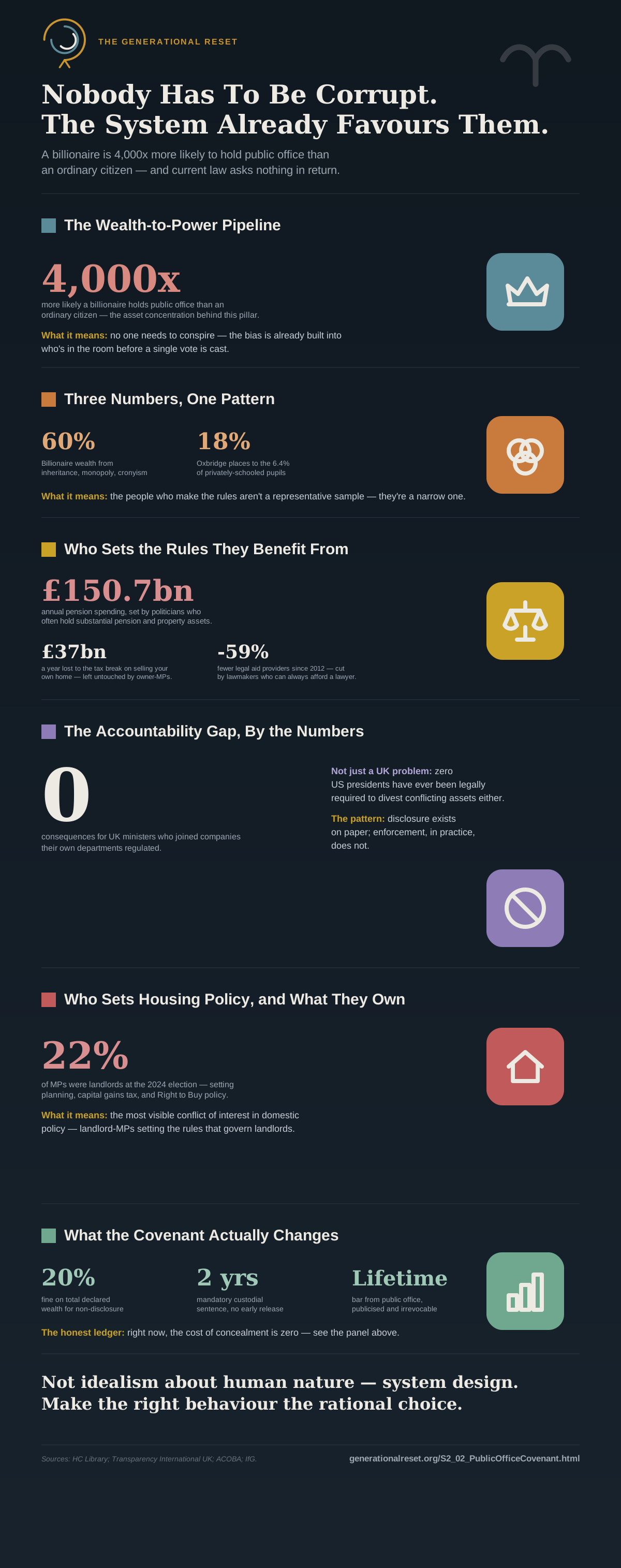
Set severe penalties for non-disclosure. A 20% fine on declared wealth, a mandatory two-year custodial sentence, a lifetime bar from public office, and clawback of public benefits accrued during service.
Require a personally signed, publicly published declaration. Every candidate acknowledges the full terms of the Covenant at the point of announcing their candidacy.
Extend cooling-off periods to a minimum of five years. For movement from government positions into regulated industries, enforced by a statutory independent body with genuine sanctioning powers.
Publish all ministerial meetings, lobbying contacts, and conflicts of interest. Within 30 days of the meeting or decision.
Establish the Covenant in primary legislation, not a code of conduct. So it cannot be diluted by a parliamentary majority of those it applies to — with a future referendum on extending it to senior civil servants and regulators.
1. The Problem — Structural, Not Individual
The argument here is not about corruption in the conventional sense — exchange of money for explicit decisions, prosecutable under existing law. That kind of corruption exists, and existing law is inadequate to address it.1 But the deeper problem is structural: the people who make decisions systematically have financial interests that are aligned with those decisions, without any explicit transaction being required.
A minister who holds shares in an oil company, whose party received donations from energy interests, or who is planning to join an industry board after leaving office, does not need to be bribed to make decisions that happen to align with fossil fuel interests. The bias is baked into their position before they walk into the room. A Parliament of property owners does not need to conspire against renters. It simply makes the decisions that property-owning politicians find reasonable. A legislative chamber drawn overwhelmingly from a narrow demographic and institutional background does not deliberately exclude other perspectives. It simply lacks them.
What is striking about the present moment is not that conflicts of interest exist. They have always existed. What is new is the brazenness. When those in power conduct their enrichment openly, without meaningful consequence, two things happen simultaneously: the behaviour is normalised, and the informal norms that previously constrained it — reputational shame, political pressure, the expectation of decency — lose their force entirely. When that consensus fractures, only hard law remains. And the current hard law is not adequate.
2. The Four Components of the Covenant
2.1 Total Transparency
Every candidate for elected public office publishes complete financial disclosure before their candidacy is accepted. This means all wealth and assets; all financial holdings including shares, bonds, and cryptocurrency; all bank account statements; all beneficial ownership of companies and trusts; and all family member holdings where they may constitute an indirect interest. This disclosure is cross-verified with the relevant tax authorities. Self-reporting is not the mechanism. Independent verification is. The gap between the two is where concealment has historically lived.
Disclosure is not annual. It is quarterly during office and triggered immediately by any asset change above a defined threshold. The era of year-old disclosures that lag behind the decisions they are meant to illuminate is over. A defined grace period — six to twelve months before taking office — permits genuine complexity to be resolved. After that window closes, strict liability applies absolutely.
Complete financial disclosure as a condition of candidacy acceptance — not a form filed with the electoral commission but a full publication accessible to any citizen. Cross-verified with tax authorities. Quarterly updates during office. Triggered immediately by any asset change above a defined threshold.
2.2 Strict Liability
Under the current system, the most powerful defence available to those found with undisclosed assets is also the most implausible one: I did not know. My accountant handles these things. I was unaware of that investment. The Public Office Covenant operates on the principle of strict liability. Intent is irrelevant. The obligation to disclose rests entirely and personally with the candidate. There is no delegation of that responsibility. There is no one else to blame.
This is not an unreasonable standard. It is already applied in food safety law, in environmental regulation, in certain financial compliance frameworks. The argument that it is too demanding for someone seeking the most powerful offices in the land does not survive scrutiny. More practically: the preparation required to achieve full disclosure is itself a filter. Someone who cannot organise their financial affairs with the time and resources available to a serious political candidate is demonstrating something relevant about their capacity for office.
2.3 Severe Penalties
A deterrent the wealthy can absorb functions as a licensing fee, not a deterrent. The penalties attached to the Covenant are calibrated to be genuinely prohibitive for any person at any level of wealth. A 20% fine on total declared wealth — applied to all declared assets, not merely hidden ones — removes the profit motive for concealment entirely. A mandatory two-year custodial sentence, non-negotiable and without early release for compliance, adds personal cost that wealth alone cannot absorb. A lifetime bar from public office, permanent and publicised and irrevocable, means that for those who seek power above all else, exclusion from it is the sharpest deterrent available. Clawback of all public benefits accrued during service — pension, salary, expenses — ensures that public service cannot be monetised even retrospectively through concealment.
The combination matters. A fine alone creates an incentive to hide wealth effectively rather than disclose it. Custodial sentences alone allow the wealthy to serve their time and keep the money. The lifetime bar alone does not address the financial incentive. Together, the three penalties attack the motivation for concealment from every direction simultaneously.
2.4 The Signed Declaration
Every candidate signs a personal declaration at the point of announcing their candidacy. Not a bureaucratic form buried in submission paperwork. A clear, explicit, personal acknowledgement — published alongside their announcement — that reads in substance: 'I understand that in seeking public office I accept a full and unconditional obligation to disclose my complete financial position. I acknowledge that ignorance of any part of my financial affairs is not a defence. I accept that any failure of disclosure, whether deliberate or negligent, carries financial, custodial, and permanent professional consequences. I sign this freely and in the full knowledge of its terms.'
The declaration does something that legislation alone cannot. It makes the acceptance personal, public, and unambiguous. It removes any future claim of misunderstanding. And it signals to the electorate, from the first moment of candidacy, that this person has accepted the terms of public service with full awareness.
3. The Self-Selection Argument
The Covenant's most important effect isn't the penalties it imposes but the candidates it deters before a single penalty is ever imposed. If the terms are clear from the outset — and they must be explicit, prominent, and impossible to misunderstand — then the pool of candidates self-selects for precisely the quality we most need in public life: a genuine willingness to be accountable.
Those who find total transparency unacceptable do not run. Those who run have already demonstrated something meaningful about their relationship with public scrutiny. This is system design, not idealism about human nature — the goal isn't asking people to be better, it's building a system that makes the right behaviour the rational choice.
A billionaire is 4,000x more likely to hold public office than an ordinary citizen, and 60% of billionaire wealth derives from inheritance, monopoly, or cronyism rather than enterprise. 22% of MPs were landlords at the time of the 2024 election, setting planning, CGT, and Right to Buy policy. £150.7bn in annual pension spending is set by politicians many of whom hold substantial pension and property assets themselves. Zero US presidents are legally required to divest conflicting assets on taking office.
When the pool of people who seek and hold power is drawn disproportionately from those with concentrated financial interests, and no disclosure regime forces those interests into the open, policy outcomes systematically favour asset-holders — not through conspiracy but through who is in the room and what they never have to explain. This is this project's own connecting argument, not a finding any single source states on its own: the bias is structural, built into the composition of the decision-making body itself, before any individual decision is made.
The causation above justifies a range of responses, not only this one: stronger enforcement of existing conflict-of-interest law after the fact, targeting proven bad actors rather than filtering candidates in advance; mandatory divestment or blind trusts, forcibly separating officeholders from the assets in question rather than merely disclosing them; or relying on informal norms and reputational pressure — the status quo, which this pillar's own Section 1 argues has already broken down as a meaningful constraint. The Political Renewal companion pillar addresses a genuinely different lever — external capture by private money and distorted representation — rather than this pillar's internal-capture focus.
Choosing disclosure-and-deterrence over mandatory divestment or blind trusts reflects a value judgement this project makes explicitly: it prioritises self-selection — letting candidates decide whether to accept the terms, and voters decide whether the terms were met — over paternalistic exclusion that would bar entire asset classes from public life outright. That choice accepts a real cost the Steel Man above already concedes: some candidates with complex but entirely legitimate financial affairs will be deterred alongside those with something to hide. A reader who weighs the risk of losing genuine talent more heavily than the value of a self-selecting filter is not wrong on the evidence — they are weighing the same facts against a different value.
Full financial disclosure as a hard, strict-liability condition of candidacy, cross-verified against tax authority records, backed by penalties calibrated to be non-absorbable at any wealth level — a 20% fine on total declared wealth, a mandatory two-year custodial sentence, and a lifetime bar from office. The falsification test below is what would show the self-selection mechanism is filtering for the wrong thing — privacy-aversion generally, rather than concealable conflicts specifically.
4. Extension Beyond Elected Officials
The Covenant as described applies to elected officials. The case for extending it to senior civil servants, regulators, and central bankers is strong — some of these roles carry equal or greater policy influence with far less public visibility. The revolving door between regulatory bodies and the industries they regulate2 is one of the primary mechanisms by which captured interests maintain their grip on policy.3
However, extension to unelected public servants raises genuine complications. Many enter public service young, before accumulating significant wealth.4 They did not seek power in the same explicit way an elected official does. Aggressive disclosure requirements would distort recruitment in ways that may not serve the public interest.
The sequencing matters. Establish the principle with elected officials first. Let it bed in. Build the public consensus that transparency is the price of public power, not an unusual imposition. Then put the extension to civil servants and regulators to a binding public referendum. Not because the principle is weaker — it is equally strong — but because democratic legitimacy for that extension makes it harder to challenge and more durable over time. The debate itself is valuable: what do we expect from those who exercise power over our lives?
5. The Steel Man
This is distinct from the self-selection objection already addressed in Section 3, which is about who chooses to run in the first place. This objection is about what happens to someone who does run in good faith and gets a detail wrong. The Covenant's own design already answers the milder version of this question — Section 2.2 argues, correctly, that "I didn't know" is already rejected as a defence in food safety law and environmental regulation, and that the preparation required for full disclosure is itself part of the filter. That argument holds for someone who simply didn't try hard enough. It is a harder argument to sustain against someone who tried in good faith, disclosed almost everything correctly, and still missed one holding in a genuinely complex financial life.
The honest answer is that this is a real cost the Covenant accepts, not one it eliminates. The mandatory quarterly cross-verification against tax authority records built into Proposal 1 gives an ongoing, continuous check rather than a single high-stakes moment of exposure — errors surface and can be corrected across a term of office, not only at one point of maximum risk. But the Covenant is deliberately designed not to offer an automatic "honest mistake" exemption, because that exemption is exactly the loophole — "my accountant handles these things" — Section 2.2 identifies as the current system's most implausible and most abused defence. Removing it for genuine bad actors means removing it for genuine mistakes too. That trade-off is accepted, not resolved.
6. Counter-Arguments
'This would deter talented people from public life'
The question is which talented people. Those deterred are, by the Covenant's design, primarily those with financial arrangements they are unwilling to expose to public scrutiny. The Covenant attracts those with nothing to hide and deters those who do. Whether this produces a worse or better Parliament is a judgment call — but it is not an obviously worse one.
'The penalties are disproportionate'
The 20% fine on total declared wealth sounds extreme until you consider what it is calibrated against. A deterrent set at a level the wealthy can absorb functions as an exemption for the rich, not a deterrent. The fine must be genuinely prohibitive at every wealth level, not merely uncomfortable. A billionaire facing a 20% fine will pay £200 million. This is the only penalty structure that actually deters rather than licenses.
'Strict liability is unjust — what if someone genuinely didn't know?'
Strict liability is already applied to business owners under food safety law, to directors under company law, and to operators under environmental regulation. The standard that 'I didn't know' is not a defence has been applied in lower-stakes contexts for decades. The argument that it is too demanding for those seeking the highest offices in the land is not persuasive. The obligation to know is itself part of the price of seeking power.
'Shell companies and offshore structures make this unenforceable'
The cross-verification requirement — disclosure verified against tax authority records, not merely self-reported — addresses the most obvious evasion route. Beneficial ownership registration, already legally required in the UK for companies and increasingly for trusts, provides the underlying data. Full enforcement requires international cooperation, which is developing but incomplete. The honest answer is that no disclosure regime is perfectly enforceable. The question is whether imperfect enforcement with genuine consequences is better than the current system of no enforcement with no consequences. It is.
Cross-Pillar Dependencies
| Pillar | Connection |
|---|---|
| Political Renewal | The Covenant is the internal complement to the Political Renewal pillar's external reforms. Political Renewal removes structural capture from outside — private money, distorted representation. The Covenant removes internal capture — conflicts of interest, the revolving door, the normalisation of self-enrichment. Together they close the loop. |
| NHS | Private healthcare holdings among MPs and ministers setting NHS policy, NICE thresholds, and private sector regulation represent the most documented structural conflict of interest in domestic policy. Mandatory disclosure changes the political cost of those conflicts without requiring proof of explicit corruption. |
| Education | Private school interests — including fee-paying parents in positions of political authority, independent school boards, and alumni networks — represent a structural conflict in state education funding decisions. The Covenant's transparency requirements apply directly to education policy decision-makers. |
| Welfare | Triple lock policy is set by politicians many of whom hold substantial pension and property assets. This is the most direct financial conflict of interest in any policy area. Mandatory disclosure is the precondition for legitimate welfare reform — making the conflict visible rather than assuming it does not exist. |
| Housing | Investment property holdings among MPs setting planning, CGT, and Right to Buy policy are the most visible conflict of interest in domestic policy. 22% of MPs were landlords at the time of the 2024 election. The Covenant's disclosure requirements make these interests visible at the point of candidacy. |
| Energy | Fossil fuel and energy sector financial interests among those setting North Sea licensing, windfall tax, and transition policy are structural conflicts the Covenant's disclosure regime addresses. The connection to the Energy pillar's analysis of policy capture by incumbent interests is explicit. |
| Economy | The financialisation diagnosis in the Economy pillar — a political class with financial interests in asset-price appreciation — is the economic context for the conflicts of interest the Covenant addresses. The Covenant's transparency requirements are, in part, the precondition for the economy pillar's reforms being politically possible. |
| Public Debt | Elected officials approving budgets that transfer debt to future generations should be required to acknowledge that transfer explicitly — extending the Covenant's accountability principles to fiscal decision-making via the Generational Debt Statement proposed in the Public Debt pillar. |
| Criminal Justice | Algorithmic decision-making in criminal justice — sentencing tools, risk assessment, evidence processing — requires the same standards of public accountability as any other exercise of state power. The Covenant's transparency principles extend to AI governance in criminal justice. |
| Defence | The revolving door between MoD and defence contractors is one of the most well-documented conflicts of interest in British public life. The Covenant's cooling-off periods and disclosure requirements apply directly to the procurement failures the Defence pillar documents. |
8. Proposals for Change
The following represent the evidence-based proposals of this pillar, put forward for public discussion and challenge.
-
Require complete financial disclosure as a condition of candidacy acceptance for all elected public offices — all wealth, assets, holdings, bank statements, and beneficial ownership interests, cross-verified with tax authorities.
-
Require quarterly disclosure updates during office and immediate disclosure of any asset change above a defined threshold.
-
Apply strict liability to the disclosure obligation — ignorance of financial affairs is not a defence; the obligation rests entirely and personally with the candidate.
-
Set penalties for non-disclosure at: 20% fine on total declared wealth; mandatory two-year custodial sentence without suspension or early release; lifetime bar from public office; clawback of all public benefits accrued during service.
-
Require a personally signed and publicly published declaration from every candidate at the point of announcing their candidacy, acknowledging the full terms of the Covenant.
-
P4 Extend cooling-off periods for movement from government positions to roles in regulated industries: minimum five years, enforced by a statutory independent body with genuine sanctioning powers.
-
P5 Require publication of all ministerial meetings with external parties, all lobbying contacts, and all decisions where a minister has a potential financial conflict of interest — within 30 days.
-
P6 Commission a public referendum on whether to extend the Covenant's disclosure requirements to senior civil servants and regulators, once the elected officials regime has been in operation for at least one full parliamentary term.
-
P6 Establish the Covenant's requirements in primary legislation, not in a code of conduct — ensuring they cannot be diluted by a parliamentary majority of those they apply to.
Public office is not taken by force. It is sought voluntarily. The person who seeks it is asking for power over other people's lives — power to tax them, to send them to war, to shape the conditions of their children's futures. That is an extraordinary ask. The Covenant says simply: if you want that power, this is what it costs. Not your career. Not your past. Not your future. Your financial privacy, for as long as you hold the public trust. If that price feels too high, the door is open. No one is compelled to seek office. The withdrawal itself is informative — and the electorate is entitled to that information.
We are not asking for saints. We are asking for people who, when offered power, are willing to be seen.
The Generational Reset is a non-partisan, public-interest project. It is not affiliated with any political party, does not accept corporate funding, and publishes all its work under open licence for public discussion and adaptation.
For public discussion. Not affiliated with any political party. | generationalreset.org
The Generational Reset | S2_02: The Public Office Covenant | For public discussion. Not affiliated with any political party. | generationalreset.org