Executive Summary
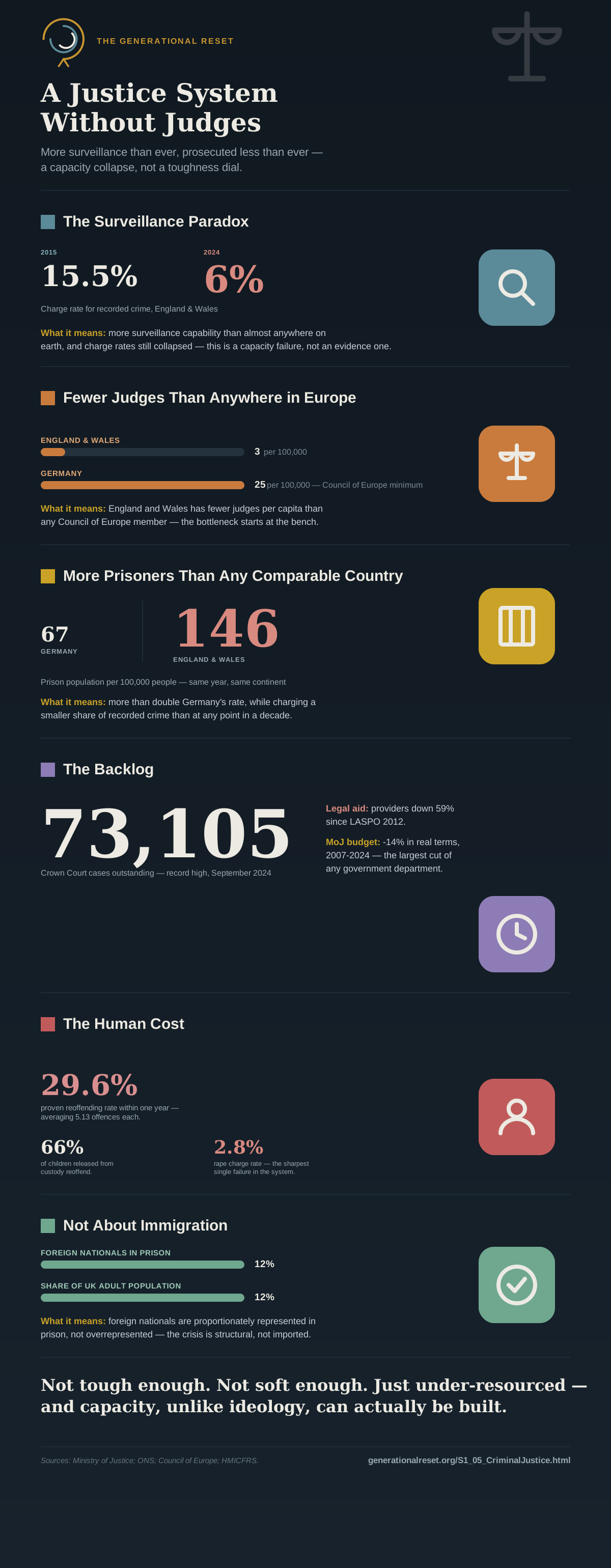
England and Wales runs a criminal justice system whose failures are well recorded, measured and politically tolerated. The share of victim-based crimes ending in a charge or summons fell from 11.1% in 2015–16 to 4.6% in 2021–22, and has recovered only to 7.3% in 2025–26.1 Nearly one in three offenders reoffends within a year, as do two in three children released from custody.2 The Crown Court backlog stood at 80,061 cases in March 2026, just below the record set at the end of 2025.3 The number of advice agencies and law centres doing legal aid work has fallen by 59% since 2012.4 And England and Wales imprisons more people per head than any comparable country in Western Europe, with worse rehabilitation results than almost all of them.
This pillar makes one central argument: the criminal justice crisis is a failure of how the system is built, not of toughness, leniency or immigration policy. Every link in the chain from policing to prosecution, courts and rehabilitation has been allowed to decay, while spending has gone mainly to the front end (policing) and the containment end (prison building), leaving the capacity that turns recorded crime into justice chronically short of resources.
At the heart of this failure is a surveillance paradox that political debate has never properly named. England and Wales has more CCTV per head than almost any country on earth. Every financial transaction is logged. Mobile phones place suspects with near certainty. We know more about criminal activity than ever before, and we prosecute less of it. The reason is capacity, not evidence: there is no shortage of evidence, only of people to process it.
This pillar also addresses the claim that immigration drives the failures of criminal justice. The data is clear. Foreign nationals make up about 12% of the prison population and about 12% of the adult population.5 Once age and sex are taken into account, non-citizens are actually under-represented in prison compared with British citizens. England and Wales imprisons a lower proportion of foreign nationals than Germany, France, Belgium or Austria. The crisis is homegrown, not imported.
Key Proposals
Triple Crown Court sitting days over five years. A funded plan to clear the backlog of around 80,000 cases and establish a maximum 12-month wait from charge to trial.
Create a statutory disclosure management framework. Mandatory AI-assisted review of digital evidence, with published bias audits and independent oversight.
Restore legal aid as a public good. An immediate uplift to criminal legal aid fees, down about a third in real terms since 2008, plus minimum provider coverage requirements to fix advice deserts.
Legislate a rehabilitation spending floor. A minimum share of the HMPPS budget, rising to 15% over a parliament, so rehabilitation is funded rather than what's left after custody costs.
Set a statutory neighbourhood policing floor. A minimum of 15% of all officers in genuine neighbourhood roles, independently verified by HMICFRS.
Implement the Lammy Review in full. A published timetable and annual parliamentary accountability, plus mandatory equality impact assessments at each decision point with published outcomes by ethnicity.
1. The Diagnosis
1.1 The Surveillance Paradox
The most revealing fact about the failure of criminal justice in England and Wales gets almost no attention in mainstream politics. In the year to March 2016, 11.1% of victim-based crimes led to a charge or summons. By the year to March 2022, that had fallen to 4.6%. It has since recovered to 7.3% (year to March 2026), still a third below a decade ago. Over the same period, surveillance expanded enormously: more CCTV than almost anywhere in the world, digital records of every financial transaction, mobile phone location data accurate to a few metres, and facial recognition in operational use. If a lack of evidence were what limited prosecutions, the trend should have gone the other way. It did not.
The legal mechanism behind this is disclosure. The Criminal Procedure and Investigations Act requires the prosecution to disclose all relevant material to the defence. As digital evidence has exploded (phones holding 50,000 messages, cloud backups, social media archives), meeting that duty has become practically unmanageable with current staffing. Cases have collapsed not because defendants were innocent but because the prosecution could not complete disclosure. The surveillance paradox is a resourcing failure disguised as a technology problem.
The share of victim-based crimes ending in a charge fell from 11.1% in 2015–16 to 4.6% in 2021–22, and stood at 7.3% in 2025–261, over the same years that surveillance capability expanded enormously (near-universal CCTV, digital financial records, mobile phone location data). England and Wales has 3 judges per 100,000 people against Germany's 256, and the Crown Court backlog passed 80,000 cases at the end of 20253. The Crown Prosecution Service costs £1.1bn against a £19.5bn policing budget, a ratio of 1 to 18.7
If a lack of evidence limited prosecutions, the charge rate should have risen with surveillance capability, not collapsed. This connecting argument is this project's own; no single source states it. Spending is concentrated at the two ends (policing and prisons) while capacity in the middle is starved, which explains why more evidence produces fewer charges: the pipeline that turns evidence into prosecutions lacks the judges, prosecutors and disclosure staff to process it.
The causation above fits responses other than this pillar's, both discussed in the Steel Man below. One is to toughen sentencing and enforcement further, on the theory that harsher consequences alone would restore deterrence even without fixing the pipeline. Another is to import the Nordic rehabilitative model wholesale, on the theory that adopting Nordic sentencing philosophy would improve results directly, which this pillar's Steel Man calls only partly valid given the different social context. The third, which this pillar proposes, is to invest specifically in the stages that turn evidence into charges.
Choosing investment in the pipeline over further toughening or a wholesale Nordic import rests on a value judgement this pillar makes openly: restoring consistent consequences by building capacity to process cases is a more evidence-based route to deterrence than either lengthening sentences again or transplanting another country's sentencing philosophy without adapting it to local institutions. A reader who thinks tougher sentencing alone would restore deterrence whatever the charge rate, or that Nordic-style rehabilitation should be adopted more directly despite this pillar's doubts about how well it transfers, is not wrong on the evidence. They are weighing the same diagnosis against a different theory of what deters.
Triple Crown Court sitting days over five years, rebuild CPS capacity (prosecutors, digital forensics specialists and disclosure staff), and set up a statutory framework for managing disclosure, treating the charge rate itself as the main measure this investment is meant to move. The falsification test below sets out what would show investment in the pipeline is not what raises the charge rate.
1.2 Money in the Wrong Places
England and Wales does not underspend on criminal justice as a share of GDP. Spending on public order and safety is about 1.8% of GDP, slightly above the EU average. The problem is how it is shared out. Policing takes about 43% of total criminal justice spending, prisons and probation 16%, courts and tribunals 5%, and legal aid 5%, after a 28% real-terms cut since 2008. Prevention and rehabilitation get whatever is left after custody costs are met.
England and Wales has 3 judges per 100,000 people, the lowest of any country in the Council of Europe. Germany has 25, France 11 and the Netherlands 16.6 The Crown Court backlog is no mystery: you cannot clear cases without judges to hear them. Combining the fewest judges in Europe with the largest prison population in Western Europe is the predictable result of a system that invests in containment and neglects the processing that would make containment less necessary. It is not an accident.
1.3 Failure Along the Pipeline
The criminal justice pipeline has four stages where failures compound: policing, prosecution, courts and rehabilitation. In policing, neighbourhood policing (the visible work that deters crime and builds community trust) has shrunk to 8% of officers. Police time has been steadily absorbed by the mental health crisis, an estimated one million officer hours a year8, and by a shift toward fraud, sexual offences and stalking, crimes that take far more resources to investigate. In prosecution, the CPS costs £1.1 billion against a policing budget of £19.5 billion, a ratio of 1 to 18.7 In the courts, a backlog of around 80,000 cases means victims wait years for an outcome. In rehabilitation, a reoffending rate of 29.9% means the system generates its own demand.9
1.4 Unequal Treatment
The system does not fail everyone equally. The Lammy Review found that Black, Asian and mixed-heritage people are over-represented at every stage of the criminal justice process in ways offending rates alone do not explain. Black women are 29% more likely than White women facing the same charges to be remanded in custody, and Black men 26% more likely than White men.10 Black children serve custodial sentences nearly twice as long on average as White children. Almost a decade after the Lammy Review, most of its core recommendations have not been implemented.
The collapse of legal aid has a direct effect on who gets justice. The 59% fall since 2012 in advice agencies and law centres doing legal aid work has helped create advice deserts: large areas where people entitled to publicly funded legal help cannot get it. The effect falls hardest on people in poverty, in housing crisis, facing domestic abuse, or dealing with their immigration status. Access to justice in England and Wales increasingly depends on the ability to pay.
2. The Steel Man: The Strongest Case Against Change
'Longer sentences and tougher enforcement deter crime'
Deterrence theory is not wrong. Visible policing in high-crime areas clearly reduces crime there. And the collapse in the charge rate, from 11.1% to a low of 4.6%, is itself an argument for enforcement: when more than nine crimes in ten end without a charge, that is a strong incentive to offend. The steel man is strongest where it says that restoring the prosecution pipeline is the deterrence reform: not softer sentences but more consistent consequences. The Generational Reset agrees with that diagnosis. The disagreement is about where to invest to achieve it.
'Nordic comparisons don't apply to England and Wales'
Norway's prison population is small and its social fabric relatively intact. It is not obvious that a Nordic model would work in a society with much more inequality, urban density and ethnic diversity. This is partly valid, and it is why this pillar does not propose importing Nordic policy wholesale. It proposes applying the principle (invest in the pipeline, not just containment) adapted to the institutions of England and Wales. Scotland's experience with a presumption against short prison sentences is a closer comparison.
3. What Other Countries Show
3.1 The Nordic Model
Finland, Norway and the Netherlands consistently achieve lower reoffending with prison populations a third to a half the size of England and Wales's. The explanation lies in specific policy choices: investment in diversion before sentencing, compulsory treatment for addiction and mental health conditions, help with work and housing on release, and community supervision that offers real support rather than just monitoring. Norway's Bastøy prison has a two-year reoffending rate of about 16%, against England and Wales's 29.9% at one year.11
3.2 Germany: Judicial Capacity
Germany has 25 judges per 100,000 people against England and Wales's 3, and 67 prisoners per 100,000 against 146.12 A larger share of its prisoners are foreign nationals, reflecting a society with more immigration, yet it achieves better justice outcomes. Germany shows that high immigration and effective criminal justice are compatible. What decides results is not who is in the system but how well it is resourced and organised.
3.3 Scotland: A Domestic Comparison
Scotland has taken a more explicitly rehabilitative approach, especially to short sentences. Its presumption against short prison sentences, introduced for sentences of three months or less in 2011 and extended to twelve months in 2019, has reduced the number of people serving short sentences without the rise in crime critics predicted. Scotland's reoffending results are still imperfect, but the direction (using prison for people who really need to be contained, not as the default for minor offences) is supported by the evidence.
4. Counter-Arguments
'This is soft on crime. Victims want justice, not theories about rehabilitation'
The current system fails victims more completely than any rehabilitation programme could. A charge rate of about 7% means more than nine victims in ten see no prosecution. A reoffending rate of about 30% means the system is producing future victims at scale. "Toughness" that leaves around 80,000 cases waiting for trial and a persistently high reoffending rate is not an effective policy for victims. It is a posture.
'More rehabilitation means letting dangerous people out early'
Rehabilitation and public protection do not conflict. The whole case for help with work, housing, addiction and mental health on release is that it reduces the 29.9% reoffending rate, which means fewer future victims. The Generational Reset is not proposing shorter sentences for serious offences. It is proposing that the time served is actually used to reduce the chance of reoffending.
'Restoring legal aid subsidises criminals; it is not a public good'
Most legal aid spending pays for the defence of people who are presumed innocent until proven guilty, a principle the justice system depends on for its legitimacy. Saying legal aid funds criminals confuses the accusation with the verdict. The deeper question is whether a justice system in which access to a lawyer depends on wealth is a justice system at all.
'The Lammy Review was published in 2017. If it hasn't been implemented in nine years, why would it be now?'
Because the political incentives have not changed, which is exactly this pillar's point. The people making the decisions do not experience the disparity; they are not the ones being stopped and searched. The Generational Reset argues that making implementation legally binding, with accountability to Parliament, changes the politics in a way voluntary commitments do not.
Cross-Pillar Dependencies
| Pillar | Connection |
|---|---|
| NHS | Police chiefs estimate that officers spend just under a million hours a year waiting in hospitals with people in mental health crisis, and a 2002 national study found that 72% of sentenced male prisoners had two or more mental health disorders (no national update has been found). The justice system cannot reduce reoffending driven by untreated mental illness unless the health system tackles the causes. These are not parallel crises; one is feeding the other. |
| Education | 52.5% of young people who went on to a custodial sentence had been persistently absent from school, against 10.9% of those with no convictions (ONS, 2022). School exclusions, concentrated in the most disadvantaged communities, are a main route into county lines exploitation. The Education pillar's commitments on SEND, mental health and reducing exclusions feed directly into youth justice outcomes. |
| Welfare | Child poverty is one of the strongest predictors of youth offending. The Welfare pillar's analysis of in-work poverty, insecure housing and the two-child limit (in force until April 2026) describes the conditions that draw young people into criminal exploitation. Justice reform without welfare reform treats symptoms rather than causes. |
| Housing | Unstable housing is one of the strongest predictors of reoffending, and people released from prison without stable accommodation reoffend at much higher rates. Housing for people leaving prison, coordinated between the NHC, HMPPS and councils, is a direct justice reform, and this pillar and the Housing pillar must design it together. |
| Economy | The regional divide described in the Economy pillar (concentrated deprivation, insecure work, stagnant wages) is the economic mechanism driving demand on the justice system in the hardest-hit communities. Economic Renewal and justice reform have to happen together, not one after the other. |
| Public Debt | The Ministry of Justice had the largest proportional real-terms cut of any department between 2007 and 2024. The knock-on costs (welfare claims, NHS demand, lost productivity from reoffending) are a debt owed by the rest of the budget, which the Public Debt pillar's framework should make explicit. |
| Political Renewal | The legal aid collapse after LASPO, a decade of Ministry of Justice cuts, and the Lammy Review's recommendations left unimplemented for nine years are all failures of political will, sustained across parties and parliaments. They persist because the people affected have the least political voice. Political Renewal that restores accountability is the precondition for justice reform that lasts. |
| Public Office Covenant | If AI tools are used in criminal justice, for evidence processing, risk assessment or enforcement, the Covenant's principles of transparency and accountability apply directly. Algorithmic decisions affecting people's liberty need the same public accountability as any other use of state power. |
| Defence | Veterans are over-represented in prison. The justice system's failure to route veterans into treatment rather than custody is a recognised failure that needs explicit joint action between the Ministry of Justice, the MoD and the NHS. |
6. Proposals for Change
These are the evidence-based proposals of this pillar, put forward for public discussion and challenge.
Restore the Prosecution Pipeline
-
P1 A funded five-year plan to triple Crown Court sitting days, starting immediately, to clear a backlog now of around 80,000 cases and set a maximum wait of 12 months from charge to trial.
-
Immediate investment in Crown Prosecution Service capacity (prosecutors, digital forensics specialists and disclosure systems), funded partly by ring-fencing revenue from automated enforcement.
-
P2 A statutory framework for managing disclosure: compulsory use of AI-assisted review tools for digital evidence, with published bias audits and independent oversight.
-
Full implementation of the Leveson Review's recommendations on court efficiency, with compulsory six-monthly reports to Parliament on progress with the backlog.
Restore Legal Aid as a Public Good
-
P3 A funded programme to restore legal aid: minimum levels of provider coverage in every local authority area, with financial incentives for firms that set up in advice deserts.
-
P3 An immediate rise in criminal legal aid fees, which the Bellamy review found had fallen by about a third in real terms since 2008.
-
A fund to restore civil legal aid, aimed at housing, domestic abuse and immigration, the areas where the LASPO cuts did most damage.
Rebalance the Criminal Justice Budget
-
P4 A legal requirement that rehabilitation make up a minimum share of the HMPPS budget, rising to 15% over a parliament, so rehabilitation is a funded programme rather than whatever is left after custody costs.
-
Ring-fence all revenue from automated road enforcement (speed camera fines) for criminal justice processing capacity.
-
P5 A statutory floor for neighbourhood policing: at least 15% of all officers in real neighbourhood roles, independently checked by HMICFRS.
Address Unequal Treatment
-
P6 Full implementation of the Lammy Review's recommendations, with a published timetable and annual accountability to Parliament on progress.
-
P6 Compulsory equality impact assessments at every decision point (stop and search, charge, remand and sentencing), with results published by ethnicity and a required explanation for persistent disparities.
-
A dedicated youth justice fund for diverting under-18s before they are charged, supporting those exploited through county lines, and providing community alternatives to custody.
Govern AI and Digital Evidence
-
A statutory Criminal Justice AI Authority: an independent body to approve, audit and publish performance data on every AI tool used in criminal justice before it is deployed.
-
A binding ban on population-level predictive policing tools until a public governance framework has been set up in primary legislation.
-
Compulsory annual bias audits for every AI tool used in criminal justice, with automatic suspension if disparities by protected characteristic exceed set thresholds.
The criminal justice system is not failing because Britain lacks the will to be tough on crime. It is failing because the resources needed to turn recorded crime into justice have been steadily withdrawn from the stages of the pipeline where they would do most good. The proposals above are rational, not lenient, and the evidence from comparable systems that use them says they work.
The Generational Reset is a non-partisan, public-interest project. It is not affiliated with any political party, does not accept corporate funding, and publishes all its work under open licence for public discussion and adaptation.
For public discussion. Not affiliated with any political party. | generationalreset.org
The Generational Reset | S1_05: Criminal Justice | For public discussion. Not affiliated with any political party. | generationalreset.org